

These paintings all have a poet’s title. I think they may be new to many. Enjoy!
Images
Illustrated Journaling Doodle
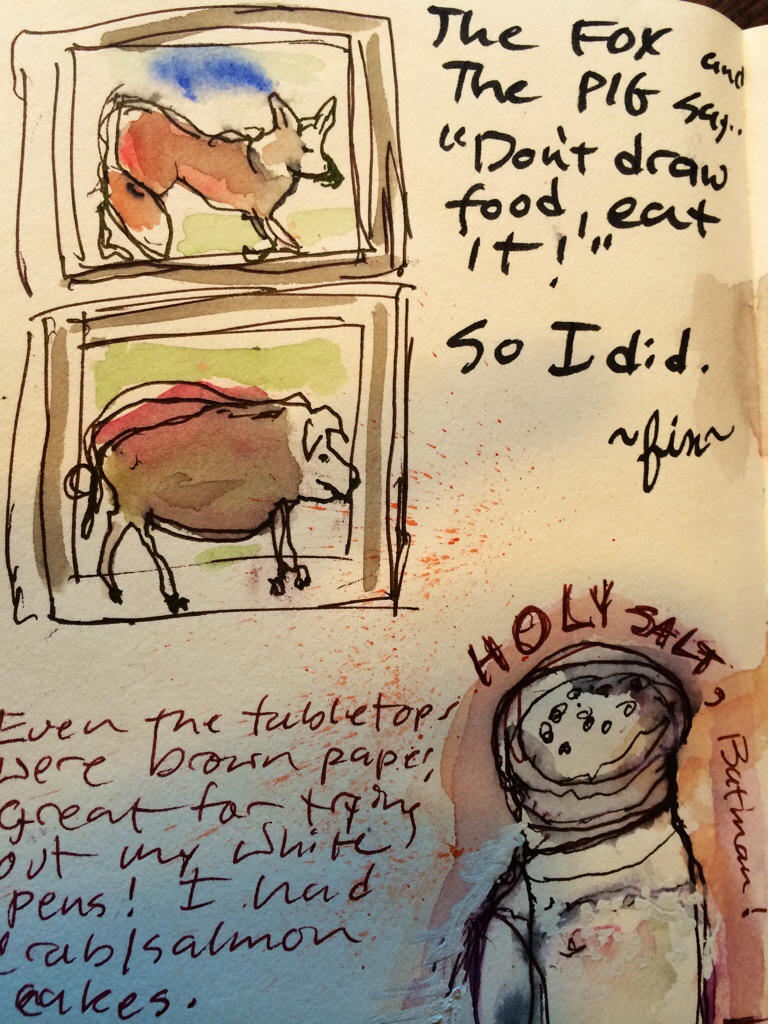
Illustrated journaling lets you make connections… salt, the etchings on the cafe wall, appetite. Somehow these disparate things come together in a good way, sort of like doing collage with pieces of your consciousness.
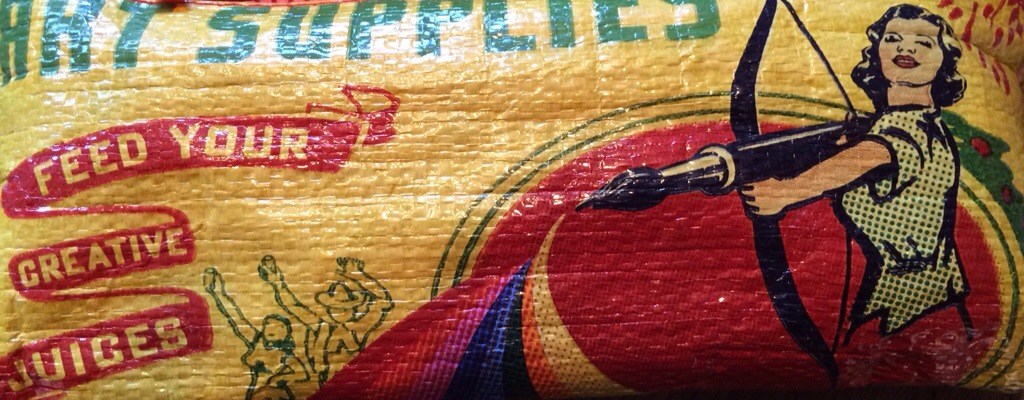
Camino art supplies: sketchbook, paints, IPhone, no camera!
 Well, I joined the 21st century this month and got an Iphone. I decided to leave the camera behind for several reasons. It’s not really a photo-documentary trip, as I want to sketch far more than photograph. I don’t want to be tied to a camera, and a camera is heavy and bulky for Continue reading
Where a pilgrim begins


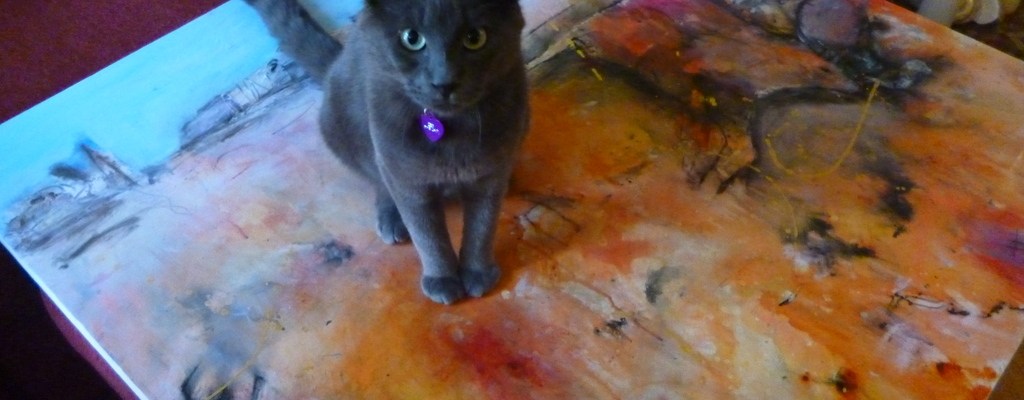
Over Underworld, acrylic on canvas, 36″ x 48″

I started this pilgrimage to Santiago de Compostela last year in September– in my mind. They say that the pilgrim way begins right from your front door. The post below was written in September 2013 when I first decided to start. In the meantime, I have bread dipped in Spanish olive oil, and walk among the twisted oaks of Spring Lake. Join me as I walk, write, sketch, and wander in the land of bull, oak, red wine, relics, grails, and pilgrims. Suzanne
Art Hearts

This is “A White Ago.” The title was taken from an e e cummings poem. He was one of the most romantic poets of our time, and a painter.
Painting with hearts is tricky. You always are in danger of falling over the boundary into treacly greeting card territory. I liked this notion of a heart in a field of white, time sweeping away old loves and perhaps bringing in the new.
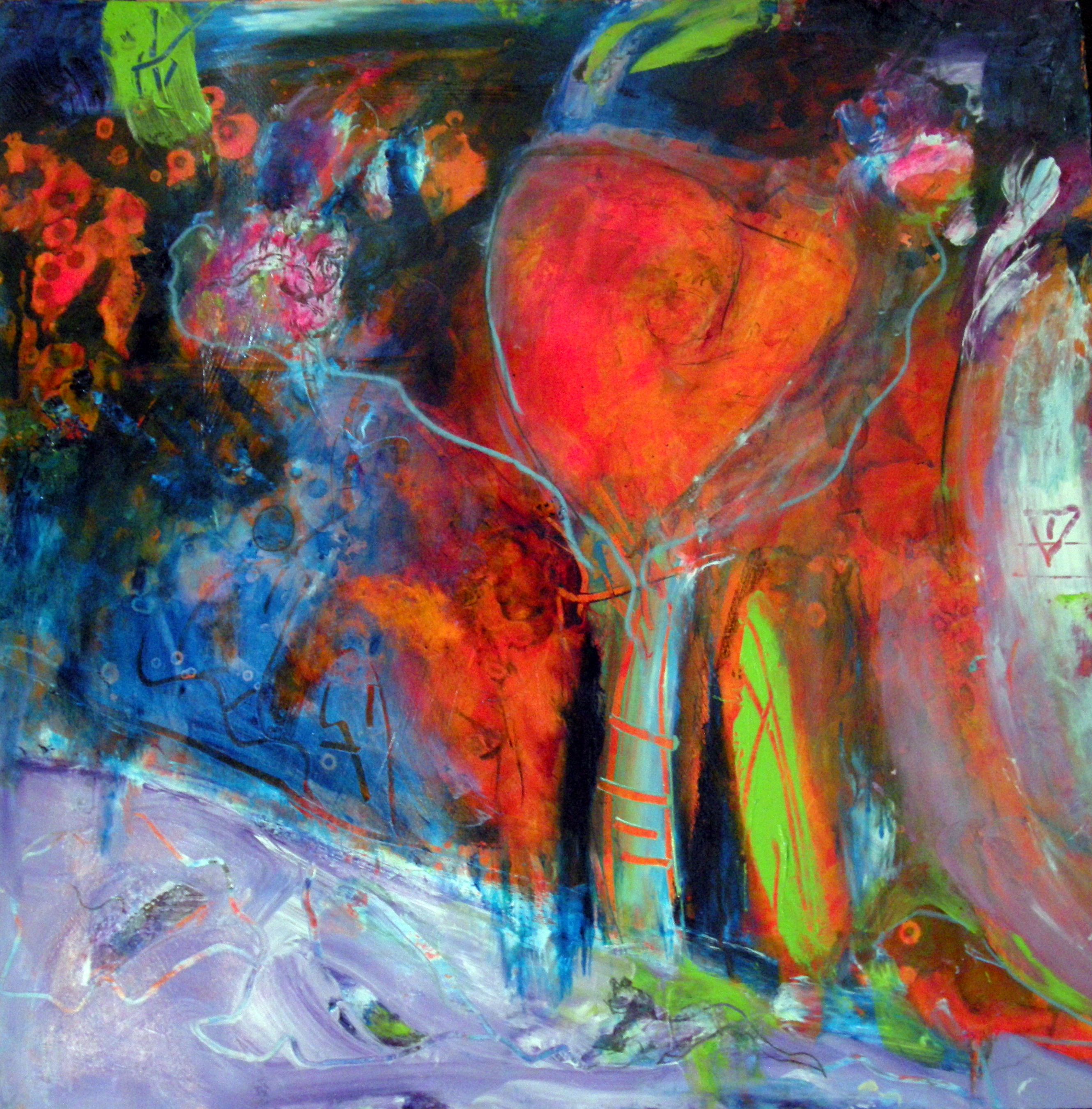
I titled this one Salamander Winter. Again a heart, but there are little salamanders hidden in the base… small fire dragons. My husband, Scott, places boards in wet places to provide little houses for real Arboreal Salamanders in our yard. In alchemy, the salamander represents fidelity and the animal that can survive the flames of adversity. Here’s wishing you luck in love.
World’s Oldest Painting in Spain: Abstract, of course
The world’s oldest painting is now found to be an abstract red “dot” or circle dated reliably back to 40,000 BCE. This makes it older than the previously dated Chauvet Cave paintings so eloquently documented by Werner Herzog. It’s also provoked speculation that Neaderthals may have been artists– the ultimate reversal of art from highbrow to lowbrow. Or perhaps abstraction is, once again, seen as “lower” art, thus the Neanderthal question… just kidding. Sort of. You can see the red area and the mouth-blown hand stencils below.

The work, age-verified last year in a series of North Spanish caves, seems to be a mixture of abstraction, hands, and animals. The figures below are called “seals”. Huh? Maybe. Or maybe female figures with a vulva mark at the end… or, even, abstractions. There is an assumption that the abstract is more primitive and came before the figurative, but if the exquisitely worked animals of Chauvet are only a thousand years off, I think it’s likely that all the styles, including the popular figuative animals, existed simultaneously, as they do today.
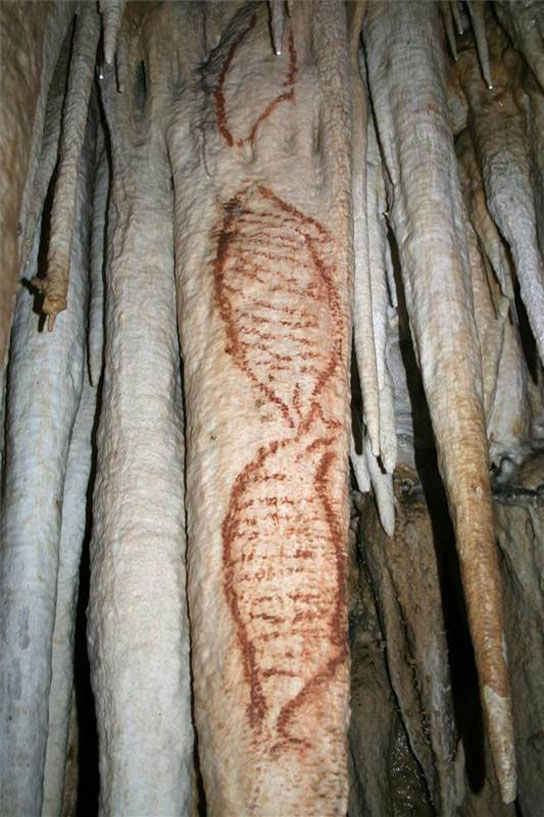
Here are horses, almost always found paired with aurochs. Look at the cute little zebra leg. It’s easier to love the horsie than the red dot, except for abstract fans. You have to interpret the dot yourself.

Let’s hear it for the red dot! A red circle is primal, like the sun, like hands, like animals.
A red dot also means the painting sold! Do you think it means he sold his wall of marks? Here’s my red dot– Over Underworld, a meditation on cave paint, civilization, and what’s underneath. You can see it during ARTrails this October in Studio 92. I hope to see you in my cave then. 
News Release on World’s Oldest Art
Ancient drawings discovered in Spain have been crowned the world’s earliest cave art. Scientists claim the images date back 40,800 years and may have been done by Neanderthals. The find in 11 caves in northern Spain has beaten the previous record held by Chauvet cave in central France, which boasts drawings of animals thought to date back 39,000 years. Scientists say Spain’s cave art is now the oldest known in Europe, and probably the oldest in the world. The drawings feature animals, round red dots and a series of handprints known as a Panel of Hands. “We find one of these [handprints] to date older than 37,300 years on the Panel of Hands, and very nearby there is a red disc made by a very similar technique that dates to older than 40,800 years,” Dr. Alistair Pike, archaeological scientist from Bristol University explained to reporters. Working in the caves, scientists had to solve the difficult task of dating the ancient images. Pike explained that unlike bones or tools that can be carbon-dated and associated with artifacts found nearby, cave art is “not associated with anything but itself.” The team of scientists used a special technique to date the drawings. They analyzed the calcite patinas that form with mineralized water dripping over the art for thousands of years, just like stalagmites and stalactites form in caves. Over time, the calcite accumulates naturally occurring radioactive uranium from the water. Uranium atoms with years decay into thorium at a very precise rate. The ratio of the two different elements in a sample forms a so-called clock that can determine the sample’s age quite accurately.
Back from Camp Winnarainbow
A wonderful post from Susan Cornelis. I was lucky enough to share a week with her, Wavy Gravy, Laura Foster Corben, and many others. Metaphoracards were as wild and unruly as ever; strange how random images glued to little paintings catch the little idio-synchronicities of our lives! Bravo, Susan!


watercolor and Uni-ball Vision elite pen in 5 X 8″ Strathmore Watercolor sketchbook
Q: What did the earth say after the earthquake?
A: Sorry, my fault!
Q: How do you keep a bagel from getting away?
A: Put lox on it.
Yes, this third grade humor helped to set the tone for the last week of adult camp with Wavy Gravy, where it’s never too late to be a kid again. But there was the Hip Hop dancing and the singing and walking the labyrinth and trapeze and stilts (I watched) and painting and Zen clowning and well, I guess you had to be there. Each morning Wavy on the rainbow stage got us chuckling and I had moments to do a bit of sketching. So here they are – of Wavy – and the backs of other campers as they sat and listened.
 Wavy read Neruda’s poetry each morning…
View original post 71 more words
Suzanne’s Virtual Manifesto for Artists
Why do social media at all? As an artist, you have to do it artfully, or it won’t work. It has to be authentic, interesting, generous,and beautiful.
Ironically, you can’t take it too seriously. It’s like throwing pebbles into a great sea. You produce a ripple or two. Keep them going and something interesting will come in on the tide, but you can’t predict what or when.
Here’s a hint for Facebook. Continue reading
A great mixed-media pen: uni-ball Vision Elite

This is a canvas painting with layers of collage and paint. I had been seeking a pen that wrote with a fluid, varied line on top of textured, dried paintings. The Uni-ball Vision Elite Continue reading
 Saltworkstudio | Suzanne Edminster