Foolish Sketching and Big Nature

fools gathering

Fools flocked and chattered in Occidental, California on Saturday April 4 for a traditional Fools celebration.  Susan Cornelis, Carole Flaherty and I went out to sketch from life.  The subjects were moving and in crowds, for me the toughest kind of sketchbook challenge.


Carole Flaherty sketching

Susan and Carole have been participating in Bay Area Urban Sketchers Sketchcrawls.  Carole had a lovely setup with her self-designed travel watercolor set and everything clipped and attached to a small drawing board.  Susan loaned me her tiny Pocket Palette to try.  I’m terrible at this kind of sketching, so it was good to do it on a Foolish day when everything was allowed.  This sort of sketching from life takes plein air to a new level.  It is meditative and process-oriented. My style tends to be more of an illustrated journal, with writing and collage.  I kept a sketchbook through Spain, and at other times,  but am entirely untutored in the finer points of more realistic rendering, and am hoping to improve.


Fears of Sketching

I might as well make a checklist of my sketching fears, and get them out of the way as soon as possible.  On Saturday I accomplished all of them.

  1. Fear of doing a really lousy sketch.  Check.  Around 5 times.
  2. Fear of doing a really lousy sketch while others sketching are doing better ones.  Check.
  3. Fear of just not being up to the task— moving figurative subjects.  Check.
  4. Fear of messing up pages in a bound notebook.  They will always be there as flubs. Check.
  5. Fear that if I share the messy process of learning, I will be seen as less accomplished in my painting.   Check.

I was happy to have some of my sketching doctors give me a critique, over Prosecco and prosciutto at the Underwood in Graton.  Here are some of Susan’s sketches from the day.  My Rx:  mechanical pencil, slower more continuous lines in ink, some media suggestions.  (I’m hearing that a new-to-me brush pen favorite is the Pentel.)  I’m taking an online sketching class from Marc Taro Holmes which is really excellent.  There is a new wave of arts education and it lives online.  What if we all came to art school with many skills and techniques, and the ways and means, spiritual and practical, of living as an artist were taught by generous, seasoned masters?

I want to sketch people in life, not in a figure class.  I think my best sketches recently were done in DMVs.  It took me 3 tries to get a replacement for the license which was lost or stolen.  Learning to sketch is a metaphor for letting a new identity emerge.  And it’s not always comfortable.

Big Old Nature

fools blog redwoods

My artist friend Laura Foster Corben and I went into a grove of coastal old-growth redwoods on a misty, rainy day.  It used to have the worlds tallest tree at around 380 feet.  Now taller trees have been measured, but these seem tall enough to me. I was struck by the primitive nature of these trees.  Inverting the black and white lets me see the almost palm-like form of these titans in Montgomery Woods State Natural Preserve.

A sunburst or natural altar of giant roots.

fools standing stone ring

The eerie magic of the giant redwood forest puts those sketching fears in their proper, tiny place.

 

Turner at the Getty Center, Sketching, and Other L.A. Adventures

Suzanne Edminster

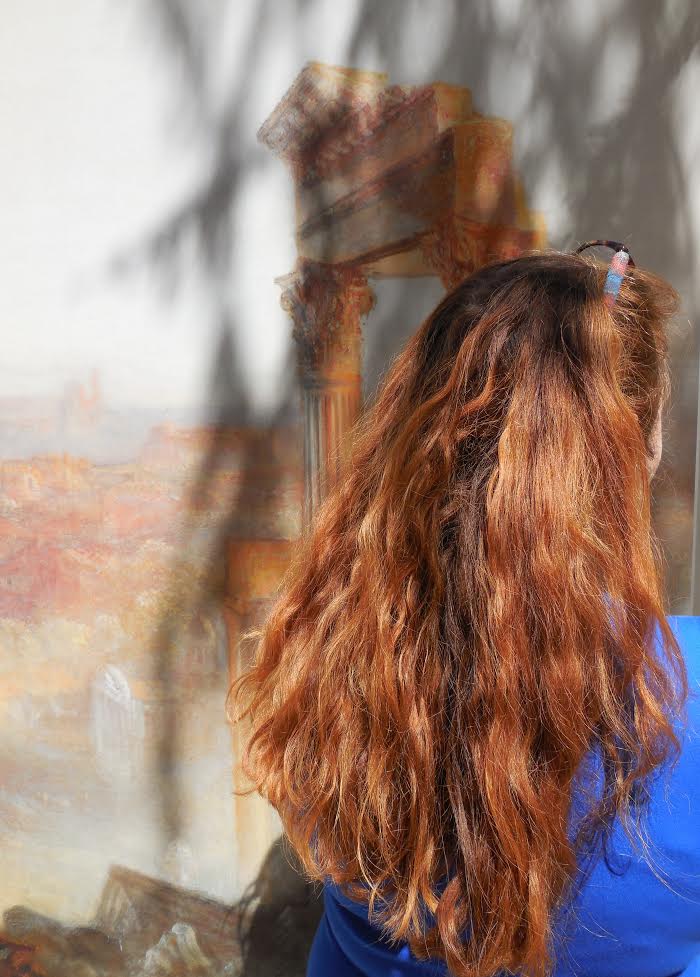
Some days are generous, magnanimous in their gifts of beauty.  We spent last Sunday in Los Angeles at the Getty Center for the amazing show of Turners on loan from the Tate,  Painting Set Free.  The sweep, majesty, and freedom of expression in this exhibit was exhilarating. No photos were allowed, but we did do a little portrait by a poster, below.

Suzanne in front of Turner poster

Turner goats
Turner goats

The exhibit was an entire education in painting. I was surprised to find many late Turners with overtly mythical themes. I was more used to seeing Turner as a sort of visual journalist:  the steam train, the fire, the storm, and so on. The allegorical paintings were fantasies constructed from elements of his imagination rather than “real” landscapes, closer to Claude Lorrain’s beautiful, improbable visions, and often were linked to lines of epic poetry he was reading.  Because they weren’t “real,” you could see how he played with  his favorite elements….. the black smudge tree, a centrifugal swirl,  the blue rectangle mountain. The landscape was never literal and the gods very subtle;  the Zeus and Europa painting had no bull and barely a maiden. It’s no news that Turner, when unrestrained, condensed many motifs down to a beautiful abstraction.

We both enjoyed the Sample Studies,watercolors he did as prototypes for larger pieces to be painted for patrons to order.  You’d choose the one you liked best and he’d do it on up for you.

A Turner Sample Study, Watercolor


Any painting could grow and change organically at any point. At times he submitted extremely rough paintings to the Academy and literally finished them on Varnishing Day. I enjoyed details I  had never seen before: his animals, the characteristic smudge of a foreground tree, a focal point exactly at the center of composition. The whole effect of Turner after Turner was breathtaking. We gawked like the flamingos we had seen at the Los Angeles Zoo the day before.
LA zoo flamingo gallery goers

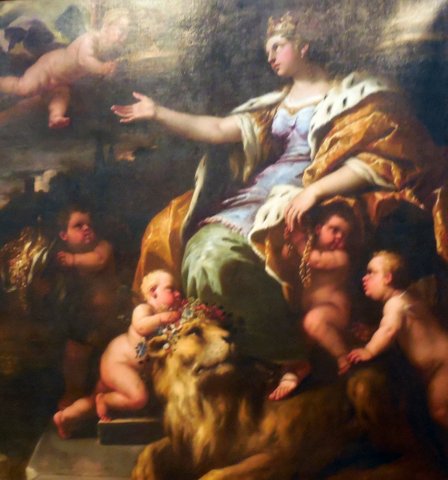
The Getty Center has a Sketching Room where, in the manner of old, one can copy masterpieces. You’re provided with a drawing bench, a board, and materials. I wish they had more variety, but I chose The Allegory of Magnaminity by Giordano. People wandered in. It seems the general museum public is shocked and amazed at the actual making of a sketch in a museum by normal people. There were 10 drawing stations and they were all full. We sketchers became the exhibit!

Giordano Painting I copied

I used the conte and charcoal, then watercolor from my travel kit.

Suzanne Edminster, sketch at Getty Center

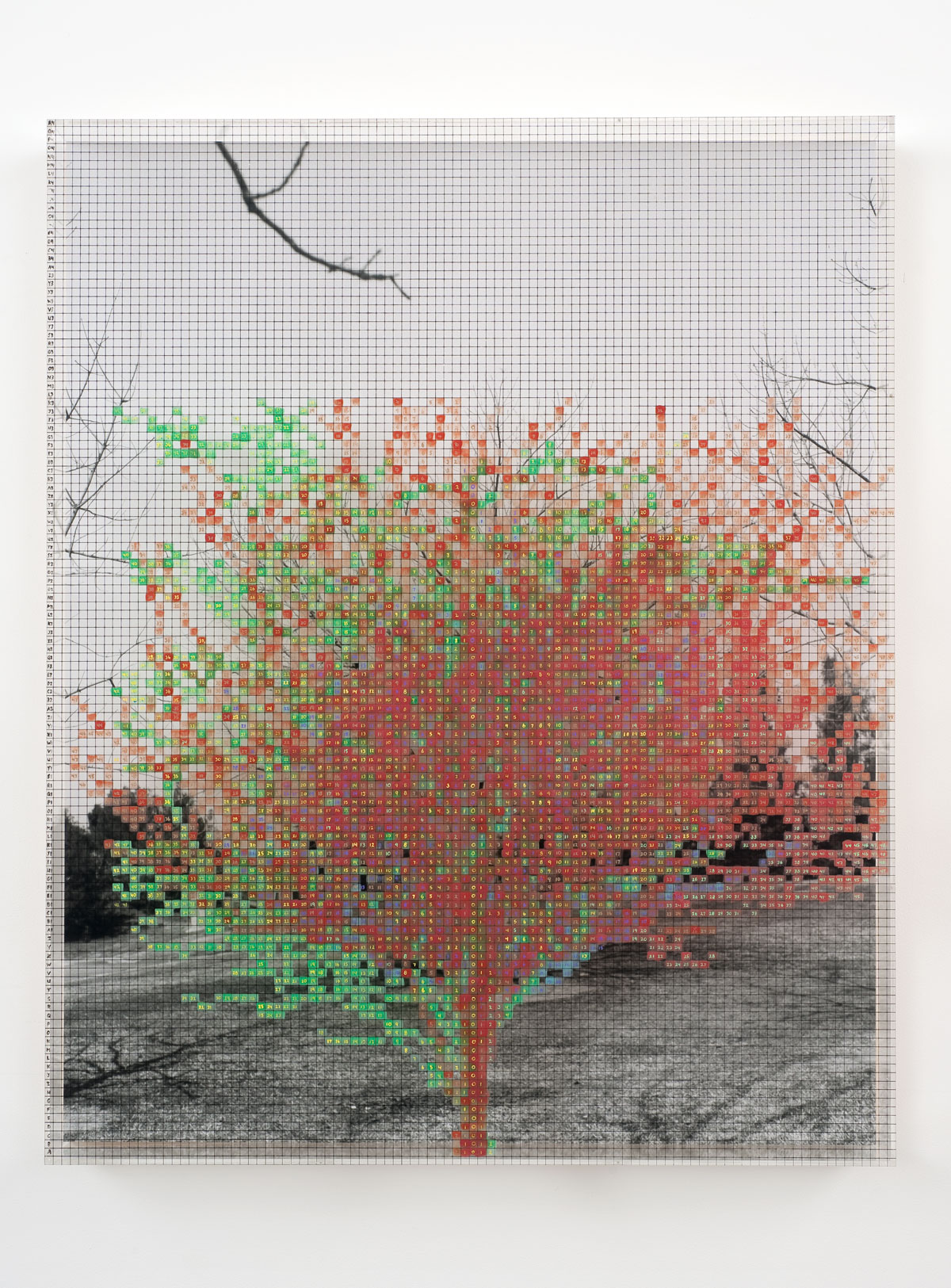
We ended up at the Armand Hammer Museum of UCLA. It’s an often-missed contemporary art museum that was a knockout. Nestled in Westwood, it has an intimate feeling. Both museums were free, another treat. Charles Gaines: Gridwork 1974-1989 was an interesting conceptual show. We were lucky enough to catch the artist in person giving a talk. In my own words, his work is based on playing with and revealing various systems of interpreting visual information. The data that comprised “tree” could be translated by assigning numerical or other values into a grid, a musical notation, or a graph. All of our perceptions are based on a sensory translation of information. He makes his alternate translation visible.

Charles gaines 3
The cultural wildlife was varied: allegorical lions, Turner goats, grid trees, and real flamingos. Only in L.A.!
LA Getty Suz portrait

Experimental Monotype Step by Step

Monotypes are odd birds, strange fruit.  It’s not a painting, yet not reproducible.  It can’t clone, but emits ghosts, flickering between positive and negative images. Since it’s almost purely process, and resists planned end results,  it’s an artist’s playground.  Here’s my process to make one print, step by step.

DSCN0740

DSCN0726
These are Akua intaglio Inks, made with soy oil for easy clean up. My glass worktop is an old shower door recycled by my husband.  The plate you see above is 18″ x 26″,  thin plastic from TAPP.  I’ve inked it up with warm colors and a few dark marks to get me started.  I used an etching press for the prints.DSCN0728


Above, the first run from the plate.  Below, another run, with magenta added for depth.

DSCN0730


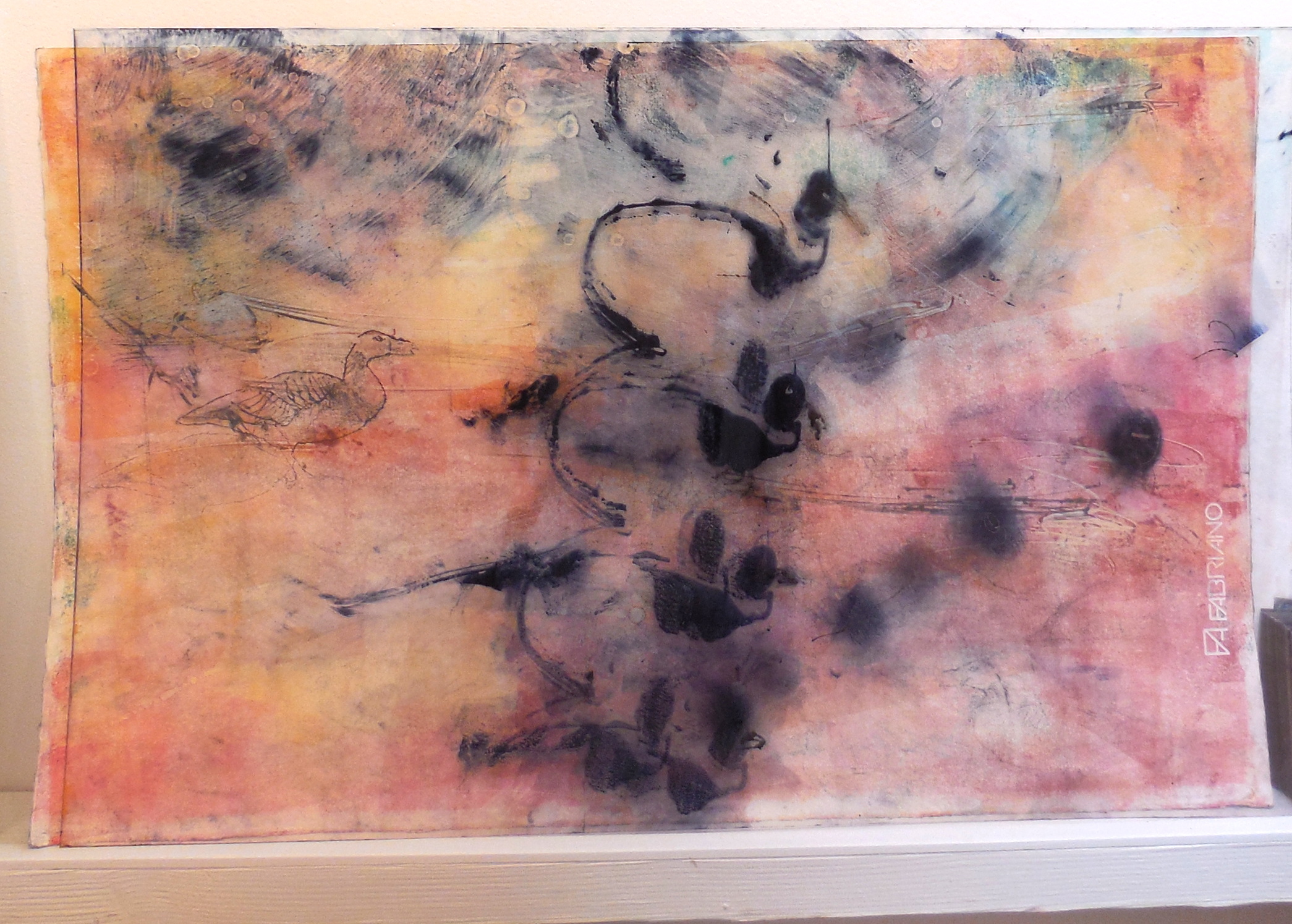
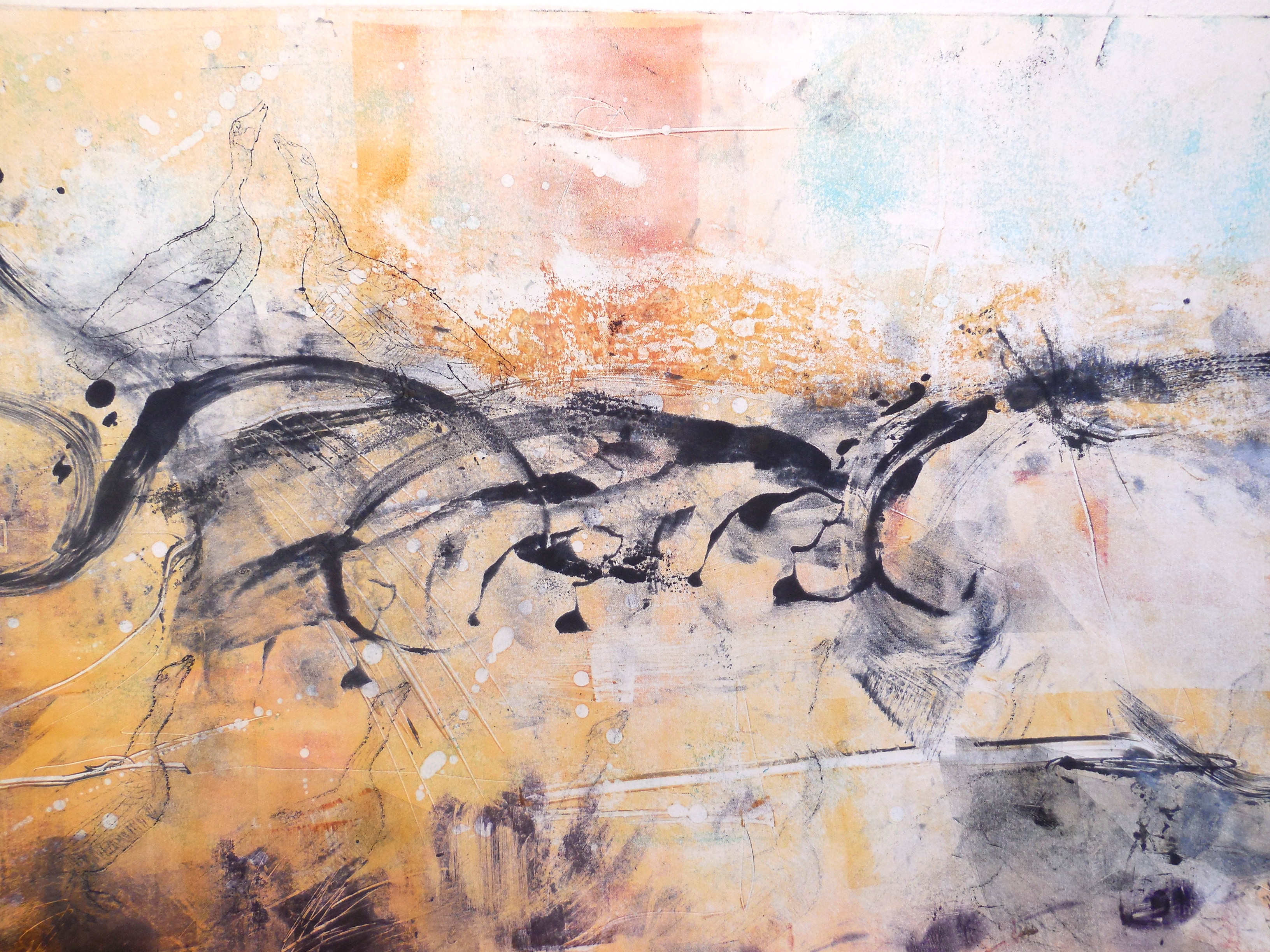
Now I press on a goose I carved with a Dremel engraver and etching needles on a plastic plate.

DSCN0734On the right you can see “brayer geese” from running the brayer over the plate and transfering it. Ghost geese! Then, the strange point where Chance takes her hand to the process happened.  I wanted to add a dark layer in my next transfer.  I spread random lines of dark ink and picked it up with a large roller. The rounded pattern ended up looking like bird and egg forms!  I had just seen a Motherwell at the DeYoung and was reminded of his use of dark form over light.

DSCN0735


Here you can see the plexiglass plate set over the paper so I could get an idea of what it might look like.  Strange, but I found it compelling, so I rolled it through the press.

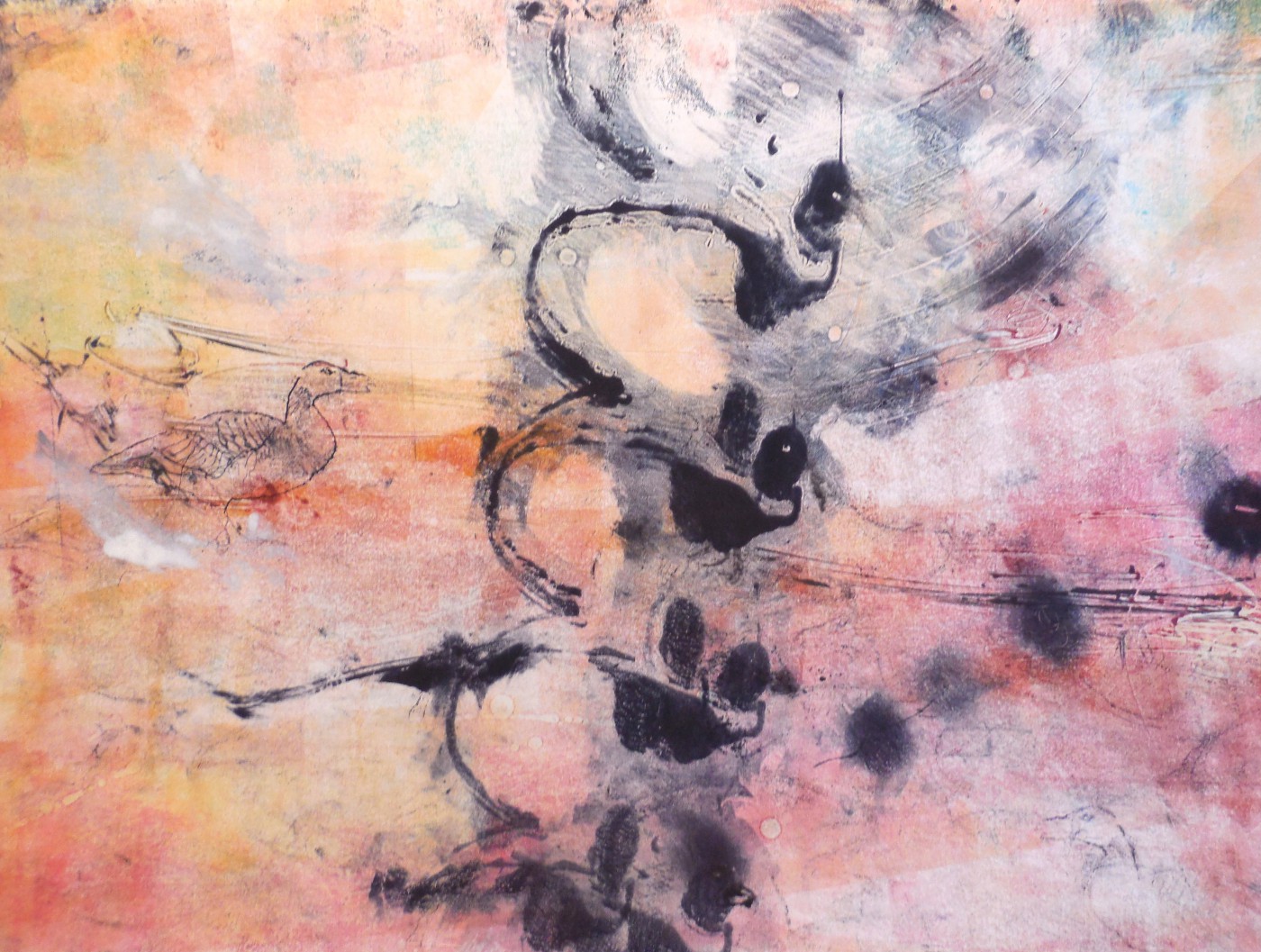
Suzanne Edminster, monotype, Goose Game

Finished!  At the same time, I had been working on another.  Both of these were done with the same plate.  I just kept wiping the plate and applying more colors in different variations.  Here is the second monotype in the series.

DSCN0739


It’s exhilarating to be aligned for a moment to the unpredictable processes of making.

Creative Manifestos and Monolithic Maidens

The “creative manifesto” is a popular idea right now.  You’ll find a good variety, and they’re fun.   But I have a problem with the word manifesto, which has a political agenda.  A manifesto is to unite a group under a banner, to inspire.  I suggest a creative “declaration”, from the old Latin, to make clear.   The root has implications of brightness, to call out clarity,  to make a contract– thus “declaring” taxes. It is a commitment, not a call to action.

Rather than another bullet point list, it’s challenging to try to condense your artist statement into a sentence or two. This should be a statement that will always return you to the authentic reason why you make art.

“My creativity feels like a divine gift to me, and I honor the gift by making my art about Spirit. I want to express the numinous quality of life, where the elements of nature and the stories and the stones and the places of power come alive and speak to us on a deeper level. ”     Caren Catterall

“I paint from a longing to give form to what is hidden, even to me, until I paint it.”  Susan Cornelis

“I work spontaneously to grow paintings as Nature creates, looking through the visible world to the undercurrents of inner forces.”  Karina Nishi Marcus

And mine:

“I explore archaic worlds to forge ancient metaphor into contemporary vision.”  Suzanne Edminster

Suzanne Edminster Saltworkstudio Mixed Media

As Americans, we can’t hear the word “declaration” without the word “independence” implied.  But these concise declarations, with their brevity, clarity and commitment, are at the foundation of creative structure.  Fuzzy, overused “creativity” differs from demanding, grounded creation, where the spark is made, however imperfectly, manifest.

A thanks to Melanie at Catbird Quilt Studio for bringing up the idea of creative manifesto!

Art from Art

In Santa Rosa Junior College’s beautiful print show, 30 Years of SRJC Printmaking, I came on students doing drawings of Caren Catterall’s Giantess series of prints.  They drew in the manner of illustrated journaling, with notes and impressions on the page along with the sketches.  Art ripples out.  You can see the prints on Caren’s website.


Camino Collection and Corrick’s Culture

20140618-204432-74672635.jpg

For this post I’ve decided to back carefully out of the darker underworld of the Screwtape for Artists letters, and turn to brighter horizons. I’ve gathered my Camino de Santiago posts from last year into one chronological story for you. The photos give me a little spirit whiff  again of wheat fields, wine, virgins, horizons. For a moment I was back in the land of blossoms and boots, mazes and muses. I hope you enjoy them.
20140714-091652-33412816.jpg

20140623-183525-66925540.jpg

I have a show hosted by the lovely people at Corricks featuring Sonoma County Art Trails artists.  It’s me and the amazing Joel Bennett. Hope you can make it on Friday, if you’re in the area.  Spring is almost here, a good  time to consider your upcoming pilgrimage, wherever it may take you. Suzanne
Bennett & Edminster Poster

Screwtape for Artists, Letter 4: Deserving

Goose Game, Suzanne Edminster

For new readers, you can find an introduction to the Screwtape for Artists letters here.

My Dear Wormseed,

Excellent work lately, my friend. The Artist/Subject’s vague sense of victimization– our beloved martyred feeling, so handy for invisible destruction– is well under way. The joyous act of artmaking is actually quite difficult to martyrize, but you are doing a good job here. Humans make art under the most horrendous conditions. Art is a pernicious vermin that invades everywhere and is hard to stamp out.

Here’s a tip: remember that the coffin of the complaining victim is constructed with the nails of DESERVE. Whenever the Artist seems to move forward with energy, pound another DESERVING nail into that brainpan. She DESERVES a break, a cookie, an afternoon off, a cappuccino, to procrastinate just one more day. Here the DESERVE acts as a somehow “earned” reward. The more DESERVING, the less creating.

I am so glad that we have managed to sever the word from it’s original root, which has no “built-in” reward. It simply means to serve completely or fully. The Heroic Artist was very good for our cause in the 20th century: all those tortured men smoking and drinking and screwing themselves to death because they deserved it as artists. In the 21st century the women are taking the helm of the arts, and a new technique for destruction, victimization or the martyr impulse, must be assiduously and viciously cultivated.

In contagion,
Your scabrous Mentor,
Screwtape

Letter 1, Letter 2 and Letter 3.

The Goose Game

Goose Game board 2

The Goose Game is a series of 63 monoprints and monotypes based on my pilgrimage on the Camino de Santiago. The Goose Game is also a European child’s board game similar to Chutes and Ladders with 63 squares. It may have been a mnemonic device used by the Templars to give illiterate medieval pilgrims a “map” to guide them. Forms of this labyrinth-style board game may stretch back to ancient Greece, where the legend is that Greek soldiers invented it to while away time on the beach during their ten-year siege on Troy.

Monoprint Making

I’m new to monoprint, but I have noticed that it seems to have a pronounced time element embedded into it. Once it runs through the press once, or twice, it is largely fixed, set, done. You get the feeling that each run of the press is a literal compression and limitation of energy, like the joint in a stalk of bamboo.

The press bed presents a threshold of before (the roller pressure) and after. In a metaphorical way, each print could be seen as a dream from the “bed” of the press, with traces remaining and fading.

We are at a hinge in time right now, the Lunar New Year before the Spring Equinox.  This is my post 100, and I hope for a hundred more. I wish you good dreams in the year to come.

Chekhov’s Ashtray

Goose Game series, Suzanne Edminster

“Always remember the famous story of Anton Chekhov, who, when asked about his compositional method, picked up an ashtray and said, ‘This is my compositional method. Tomorrow I will write a story called ‘The Ashtray.'”

Anton Chekhov, from the book Cartooning by Ivan Brunetti

As a former smoker, ashtrays are fascinating fossils from a past life.  What a great prompt, though: write or create art based on memories of ashtrays.  I love this book by Brunetti, part of my interest in the uncharted land where word meets image.    Why are comics seen as lowbrow? Doesn’t it take twice as much skill to write a graphic novel as a “real” one?  What is so not-fine-art about cartooning? Will an artist who writes, or a writer who arts, inevitably be separated out into “better writer” or “better artist?” Not that I care.  Much.

Sometimes the random is all we need.

cartooning coverI’ve added Cartooning to my short shelf of astonishing books on creativity, applicable to any art form. Here’s the last paragraph.

“Although you have no control over the future, you have control over what your are creating right now, and if what you create is honest, it will be compelling.  Whether or not it is truly good will be decided long after you are dead. But if you hedge your bets, compromise, prevaricate… are are lost.  Something has to be at stake, a part of you has to die and be reborn into your work, if it is to ‘live’ on that sheet of paper, cave wall, or assemblage of pixels.  In the end, all we can do is try our best.  We are none of us perfect.”

Ivan Brunetti

A Wild Goose Chase and Mr. Turner


Goose Game monoprint, Suzanne Edminster

I’ve making experimental monoprints in a series I call the Goose Game. All artists are on a wild goose chase, pursuing an ever-vanishing Muse. There’s no sense to it. Even inventors, or artists of function, have to get lost repeatedly, fumbling in the darkness, before the light goes on. Abstraction, or any creating from nothing, is just plain crazy.

goose game chop I had a chop made in the form of a rubber stamp. The symbols mean goose, board game, luck, art. A Shakespearean origin of the term “wild goose chase” said it was a kind of horse event where the leader swerved crazily around and the rest of the riders had to follow him. We follow our instincts up the mountain and into the muck and over continents, with the wild goose.

I just saw the film Mr. Turner, and I am so glad I did. He was on a wild goose chase of a new vision of land, water and air, though he was often reviled. Some people say “nothing happens” in the film. Nothing happens, except life. He coughs through bitter winters,  scribbling in notebooks, attacking the canvas, day after day until death. We walk with him through vast horizons and empty beaches; never again will we see these views so free of humanity. This film shows the big belly, humble scratching. and wide horizon of Turner’s creation. It’s a treat.  Everything happens.

Screwtape for Artists, Letter 3: On Originality

Monotype experiment, Suzanne Edminster

Even in literature and art, no man who bothers about originality will ever be original: whereas if you simply try to tell the truth (without caring twopence how often it has been told before) you will, nine times out of ten, become original without ever having noticed it.

C. S. Lewis

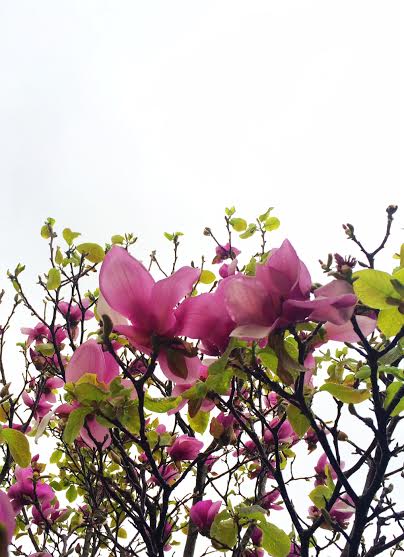
Stormy weather outside, for California, that is. There’s a beautiful grey light against the too-early bloom of the magnolia petals outside the classroom door. magnolia

This C.S. Lewis quote really spoke to me, especially as I flounder about in a new media for a while. Reduced to the status of a beginner, questions of originality pale against simple technical ignorance. As I get older, I feel less unique and special, less original, as a person. I share experience with so many, and, as and adult, know it.

Dear Wormseed,

Congratulations on  the recent sale of the Gauguin for 300 million dollars. A flood of artists will feel discouraged in their own art, and the price obscures the painting itself completely, making it nearly impossible to view with fresh eyes.  Corruption rules!

The Subject-Artist recently proposed making a tableau of dream images.  This is very dangerous, as these inner vapors carry far too much information and spirit, and may speak to others as well.  Keep her in the familiar territory of easily understood beauty, like your recent Artist-Subject Thomas Kincaid.  You earned a sizeable bonus on him, did you not?

You are on still on shaky ground with the daily studio visits.  You must redouble your efforts to keep her away, or you will feel the consequences.  Keep your team on the streets with graffiti– it was brilliant to unify the art impulse with vandalism.  Keep it up.

In Venom–

Screwtape

Archived:  Letter 1 and Letter 2