Abstract Paintings with Gold Metal Leaf – Suzanne Edminster
Gold leaf always seems so complicated. It makes us think of old masterpieces and secret processes. How can you use gold metal leaf in intuitive, contemporary abstract painting?
Prep the canvas first. I like to use gesso and modeling paste. Build a few bumps and ridges into the canvas. This will make the gold metal leaf have interesting texture when you apply it later. Then drip on a few interesting colors in light, abstract washes. You can use Golden liquid paints. Remember that you are not planning too much. In intuitive art, the painting will form itself from the media. You will get ideas as you go along. Let the layers dry. You can see an example with texture under the leaf here.
Detail of Danae by Suzanne Edminster. Note the different kinds of texture under the gold areas.
Let the gold metal leaf tear into large and small forms. Don’t try to control the shapes: that’s part of the process! Then use regular waxed paper from a household roll to pick up the “broken” pieces.
Apply the gold metal leaf first or in the under layers of the painting. I use a Minwax acrylic deck varnish from the hardware store. I brush it on, let it dry a minute so that it is neither wet nor completely dry, then apply the gold leaf. Let each random fall of the leaf lead you to decisions on where to place the next layer. Press the waxed paper to make the leaf adhere.
Now you have the start of a very interesting abstract painting!
But how do you integrate the gold leaf and make it a finished painting?
I will write more on the process next month. I don’t believe in “trade secrets” in painting anyway. I will always reveal media and techniques– because your painting process and finished work won’t be like mine anyway!
I am hosting a class in my Santa Rosa, California studio this month. You can find the listing for Abstracts with Gold Metal Leaf here on my website. Please scroll down. Gleam on! Suzanne
“What imagination seizes as beauty must be truth.” John Keats
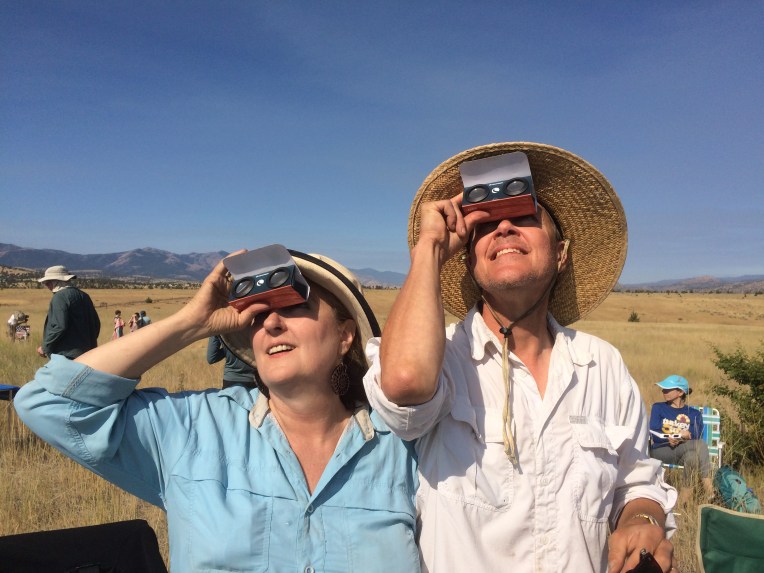
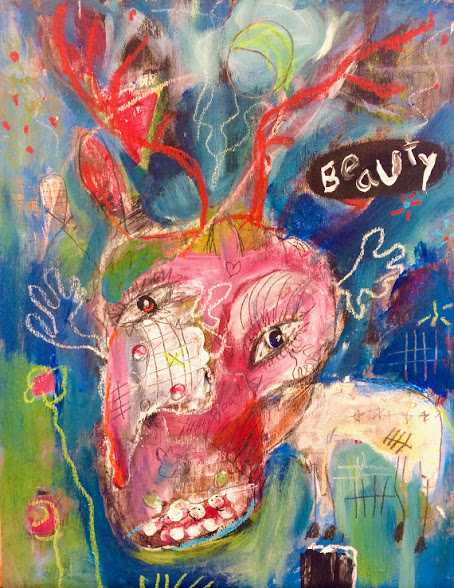
I painted Beauty in early August, shortly before the total solar eclipse, which we caught in John Day, Oregon.
Watching the solar eclipse from John Day, OregonBeauty, Suzanne Edminster, acrylic on board, 16″ x 20″
The eclipse was a summer zenith of awe, cosmic mystery, and great American road trip. Scott and I met up in Portland after I finished taking a painting workshop with Jesse Reno, and took off from there into the high desert of central Oregon.
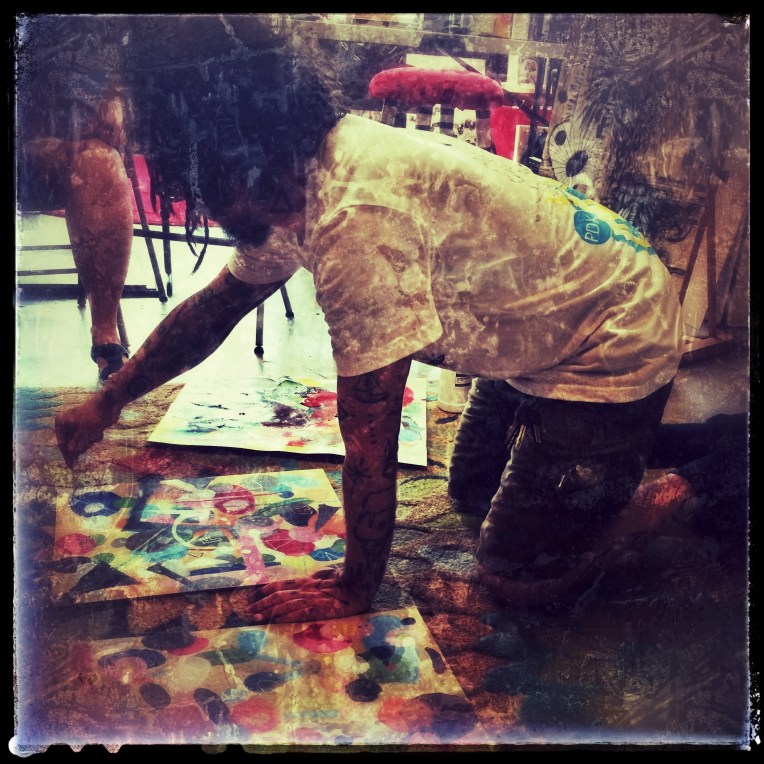
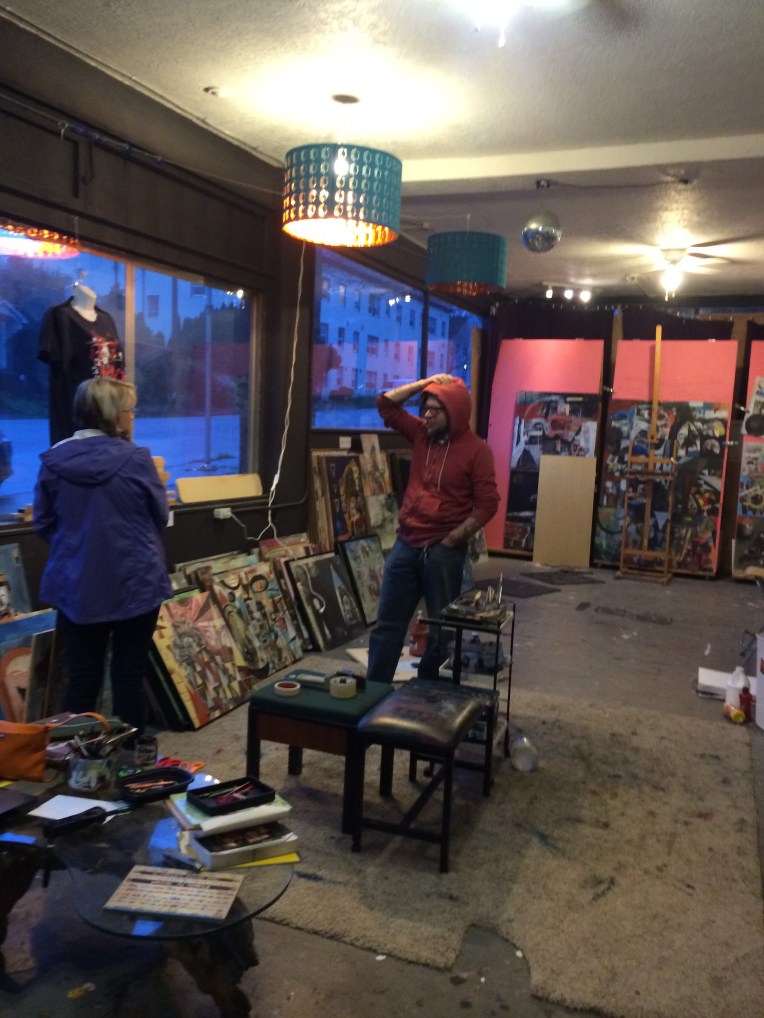
Jesse Reno working in his True Measure Gallery, Portland, Oregon
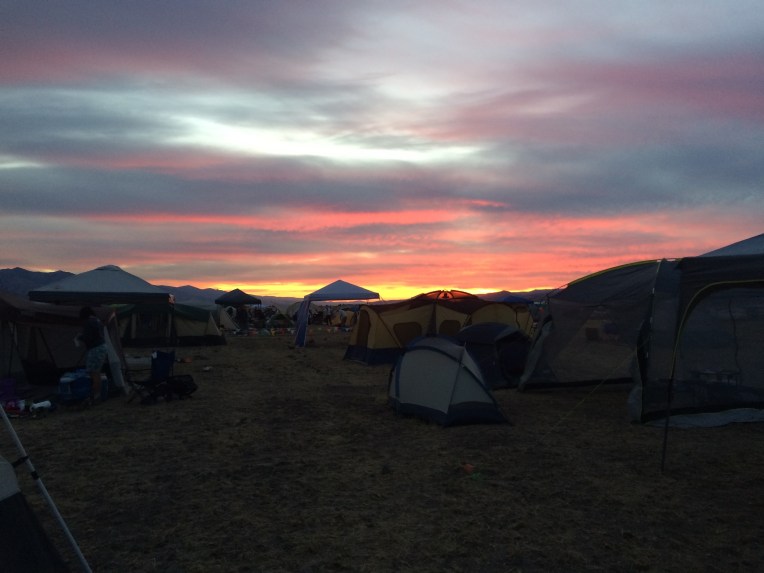
Our eclipse camp in John Day.
My painting Beauty, with images of teeth shining as if for a selfie, a band-aid on a cheek, scratches and boo-boos, precariously balanced on a tipsy pedestal, and a sort of sweetness in her mismatched eyes, is how I have felt for nearly six months.
In October we were caught in the devastating Santa Rosa wildfire. Thankfully, our home and my studio were not harmed, though Scott’s place of business was badly damaged. In December I tripped and fell on cement and hurt my face under my cheek, just like Beauty, who was painted in August. I am recovering from pneumonia in my left lung. And on the day of the Blue Blood moon, the second moon of January and a total lunar eclipse, our cat Nora was killed by a car. From eclipse to eclipse, it’s been a wild ride.
Sometimes paintings hold the future. Beauty’s childlike sweetness and humor made me smile between the eclipses, through precarious times. Seize that beauty.
I’ll be sharing new paintings and exploring ideas in more depth in my upcoming Tinyletters.
“The pursuit of truth and beauty is a sphere of activity in which we are permitted to remain children all our lives.” Albert Einstein
One good thing about a real painting is that it’s a gift, not a Trojan horse. You can look at a good painting over and over. It will still speak, still radiate, still suggest. When the CDC asked to use this painting on the cover of a medical journal, it reminded me of the process of Four Hands Painting with Susan Cornelis. It turns out I also did a blog about this particular piece.
When images spontaneously appear, it makes you believe that the image somehow has its own consciousness. The image/idea wants to manifest itself, if not through you, then someone else, or more than one person, in the case of Four Hands Painting. If images are living things, they come alive again when someone else sees them. Apparently the Trojan Horse wants to canter again, this time in a medical metaphor. I see the painting as a meditation on time. What do you see in it?
I recently started a newsletter called Symbol Warehouse Paintbox through TinyLetter. The email is more like an old-style snailmail letter, more intimate and newsy, and reveals more of my inner process and personal life. I’m writing them about twice a month. If you’re interested, go to this link: https://tinyletter.com/saltworkstudio. You can read the letters in the archive and decide if you want more.
I’m getting cool emails from my friend Travis, full of big dreams and symbols. Things are popping in his spirit. Travis is an interesting guy, so Etruscan pot shards and kabbalistic alphabets are involved. These are times in life when everything makes sense, moves forward and is enlivened by meaning. Your intuition is part of the great Round, and you feel it. Life advances.
It’s a bit like travel. What makes travel, travel? It’s that we are living intensely, noticing things, sorting them out, digesting them. The days are charged with meaning, and often, pleasure. We advance into fields of unfolding metaphors. It’s risky and interesting. As one of my teachers said, “That’s why you call it risk-taking. Otherwise it would be ‘sure-thing taking.'”
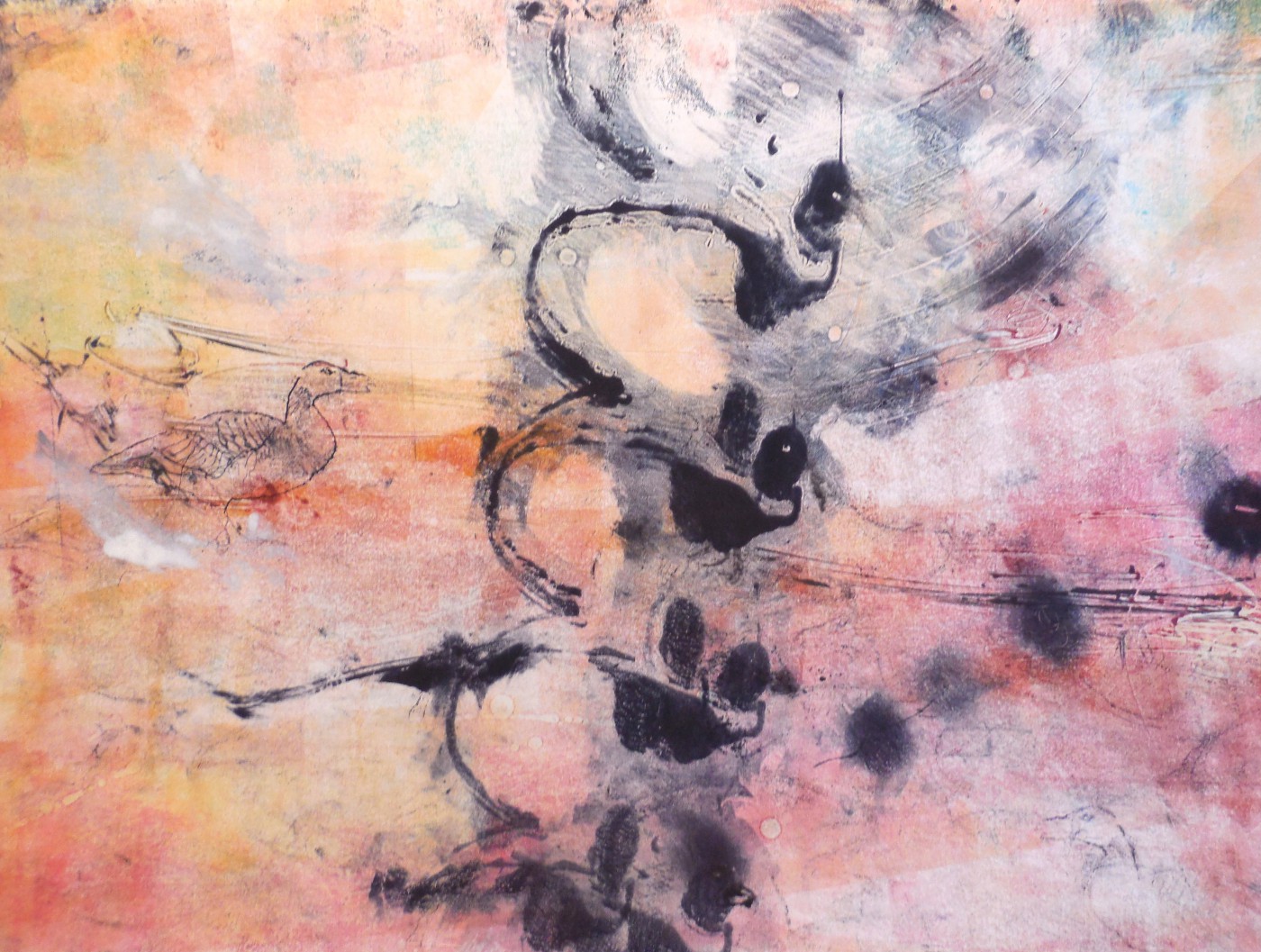
Discarded monotype.
I’ll take a risk here, not knowing who I’ll offend: any real painting is a journey where you might not know where you end up. I’ve been listening to Brene′ Brown’s interview on creativity, risk, and criticism. Well, as benign as it may seem to risk something in painting– after all, it’s only a surface and pigment— I, and so many others, will clutch and stutter and smother when it comes to taking a true risk. Because we will fail.
Yes, we will fail: that’s one thing that Brown insists on. There’s no way to mitigate the risks: no perfect paint or brush, no perfect teacher or color scheme. But we will sometimes have a glorious “yes,” a breakthrough, which is burned into our happiness like a shining brand.
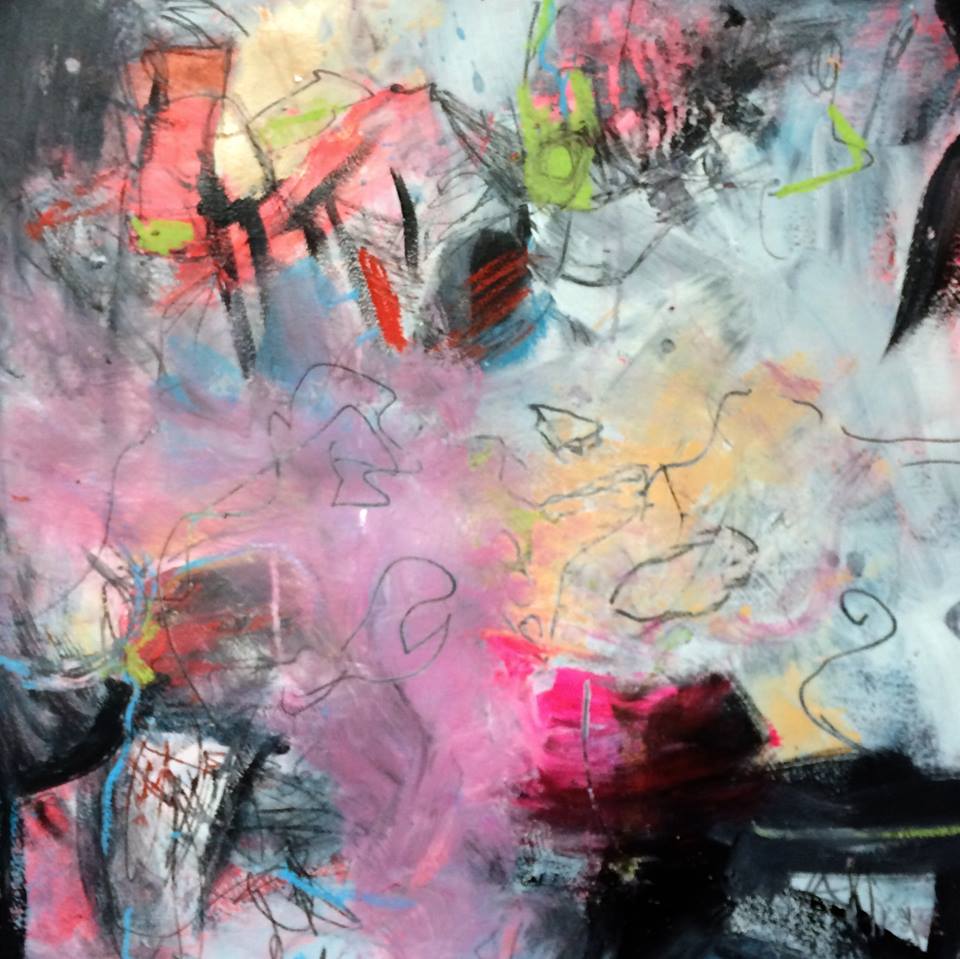
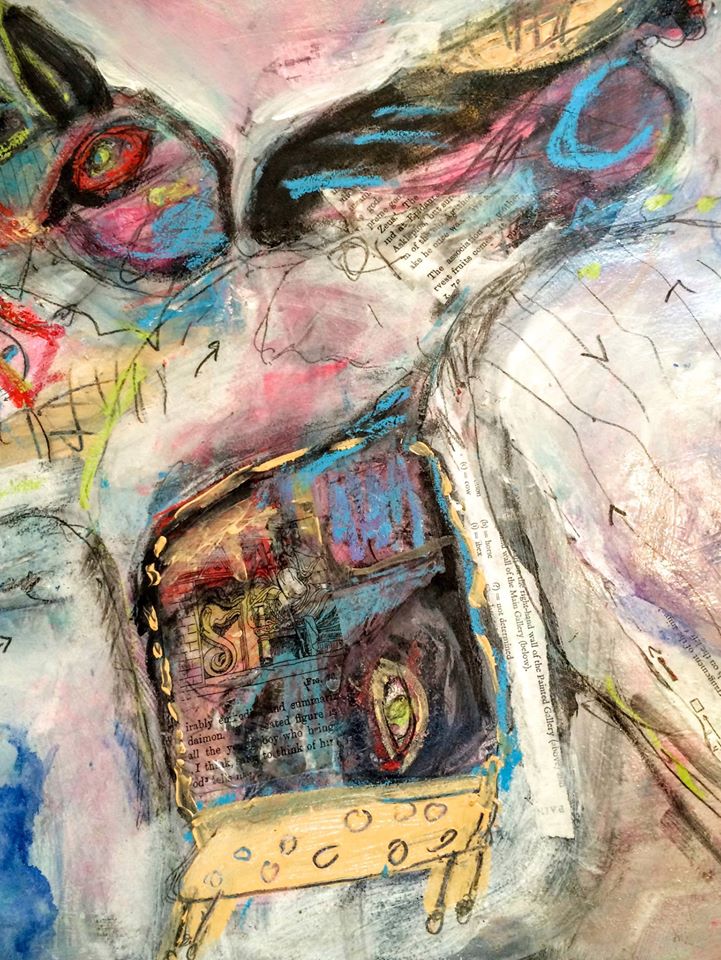
All the pictures of work you see in this blog are failures. They never made it to maturity, but were stages later obliterated, or discarded. Yet they have their integrity as individual marks. They have a transient beauty, like most of life.
I am interested in teaching how to retain the flow of unconcious, or vision, in painting. At the same time, I love the finished product, so I’m also into working with archival materials, frames, shows and showing. But the finished product is only a product without intuitive vision lighting the way. Because who are you painting for, anyway? You are painting for yourself, and a tiny handful of other artists and humans you love and respect.
Painting, unfinished stage, later lost.
I’ve long wanted to link abstract painting with dreams, vision and intuition, and to teach it. I’m teaching an intuitive painting retreat in a beautiful locale in Calistoga in October. I’ll be keeping you up to date here in the blog as I develop my ideas on intuitive vision in painting, and how to take the risk. Oh, and Travis will be there!
Friday May 5, 5-8 PM. First Friday Open Studio in SOFA Arts District, Santa Rosa. Join me for an informal evening of art. Many studios are open in the neighborhood. map/directions
Friday June 2, 5-8 PM and Saturday June 3, 12-5 PM. Art and Absinthe. Drop by my studio in the SOFA Arts District, Santa Rosa, on Friday or Saturday, to partake in a drop of the legendary art drink, Absinthe, see art, and hang out. Add a Saturday visit to me to your Art at the Source plans! map/directions
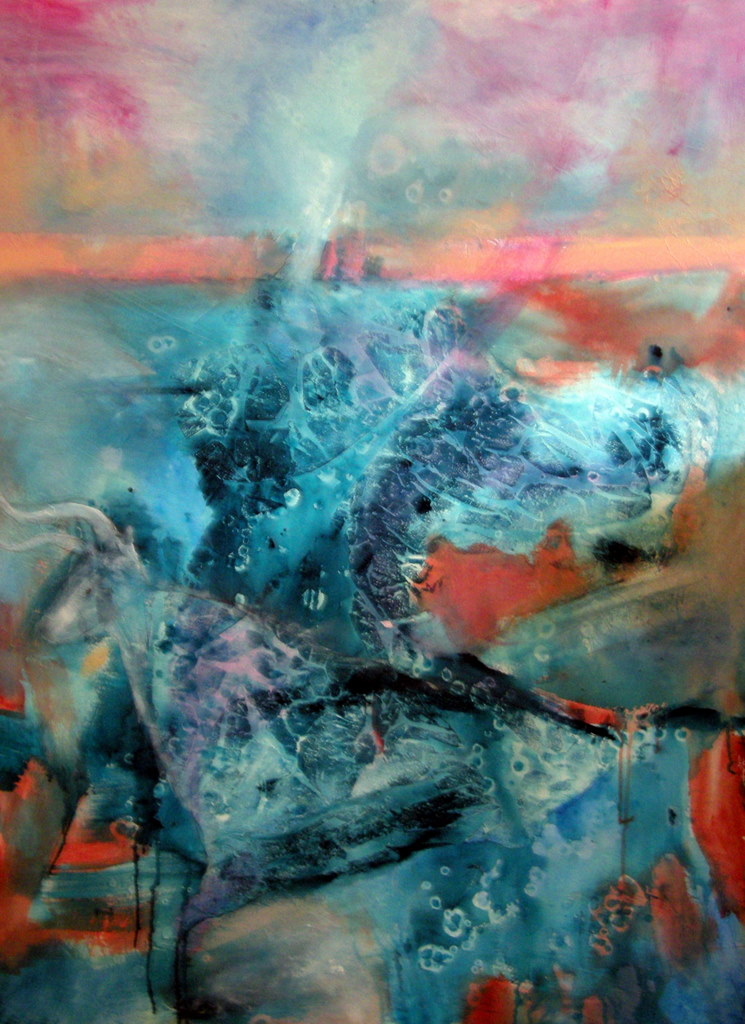
I’m back to writing you after a long hiatus. I’ve been doing lots of journal and dream writing, but that’s not for public consumption. Paintings are leaving my life, going to owners; their exit feels almost more like a sign of a change in my life than “sales.” Europa, above, caught in paint my interest in travel, ancient culture, Greek myth, and the ocean–and, of course, Europe. And now Europa has traveled to her new destination, swimming away, founding a new civilization.
I’m at a point of change in my life, almost at the end of my “day job.” It strikes me, now, that “day job” has a slightly derogatory ring to it. I suppose that the term is supposed to carry the message that capital-A art is the only worthy profession for an artist. I have been lucky in my job as a public high school teacher; I’ve managed to maintain an art practice, and served a few young people. Soon my life will be turned upside down.
Upside Down, Suzanne Edminster, acrylic on canvas, 36″ x 48″
This painting, “Upside Down,” recently sold as well. It was painted for a film festival as a response to the Indian filmUpside Down, a charming antidote to Bollywood and well worth a watch. The white designs on top are calledWarli, originally made with paint made of rice and used to decorate Indian houses. We’re turning our own little house upside down right now, shaking out the dust and getting rid of outworn items, ancient papers. But no matter what walks out of our life, something new and fresh will be waiting to appear on the canvas. I rely on that.
I’ll be back to blogging weekly for a while. It’s nice to be back.
“Black Elk Antlers,” acrylic and oil stick on wood, Suzanne Edminster
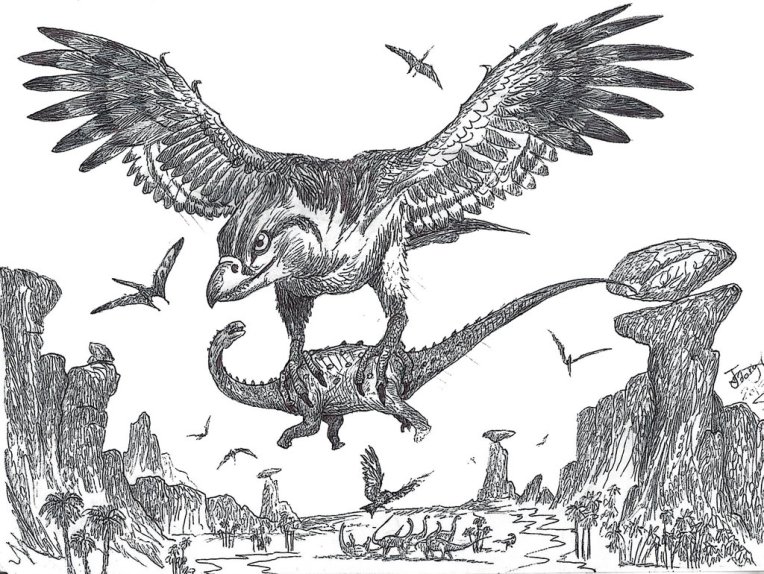
It’s always exciting to have a new series choose you. It makes you famous with yourself. A great notion has flown down to take you away its talons, like a mythical bird, the Roc. This bird only sees you.
Cretaceous Roc by Hodari Nundu
This year two new series occurred in me, “Blackboards” and “Kerubim.”
I think much art lies outside conscious control. These do. Each “Blackboard” develops itself. I have no idea of what the end result will be when I start. It’s childlike. I see this, then I see that, then I turn the board and see something else. I tell stories. They develop out of the darkness of dream, the blackness of the childhood chalkboard, with markings and erasures like chalk. And they can disappear like dreams too.
I believe art visits us. The Kerubim series (see below) is about visitation of ideas and phenomenon, texting from beyond, and decoding. Cherubim are very old, going back to Assyria and Babylonia. They orbit, rotate, have wheels, flames, eyes, thrones, and messages.
Chair Ubim, acrylic on Arches paper, Suzanne Edminster
If you can make it, drop by during August. The opening is in my studio, Friday August 5, 5-8 PM (invite below). I’m happy to be showing with Chris Beards, an astonishing mixed media sculptor. I’ll be releasing images on this site through the month of August for those of you who are far away.
It’s so much more interesting to be visited by Rocs or Muses than it is to watch summer blockbusters. With ideas, when the blockbuster opens, you become its personal theatre. I wish you happy visitations.
I took a two-day workshop with Jesse Reno in Portland recently. In the glare of the plastic-covered hotel conference room, under alarming chandeliers and migraine-friendly fluorescent lights, Jesse led us down the rabbit hole to the place where composition meets dreamtime.
On a studio visit to Jesse Reno
Even if you don’t especially want cosmic floating eyes, bitey teeth, and monsters in your work, Reno’s rigorous approach is compelling. Starting with random strokes of paint applied primarily with hands and a few brushes, he asks the students to focus on what is on the painting surface, NOT a pre-formed vision or an invisible viewer or reviewer. There is no end in sight, only process. Figures may appear and be obliterated. At least two paintings are started simultaneously.
In focusing only on what is there, Jesse asked us to respond only to the immediate and present world of the painting in any stage of chaos. One student asked if doing a particular move–some outlining, I think– would “help the viewer.” “F….. the viewer,” he told one student. Your allegiance is to yourself and the mess on the page. Another student asked if she could cut out the head of one painting and collage it on another. (She apparently liked the head but disliked the rest of the work– the common problem of the “precious” spot that dominates the rest of the work.) He said that she could, but she would be avoiding the problem. The problem is staying with the process through the dark, murky stages where nothing is working, internally or in the painting.
Reno works with only five colors of acrylic paint, his hands, and a few brushes. The limitations provide a framework to contain an extremely intuitive approach. His method is to consider only what appears at the moment, and to spontaneously follow every impulse. In this sense, it feels like meditation, where one loses focus on the breath and continually brings it back. At the same time, a governing aesthetic is in operation, an unusual combination with intuition. Each handstroke produces its own small story, especially as the mind of the painter begins to see figures in the mess. This method has a distinguished provenance; Leonardo da Vinci espoused it, even though apparently people mocked it even in his time, given the slightly defensive tone of his quote.
“Look at walls splashed with a number of stains, or stones of various mixed colours. If you have to invent some scene, you can see there resemblances to a number of landscapes, adorned with mountains, rivers, rocks, trees, great plains, valleys and hills, in various ways. Also you can see various battles, and lively postures of strange figures, expressions on faces, costumes and an infinite number of things, which you can reduce to good integrated form. This happens on such walls and varicoloured stones, (which act) like the sound of bells, in whose peeling you can find every name and word that you can imagine.
Do not despise my opinion, when I remind you that it should not hard for you to stop sometimes and look into the stains of walls, or the ashes of a fire, or clouds, or mud or like places, in which, if you consider them well, you may find really marvelous ideas. The mind of the painter is stimulated to new discoveries, the composition of battles of animals and men, various compositions of landscapes and monstrous things, such as devils and similar things, which may bring you honor, because by indistinct things the mind is stimulated to new inventions.”
― Leonardo da Vinci
I find it interesting that da Vinci mentions “monstrous things, such as devils and similar things,” which are often seen in Reno’s work. He mentions composition twice. Composition– and what lies beyond it– has been a recurrent theme for me this year. I can’t know the intent of the original Italian, but it inspired me to look into the root of the word. Compose has some wonderful non-aesthetic meanings: to be composed, be still and calm. The root comes from the Latin and Greek. Com means “together,”, and pose comes from to stop, cease, or to place in repose, a pause, a stop. Each time we stop to bring elements together, and then pause, we have composed. We pause or stop together.
Martini amidst the media– my workshop table
Back to the class. Reno sometimes models or speaks aloud both his aesthetic and narrative process. “I don’t like this, so I’ll try a little green.” “The horseshoe is in the elf’s stomach now.” My experience was that of following traces of soul or dream which emerge through paint marks, a distinct feeling of scouting or tracking. One can follow the trace or lose the track and fall off the road. Sometimes the highway is clear, but often you have to take the machete into the jungle.
When a painting emerges, it has been retrieved by a long and arduous process. It is full of information for the painter. The viewer is on his own. It’s not really about shamans, monsters, animals, tricksters, but about the process by which they emerged— or submerged, or de-composed.
Chicken with cigarette. A narrative emerges, but cannot be forced. And the story changes its ending constantly. Slippery paint, slippery slope, a wild ride.
Dear interweb world humans, beings, friends, voyeurs, and artists,
Thanks for following me all these years! It has been a journey reflective of my inner world, a composition of shadow and light, beauty and imperfection.
Turquoise Window World, an early painting post from the blog
It’s been a while since I’ve posted. I have to break through an invisible membrane of fear every time. As an introvert, sometimes I don’t even enjoy posting carefully edited versions of my life and paintings. I’ve constantly struggled to be “authentic” with the innately inauthentic medium of social media and blogging. At times I have been both over and under-attached to your reactions, first living for them– the fabled “stats”– and then rejecting them entirely.
Floating beauties from the Naples Archaeological Museum
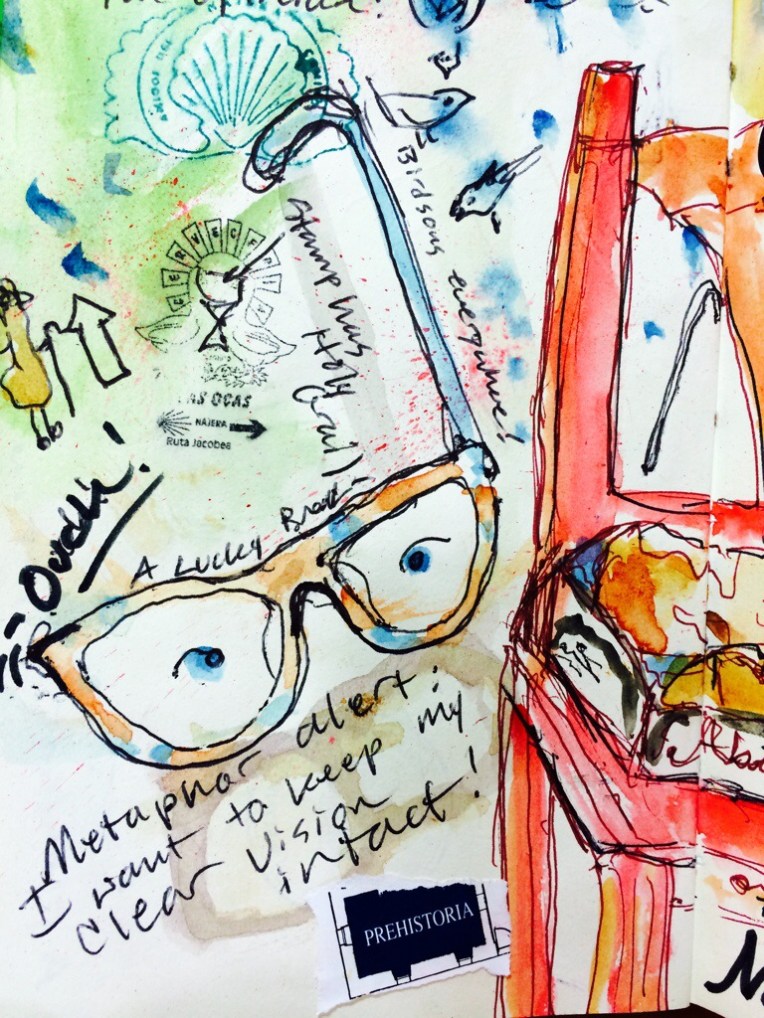
I think the high point of authenticity for me is, ironically, not the art blog, but the Camino de Santiago pilgrim posts. I really perceived the blog, during the time of being on the road, as a tentacle of true connection. I could feel support reaching through it. The art, if you can call it that, was completely unrevised– the messy notebook pages.
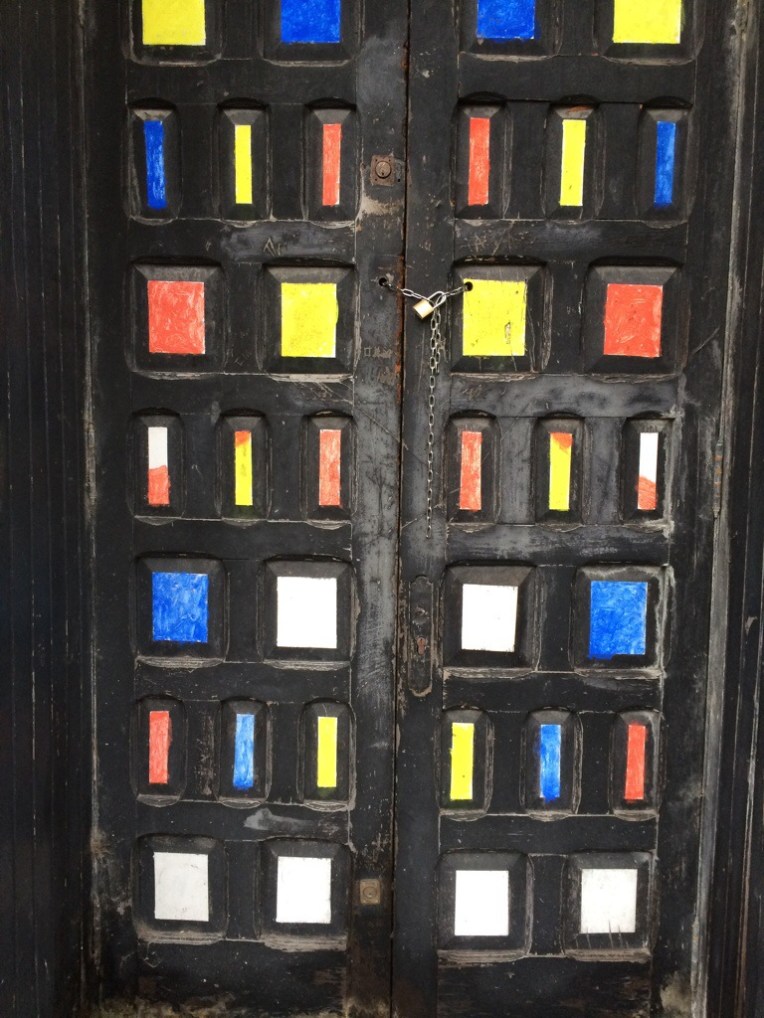
Portals of color, locked, SpainPilgrim sketchbook, Camino de Santiago
Looking forward, I find myself increasingly interested in pure abstraction and an authentic gesture. I want distance from approval and marketing and time to develop on my own without outside pressure, time to grow a new set of metaphors. So I’ve decided to take 2016 as a learning year, not showing year.
I won’t be doing open studios, except for our local events. I am going to paint at the Art and Soul Retreat in Portland this March. These 5 days in a hotel room, painting and sketching, should be fun and instructive. I’m excited to finally be studying with Jesse Reno. I think he is a master of staying with the process until the final image, however eccentric, emerges. I hope to focus on composition with Jane Davies. I’m looking forward to cooking on the hotel room iron! (Just kidding. Sort of.) I will be in the Sheraton Airport Hotel, car-free, and am thinking about how to keep costs low. It will be a rather fancy art garret. I’m bringing plastic sheeting so I can paint in the room if I want, storing the paintings on the extra bed.Let me know if you have ideas for hotel room survival.
At home, projects include new chicks in March, and planters for the heritage grapevines we got as starts from the UC Davis plant ark. The grapes are no longer grown in France, having been hybridized, but they are the ones that appear in many old masterpieces. An ancient strain has been preserved and will grow on our arbor, or so we hope. The grapes themselves are perhaps these that Monet painted, pale green with a rosy cast.
Both chicks and grapes grow fast once they start. I wish you a surge of new growth as well in the Lunar New Year.
Elizabeth Gilbert’s Big Magic on a background of paintings by Suzanne Edminster
Big Magic, by Elizabeth Gilbert, is the latest in a tidal wave of creativity books, and a very fine one. I believe it will be the go-to creativity guide for the next decade. It was only in the last twenty years that bookstores developed sections devoted to creativity in the written or visual arts. For many years it was just If You Want to Write by Brenda Ueland , Art and Fear by David Bayles, or The Artist’s Way by Julia Cameron. And you never knew what section to find them in the bookstore; they were obscure. Gilbert’s message is not new. In fact it is ancient, but is desperately needed today. Why are we dealing with an erosion in the basic knowledge of how imagination and creativity work? Is creativity among our endangered species? Why is a book on creativity a best seller, besides the fact that Gilbert writes like an angel, or a daimon? Anyway, Big Magic was in my bag during my recent open studios. Interesting that its cover is abstract art. Hey, I make that stuff.
Over Underworld, Suzanne Edminster
I approve of Big Magicand its exploration of Big-I Imagination. I first learned the tenets of Imagination that Gilbert espouses through studying the Romantic Poets with poet Diane di Prima. The primacy of Imagination was stressed; the world be damned, and often was. David Meltzer taught gematria and the concepts word-as-creator, letter as energy, word itself creating the universe, for good or creepiness…. go Golem!
Letters create Golem- check out his forehead
I’ve always been lucky with teachers; I was taught about Blake’s Spiritual Sensation. The line was drawn deeply in the existential sand. Imagination is more important than reality. It creates reality, in fact. Ideas exist independently of us. The Big-I Imaginations fly, walk, swim, or lump about all on their own, shedding light and shadow, ambrosia and dung.
Blake said Imagination is Spiritual Sensation
Diane di Prima also taught Western Magical tradition and guided visualization to students back in the 1980s, long before the vogue, as part of her own rich creative resources. In Big Magic, Gilbert quotes her friend and mine, Caroline Casey: “Better a trickster than a martyr be.” And Gilbert has the right idea on gods, spirits, angels, archetypes: they are both real and unreal, terribly important and trivial at the same time. Her approach is positive and full of stubborn gladness and a durable mysticism. I think it is the creativity book for our time, just as The Artist’s Wayby Julia Cameron touched a nerve in the 1980s. Cameron’s book was based on an archetype of wounding, addiction, and a 12-step style reclamation of damaged creative impulse. I prefer Gilbert’s straight-ahead optimism and humor.
Here’s what I loved in the book: The return of the notion of the individual creative daimon or genius. We each have a little whiz-bang spirit assigned to us at birth to guide or goad us. Ideas have lives independent of us. Court them, invite them, respect them, don’t ignore them too long. If you lack inspiration, curiosity and showing up are enough. Permission– Bob Burridge’s permission slips for painting, for example. The right kind of entitlement. Her own experience with the Day Job: no shame, keep it as long as you need to. Your art is not actually your “baby.” You can’t dissect, discard, neglect, or chop up a real baby. You can’t ignore it in garages or sell it.
Bob Burridge’s Permission Slip
She’s so funny! How to speak to your inner critic: “It’s best to be insistent, but affable. Repeat yourself, but don’t get shrill. Speak to your darkest and most negative interior voices the way a hostage negotiator speaks to a violent psychopath: calmly, but firmly.”
And when you’re in a lull– as I am right now, exhausted from open studios and down with a cold– she writes, “Any motion whatsover beats intertia, because inspiration will always be drawn to motion. Make something. Do something. Do anything.” And some sort of inspiration has visited… the next step in narrative abstraction, the next series, maybe called “Themis.” Or not. Or maybe some silly illustrated journaling or un-sellable Metaphoracards. But something, something, to give a little pinch of snuff or spice or something stronger to my daimon.
Metaphoracard “Help”
In Sonoma County, one person in ten describes themselves as some kind of artist. For each one of those, there may be a hundred who want to be. In the meantime, we swim in a polluted ocean of information and mind-waste created by nameless others. (I have just read the excellent novel The Knife of Never Letting Go by Patrick Ness. The book postulates a nightmarish culture where we all must hear everyone’s thoughts, all the time, a decent metaphor for the interweb. Fortunately, in his book, men are more susceptible than women to this infection.)We have become greedy gluttons of instant, fragmented nano-art rather than makers of a modest, enlivening, everyday creation. Everyone wants to be an artist. Gilbert’s Big Magic could help.
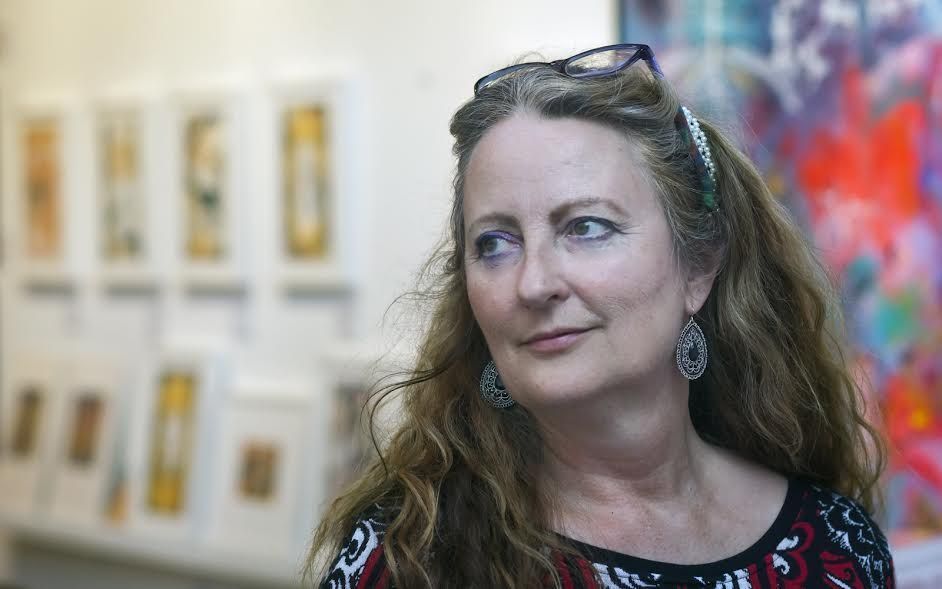
Suzanne– and thanks to the talented Adrian Mendoza for the portrait














 Saltworkstudio | Suzanne Edminster