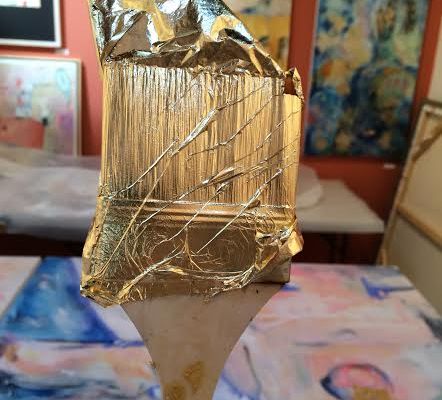
How to Use Gold Metal Leaf in Abstract Painting, Part 1

Abstract Paintings with Gold Metal Leaf – Suzanne Edminster

Gold leaf always seems so complicated.  It makes us think of old masterpieces and secret processes.  How can you use  gold metal leaf in intuitive,  contemporary abstract painting?

  1. Prep the canvas first.  I like to use gesso and modeling paste.  Build a few bumps and ridges into the canvas.  This will make the gold metal leaf have interesting texture when you apply it later. Then drip on a few interesting colors in light, abstract washes. You can use Golden liquid paints.  Remember that you are not planning too much.  In intuitive art, the painting will form itself from the media. You will get ideas as you go along. Let the  layers dry.  You can see an example with texture under the leaf here.

    Detail of Danae by Suzanne Edminster. Note the different kinds of texture under the gold areas.
  2. Let the gold metal leaf tear into large and small forms.  Don’t try to control the shapes: that’s part of the process! Then use regular waxed paper from a household roll to pick up the “broken” pieces.
  3. Apply the gold metal leaf first or in the under layers of the painting.   I use  a Minwax acrylic deck varnish from the hardware store.  I brush it on, let it dry a minute so that it is neither wet nor completely dry, then apply the gold leaf.  Let each random fall of the leaf lead you to decisions on where to place the next layer.  Press the waxed paper to make the leaf adhere.

Now you have the start of a very interesting abstract painting!

But how do you integrate the gold leaf and make it a finished painting?

I will write more on the process next month.  I don’t believe in “trade secrets” in painting anyway.  I will always reveal media and techniques– because your painting process and finished work won’t be like mine anyway!

I am hosting a class in my Santa Rosa, California studio this month.  You can find the listing for Abstracts with Gold Metal Leaf here on my website.  Please scroll down.   Gleam on!   Suzanne

A Trace of Gold


A Trace of Gold series at La Crema Tasting Room
Selfie with "Phaistos"
Selfie with “Phaistos”

It’s been a summer full of road trips, but my newest show, “A Trace of Gold” is staying put, on view at La Crema tasting room in Healdsburg through September 2015. It has been great to have such an elegant space to display them.  I’m told that tasting room patrons have a few glasses of the outstanding Pinot Noir , then take each other’s photos in front of them. Larger scale paintings– these are four foot by five– take you into totally new spaces.  You enter the particular alternate universe of that painting in a way different from other work.  The broken gold metal leaf catches the light, even in near-darkness.   I painted these to try to catch something both fragile and eternal, like our lives.

Over Underworld at La Crema
Suzanne Edminster, The Phaistos, acrylic and gold leaf on canvas, 48 x 60

Right now I’m writing from Mendocino, artful and artsy, charming and  pretentious.  I’m staying for a night in a watertower art studio– more on that in my next post. This is my third road trip of the summer.  Not to stretch the metaphor too much, but larger work is really a bit like travel that takes you into odd worlds.  It’s the closest we have to time and space travel through wormholes.  The brush is your vehicle, jalopy or spaceship.   Now I really have stretched that metaphor to the breaking point.  Next post will be the real road trips.  Don’t disembark yet.

The Goose Game: Painting by Chance

Suzanne Edminster

I decided to compose two large abstract paintings for The Goose Game series using rolls of the dice and the old European board game, the Goose Game.  I’d let chance dictate the process.

DSCN0855


I used notebook pages and wrote either thematic or painterly elements in a list , randomly numbering them 2 to 12 to correspond with dice rolls.

You can see it’s a real mix: all the way from “use neocolors” to “holy spirit.” This way of working does have a lineage. John Cage used the I Ching to compose music, notably “Music of Changes”, including the notorious Roaring Silence segment. I found out about this during the eighties in New College, San Francisco, where a teacher, either Robert Duncan or Duncan McNaughton, friends of poet and musician Lou Harrison, who apparently also used the I Ching to compose, brought it up in class. Less known is that John Cage also used it to compose prints, monoprints and lithographs, during the seventies, at the end of his life.

john cage two


The best article on this I’ve found on John Cage and his use of the I Ching  is on S J Marshall’s fine site, Calling Crane in the Shade.  For painting,  I found the process beautifully meditative.  Quiet and slow, it let each element unfold by itself until I was done with it, with little anxiety or the press of “I could do this, I could change that.” Most important, it gave comfort to be rid of the tumult of “What should I do?”

It was calming and centering to give away the control to a larger element, as I did when I was walking the Camino de Santiago.  The Goose Game is an ancient European board game that has many metaphors for pilgrimage, which is why I chose it. This all sounds so odd.  I find it interesting that abstract composers and artists are drawn to chance in creation.  Something larger moves through us.

I’ll be happy to share more about my process at the opening of The Goose Game, Friday May 1st, 2015, 5-8 PM, in the Backstreet Gallery.  I’m located down Art Alley in SOFA Santa Rosa.  I’ll give an artist talk at 7 PM.  You can play the Goose Game if you visit.

Suzanne Edminster, Wind Over Water, The Goose Game Series.  Acrylic and gold metal leaf on canvas, 45 x 60.
Suzanne Edminster, Wind Over Water, The Goose Game Series. Acrylic and gold metal leaf on canvas, 45 x 60.