What It Took for “Upside Down”

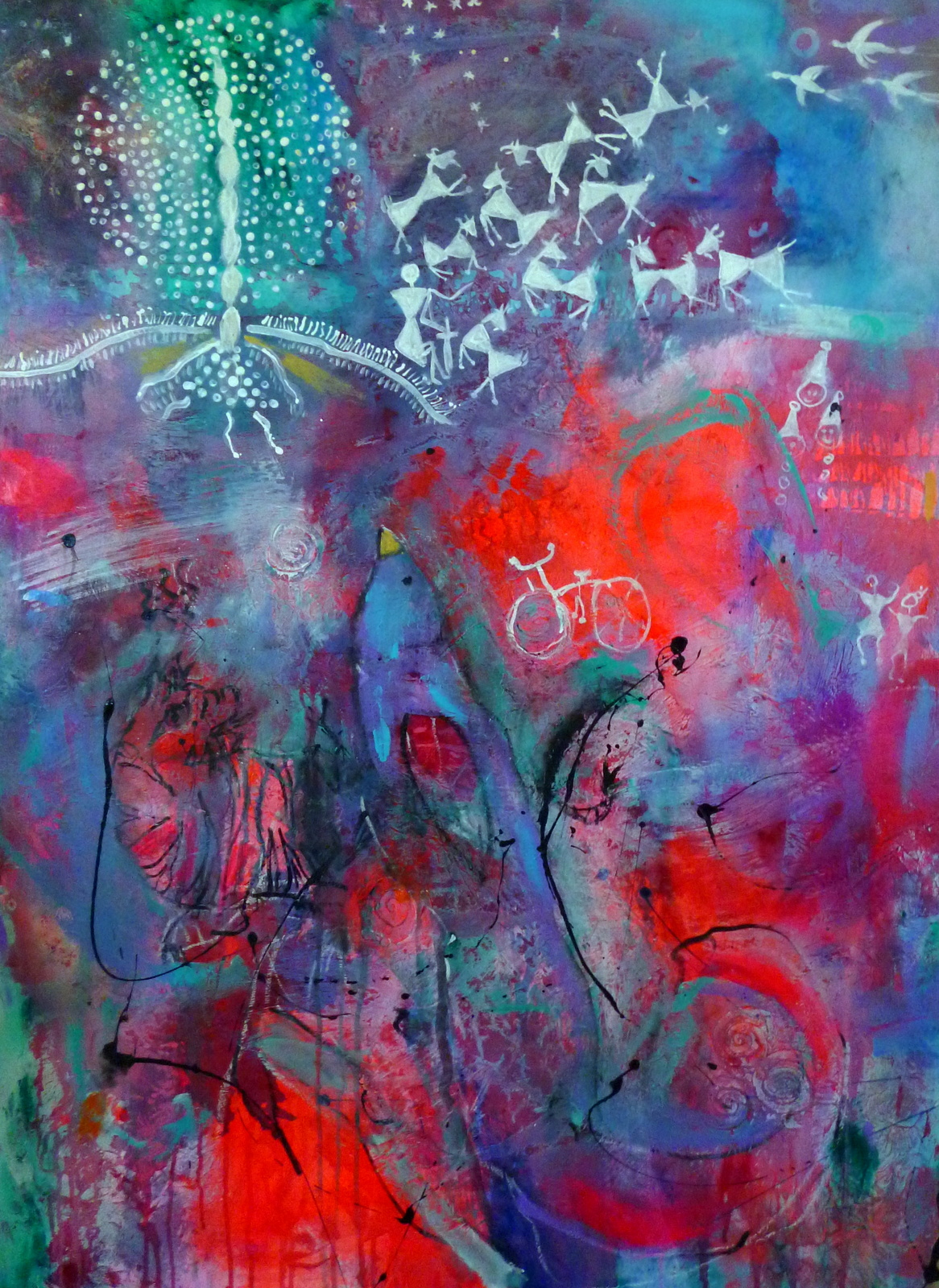
Upside Down by Suzanne Edminster, 36" x 48"
Upside Down by Suzanne Edminster, 36″ x 48″

Artists are often asked how long it took to make a painting.  Less often are they asked about materials, techniques, theme, and concept.  I’ve decided to tell you what it took.  My story is not unique; every artist has hundreds of these stories.  Most artists are polite enough not to bore you with them.  Here goes!

Materials: Golden liquids.  Flourescent Nova colors.  White acrylic ink and gesso.  Huge to tiny brushes.  Canvas prepped in 2010-2011 with gesso, lightweight spackle, and hand-carved forms.  Masking tape to establish horizon consistent with previous series of 10 paintings. Then swaths of translucent red, then swipes of flourescent red-orange.  Allow canvas to sit for 14 months to mature, and because you don’t quite know what it wants to be. 5 books on Hindu motifs, 2 books on symbols, 2 hours of research to establish authentic Warli painting examples.  Notebook with notes.  Film called “Upside Down”, an Indian movie not yet released in the US. Brushes borrowed from Karina Nishi Marcus.  One glass of cognac drunk in her studio.

Techniques: pouring, stamping.  Gesso applied with gloved hand, no brushes, for smooth yet organic texture.  Mixing of whites to achieve varying translucencies for folk painting.  Wiping back with variety of materials. Acrylic inks applied with brush and pen, water-soluble wax crayon scribbles, and 2 different varnishes, one spray and one applied by brush.

Experiential and conceptual development: one marriage, 1991-1998, in which I lived in Bangalore, India for several years and collected both fine and folk art.  Conversation with Indian woman who decorated the threshold with gorgeous rice flour designs daily at 4 AM so that her husband could step through this blessing on his way to work at dawn, her paintings destroyed and rebuilt day after day.   Color vocabulary from photographs and memories of India.  Conscious decision to paint naively.  Memories of circus and thoughts of Ganesha,  a major presence in South India. Wanted to use a sort of ‘tumbling down the rabbit hole” theme used in previous paintings, where animals float and turn in a metaphorical world, Chagall-like.  Mythic theme for paintings and series size established in the Terra Incognita series, 2011. A sadness over a  recent death and a desire to use forms drifting up and away, or birds to symbolize soul in release and  in captivity.  Threw out color balance and let the colors blend randomly, as in India.Memories of elephant festivals and ecstatic dancing.

And luck.

Questions?

Studio Note:  You can see “Upside Down”, both my painting and the film, at the Santa Rosa International Film Festival, which runs Sept. 12-21.  Visit http://www.sriff.org/ for more information.
A Contract with Creativity: 5 Tips on Time for Art

I am secretly annoyed when people ask me “How do you do it?”  I have a job.  I make art.

My first thought is that any young mother is ten times as busy as I am.  It’s just that she doesn’t get the public accolades of an art show.  Her project is her child.  How do young mothers do it?

Here are a few hard-won ideas on how to make time for art.

  1. Do your art first, before anything else.  Use your best time of day.  Twice a week I go to the studio and work from 6AM to 7:30, then go to work.  I have an alarm clock set in the studio to remind me to leave, just in case I enter flow time or art trance.
  2. Keep notebooks everywhere, not just in your home or studio.  That’s right, have duplicate or triplicate notebooks.  You can do some studio time in a notebook, but it has to be there.  Sketch and write down poetry, daily junk, and ideas. It’s not important which notebook is your art notebook and which is a daily journal.  Mix them up.  The important thing is writing in them.
  3. Remember that even if you had more time, you wouldn’t necessarily do more art in it.  Work in what you have right now, rather than get lost in a resentful dream state about your “other” imaginary life, which has both more time and more money, and in which you are better-looking.  This is easier said than done.
  4. Make a contract with yourself or another person.  That’s what the Caerus Artist Residency is all about: a simple support structure for art time and work for two weeks.
    Caerus, god of opportunity.

    Impose a commitment and yes, gasp, a few limitations on time and energy.  Be accountable to yourself and a few other people as well.

  5. Stop work when the painting (or your art form) is going well.  Leave it in a good place.  Do not work until crazed exhaustion and retinal eye spots begin to appear.  If you stop when your time is over, and the work is going well, you’ll have an eager feeling when you hit the studio again.  JUST PUT THE PAINTING DOWN AND LEAVE THE ROOM.

Don’t over-dramatize or over-romanticize the time needed for art.  Routine is not a dirty word for creative work.  It’s the fuse for the fireworks.  I know you know this already.  Just sayin’.

Book recommendation:  I found The War of Art by Stephen Pressfield  incredibly useful.  We make war on our own resistance.  Though I don’t like war and warriors as a metaphor, he uses it beautifully, and it’s one of the best books on artistic discipline I’ve ever found.

I liked this recent article by Aimee Bender called “A Contract of  One’s own.  You can read it here.  Both authors are professional writers.  I’ve often wondered about the difference in time needed for writing and painting.  Painting, I found, requires more time and more “stuff.”  Anyone else have an opinion on this?