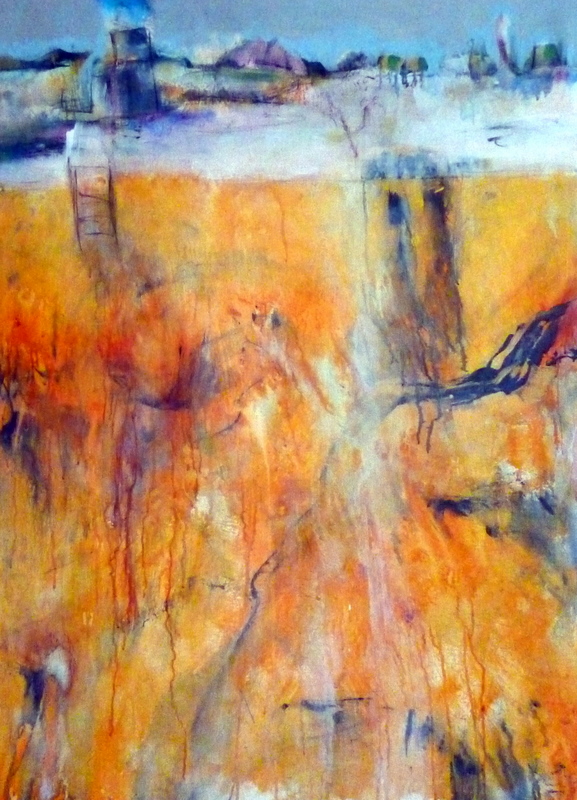
Over Underworld, acrylic on canvas, 36 x 48, Suzanne Edminster
Over Underworld is going on a vacation in Graton.
This painting is part of a meditative abstract series on the links between worlds. I’ve always found it fascinating how much of our lives are lived in fantasy, dream, reading, and contemplation. These are whole worlds that float beneath us. I wanted to paint the notion of a thin “skin” of organized thought, houses, civilization, geometry, over a beautiful chaos of creative form. Ladders link the worlds, so, that with focus, we can climb up and down from one world to another… ladders without the chutes!
Painting process: I established a horizon line for the three paintings, then started a gold and orange spatter process underneath, working on all three paintings simultaneously. I tried various stages for the top. You can see some of these in October Underworlds. I opted to paint the whole thing rather than adding on the black and white paint compostions I had considered mounting. Then I used areas of intereference paint mixed in with other paints over large areas of the painting, so that they would shift with the shifting light.
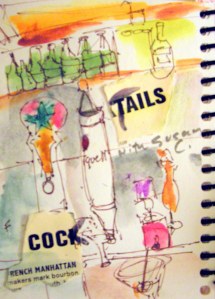
The Underwood, 5 x 7 watercolor collage sketch, Suzanne Edminster
I’ve spent little time in Graton, but the painting is currently on loan to Catherine Devriese and Isabelle Proust. That’s mighty fine company, I would say. And I did have a drink at the Underwood with Susan Cornelis last night, resulting in this immortal masterwork of a sketch. Overworld, underworld, Underwood– after my martini and some fun with Susan, watercolors, and ripping up the Underwood menu to collage, the horizons between them seemed to become , delightfully, more permeable.
Tell me, what lies Under your Overworld?
Mythic News: I’m going to Rome this Christmas, and had forgotton that in one version of the Trojan myth, the last of the remaining Trojans fled to found Rome. I don’t know how this fits in with Romulus, Remus, and the Wolf Mom, though. I’ve been feeding my soul with the classical warrior heroes, and only periodically get patriarchal indigestion.
Studio News: my new weekend workshop is called Spontaneous Construction and will be offered in the spring. More soon.
What’s collage painting, mixed media painting, or combined media painting? How does it differ from collage?
How can you use collage elements in painting without being highjacked or overwhelmed by the collage image?
Here’s a simple rule of thumb: A collage painting is more paint than collage elements. The paint is 60% or more of the painting. The collaged parts merge and meld seamlessly into the whole.
How to do it? Here are 5 tips. All paintings shown here are acrylic paint on paper or canvas. I affix collage pieces to the surface with glossy acrylic gel medium.
1. Use only your own images whenever possible, including photographs, text, and your own sketches and handwriting. You can also use copyright-free black and white images. Copy and recopy the same images in larger and smaller sizes at a copy store or using a laser printer. Black and white is easier to incorporate, and leaves the color elements to the painter and paints. I prefer to avoid colored magazine images, as tempting as they are. The more you play with a single image by altering size, color, dimension, the more freedom you will gain in painting. You’ll own the image, rather than the image “owning” you.
2. Choose a theme. I used non-copyrighted Dover deer. Avoid themes that are intensely personal, like pictures of your dog, your mom, or your child. You need to have a bit of distance to use images effectively, or to rip one up. Eventually you’ll develop image banks of differing themes that become your private visual language.
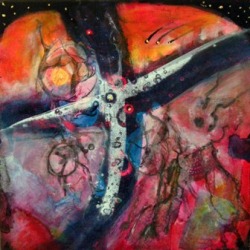
3. Paint first. Put color on the surface, or paint a very sketchy painting, then affix images, then paint some more. Painting first, before applying images, establishes that it is more a painting than a collage. For all of these I chose a crucifix composition and applied paint first. Then I put down ripped black and white collage images. A warm background is good, as it can glow up through layers of paint.
4.Be willing to sacrifice the image. Let go of the image you love and let it disappear, if the painting demands it. Show only a part of it. If you want to keep it perfect, do regular collage, not collage painting. This is one of the hardest parts of using collage elements in paintings.
5. Cover your images with glossy gel medium or UVLS varnish as you apply them. Then you can pile on coats of paint and still wipe back to find them.
Toss the collage boxes and go back to only a few images. Use them thoughtfully in series of paintings. And have fun!
Please use the comment section for questions on the collages or techniques. I’m happy to share what I know. If you’re one of my student who gets the blog, please share something about your experience with collage painting.
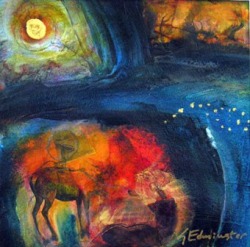
Mythic news: Deer are symbols of sacrifice and purity, often used in Christian iconography. It was said that deer gathered at the foot of the cross where Jesus hung. I used them here in these three works floating up and down through a penetrable horizon of birth and death, ancestor souls. Collage itself belongs to the realm of Kali: dismembering of paper , appropriation of image, rebirth of pieces into a new whole. The goddess of Necessity wields the scissors and snips the thread of life– or the image.
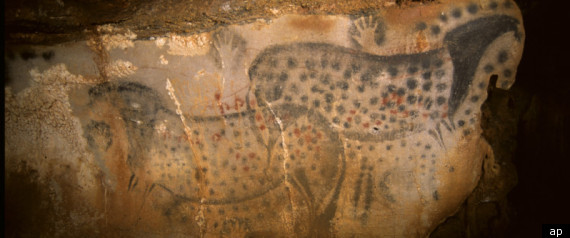
Spotted horses probably existed way back then, says a new genetic report. This means that the cave painters weren’t just having a great time making a cool, fun, repetitive dot pattern on their creations, but were somehow representing AN ACTUAL HORSE. DNA now proves that the cave painters were “good.” Good means realistic in painting. We wouldn’t want cave painters painting their dreams, now would we?
I salute the writer, Alicia Chang, for pursuing this connection. And the article in the NY times is more fleshed out… or more boned out, because that’s where they got the DNA. But these articles proceed from a number of assumptions that make me a bit crazy. Here’s a list. Ancient artists couldn’t paint realistically. Ancient artists make “primitive” art. Ancient artists just sorta prayed to animals or grooved on them but didn’t observe them. Ancient artists didn’t really know about paint application, media, and drawing. Ancient artists weren’t da Vinci, or even Dali (who is actually a super-realist using the images in a surreal way).
In fact, recent research strongly implies that ancient people observed the animals so closely that they recorded the small changes in appearance and behavior in different seasons and during mating times. They applied paint with brushes, air, organic materials like moss or hide, and fingers. They always used as many colors as they could, including greens and purples. They used lamps and scaffolding to paint in high places. And as Werner Herzog’s new film Cave of Forgotton Dreams shows, they clearly used the three-dimensional stone as part of their media, as well as animation techniques and a convention called “twisted perspective.” Which I love, because it’s twisted.
But the thinking remains either/or. Was it realism or surrealism? Science or art? Why not both?
And now I have an excuse to put in my favorite little spotted horse, the Dawn Horse from my dad’s 1963 high school science textbook. I also found newly released Lascaux cave photos from the 1940’s in this amazing Life photo essay. I adore Lascaux with all my stone-and-iron-oxide heart.
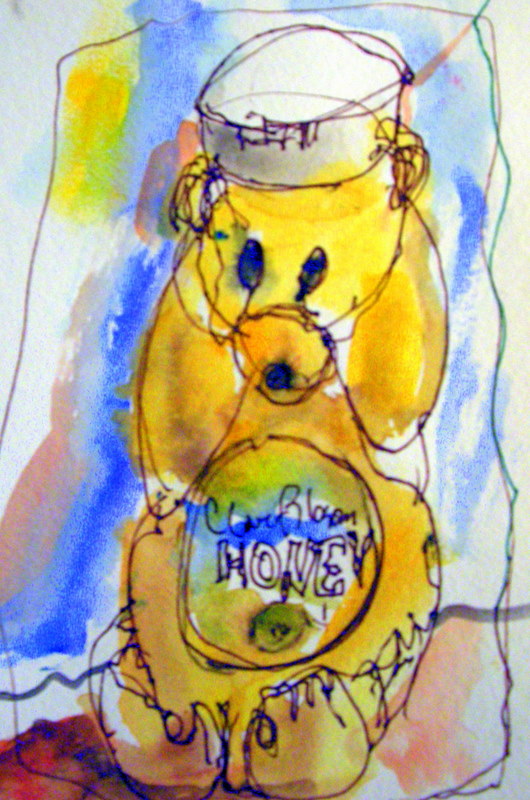
I did a little Honey Bear sketch of to honor Hezog’s cave bears, whose skulls decorate the floors of Chauvet . My father, Bob Edminster, who passed away this year, loved honey and told a mean Eeeeeeyow Bear bedtime story. This picture is for you, Werner Herzog and Bob Edminster.
Mythic News: Hey, it’s 11-11-11! I give you here a link to my favorite visionary, Caroline Casey, who talks about eleven, and de-apocolizes the day. Eleven is a threshold number: go ahead and step over.
Studio news: the divine Laura Hoffman, along with her ladies, women, folk-art motifs, resins, and power tools– yeah, baby– will be our guest artist on the blog next week. Don’t forget the A Street Studio’s innocent-yet-decadent Winterblast! Tomorrow!
Salamander Winter, acrylic combined media on Fabriano paper, 23″ x 23″, Suzanne Edminster
Last night I closed my open studio after an impromptu party with three muses , one rather hairy, in which the absinthe bottle of La Muse Verte was emptied. Scott, Ed, and I ended up at the Ira Glass show at the Santa Rosa Wells Fargo Center. Ira Glass, a semiotics major made good as creator and host of NPR’s This American Life, spent a long time giving out his trade secrets of storytelling, or story cultivating, or story minding, or whatever it is he does so well.
I felt like I was watching– or rather, hearing, as the show celebrated the audial life of the radio– an alchemist giving out his “secret” recipes for turning lead into gold. Open secrets: everyone can hear them, but only a few can use them. Storytelling, he said, is a semiotic pattern. One thing happens, then another thing happens, then another thing– an Ariadne’s thread out of the labyrinth– and it doesn’t matter a bit what the story is or who’s telling it. At the end there’s a bump, a pause, and a moral. The elements of the story are the abstract bones. If the substructure is strong, any story propels us into the other world. Anyone and anything might work in these stories. And you can tell thousands of them, like Scheherazade. Or Ira Glass.
This reminded me of abstract painting. We move away from the subject, and into bones of pure visual action. The structure of the painting carries us along even without subject matter or explanation. First one painting element happens, then another, then another…. it’s fashionable to avoid the word “narrative” with abstract or non-objective painting. But there’s a story embedded in every piece, if we know how to read it. The composition rocks and rockets us toward meaning.
Glass paced the stage, IPAD in hand glowing like magic tablet of a new Moses, as he expounded on the world’s oldest art form, storytelling. In the story of the painting Salamander Winter, you may find Scott building salamander “houses” in our back yard. We lay down boards on the damp winter ground on purpose to be salamander homes. You can find two kinds of California salamanders in our yard, little wormlike Slender Salamanders and classically newty Arboreals. We encourage them to raise their tiny, slimy, cute babies there, and we lift the check their progress. We identified them through this wonderful site, Identifying California Salamanders.
I'm Branka's painting now
My Ariadne’s thread is tangling here, so I have to quit. The Open Studios went well. Paintings bumped their way to new homes: I’ve posted one here. My thanks to all who visited and to my collectors. The semiotic form of the blog requires that I ask you a question or two, to encourage socializing. So I have some: did you like my studio? huh? huh? and, hey, did I invent the worst blog title ever, or not? And the moral: Know Thy Salamanders. Do you?
Mythic News: Theseus dumped Ariadne after she saved his sorry self from the Minotaur, but a god (Dionysius) ended up marrying her, so it all worked out. She traded up. The Alchemical Salamanders in my painting go through fire unscathed, faith enduring after earthly passions smolder.
Studio news: the Open Studios were successful. The Barracks Artists, in the old Finley Barracks in Santa Rosa, are emerging from the mist. Guerilla artists in the mist. Come visit me by appointment.
Opening a studio is like cleaning a window into the inner life of the artist. Down the rabbit hole we go!
Saltworkstudio Nov. 2011
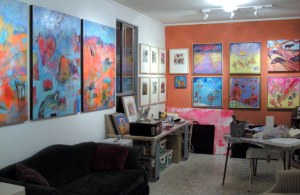
It’s more intimate than having people into your home, because you give your hospitality to everyone. They can luxuriate in your colors, drink in images, and dine on your line. The public sees the traces of your best effort and your worst nightmares, the deep and superficial. The artist tries to be fully with each question, from sublime to inane, without falling into the pit of sales obsession. It’s quite the wine-and-cheese marathon. Unless your heart is open, it can be nerve-wracking . But when someone really sees your art– and really loves it– there is no greater high.
A few times people have burst into tears in front of one of my paintings. James Elkin explores the phenomena in his Pictures and Tears: People who have cried in front of paintings. The book is a strange and fascinating exploration reactions to art when the eyes in our hearts have opened. Museums used to have nursing stations where patrons overcome by art could recover… I think the Louvre still does. Have you laughed or cried over a piece of art?
Turquoise Window World is a sort of threshold or sill where the everyday table starts to tip over into the extraordinary, like the tables that the spirits move. Strange fruit converse. Flowers march and sprout angels, and a grove of spirits wavers in the background. The painting expands domestic motifs as an un- still life , animated. The turquoise paint, that bright opaque, came from my time living in India, where houses are unabashedly brilliant blue as a Kodachrome sea.
Saltworkstudio and my friends the Barracks Artists are open November 5-6 at 3840 Finley Ave, Santa Rosa, California. Drop by to visit 24 artists in one location. I’ll be painting.
In a Mythic News today, I introduce Jeremy Joan Hewes, Caren Catterall , Mardi Storm, Paula and Cliff Strother, Kathryn Kelsey, Maris Peach, Claudia Rhymes, Monica Lee-Boutz, and Chuni Anello. We will be having a party on Saturday between 4 and 6. All our studios will be open. Join us!
Jeremy Joan Hewes
Jeremy Joan Hewes is a dynamic, subtle printmaker, photographer and my friend. In her words: Sometimes you walk into a room and a discover an alluring mystery. That’s how I think of this image of subtle colors, dynamic pattern, and silhouettes, which I made at a recent workshop in Coupeville, Washington. I kept returning to that room as the day wore on and the light changed, each time taking more photographs. Color and light, with a little bit of “what is this?” thrown in. Come see this photograph and some new mixed media pieces in studio 250 at the Barracks Artists open studio on November 5 and 6 – this weekend!
Caren Catterall, master printmaker, is a guiding star at the studio. She produces a wonderful moon calendar for gardening , as well as her mythic prints. Visit the beautiful print studio for goddesses, coyotes, ravens and giants. For a treat, relax with a cup of tea and her delightful video, The People with Spirits Strong as Stone.
Don’t be fooled by Claudia Rhymes’pixie glasses or shy demeanor. Her new series of urban landscape grids over bright backgrounds rocks, and she’s a gifted, secret graffiti artist. She also has one of the new, larger downstairs studios. Claudia is our hidden wonderchild in this Open Studio.
Paula and Cliff Strothershare the studio with the most beautiful outlook on the hills. Paula paints in acrylics and Cliff in oils. Visit this newly established studio to enjoy lush landscapes in a room with a view.
Kathryn Kelsey’sfascinating mixed media work changes every year. Dedicated to wild animals, the environment, and indigenous peoples, her textures and materials are a delight. I love her mixed media with dried radishes. She is the Editor of the Barracks Bulletin and writes a blog. Her downstairs studio is filled with the calm green light of nature, one of my favorite places to sit and relax.
Maris Peachis our very own Joseph Cornell. I own a piece she made, the Alchemist’s Arcade. In her words: I tell stories using the flotsam and jetsam of life’s leftovers. Sometimes I begin with an object, sometimes I build from a concept, sometimes I fiddle and nuture a dream memory until it becomes an elaborate narrative. Othertimes the story is sparsly simple or even hidden, revealing itself through the beholder’s eye. Don’t miss her intricate, fascinating workshop and studio.
Monica Lee-Boutzis an energizing force of nature! She paints in watercolor, is an accomplished collage artist, and has had several recent exhibitions. Visit her studio upstairs across from Paula and Cliff.
Chuni is from Madrid, has a new studio downstairs, and absolutely unique mixed pieces using fabric, fiber, and wool.



 Mythic News: Hey, it’s 11-11-11! I give you here a link to my favorite visionary,



 Saltworkstudio | Suzanne Edminster