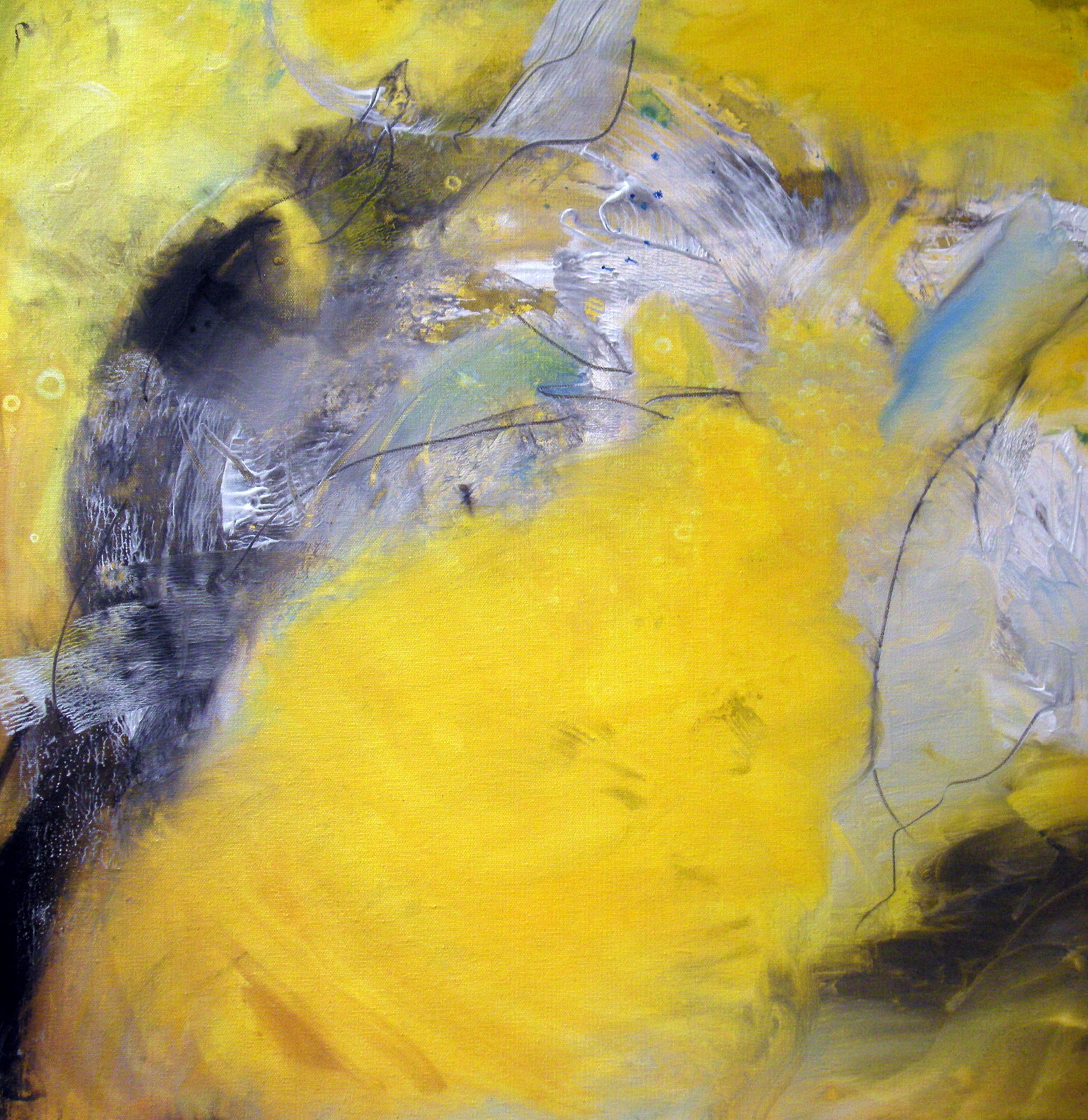
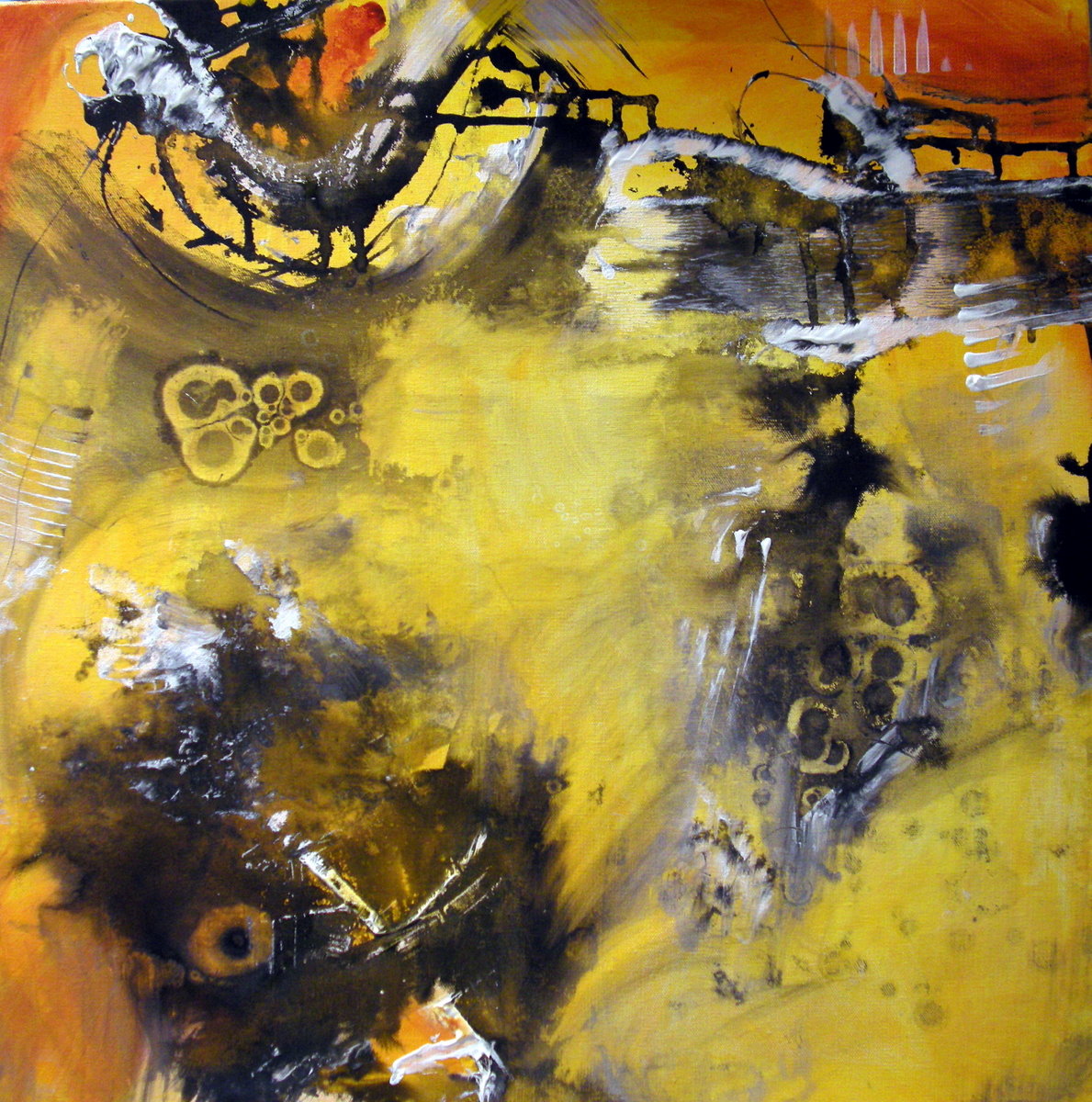
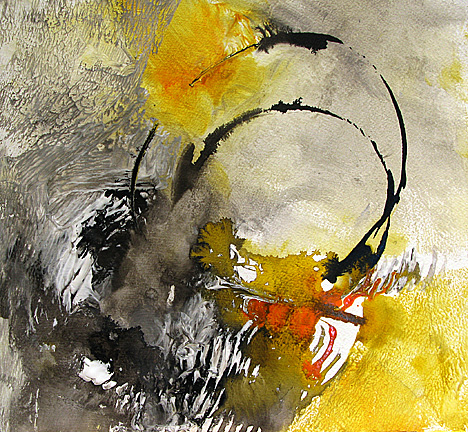
Four Hands Collaboration: The Paintings Here No Longer Exist

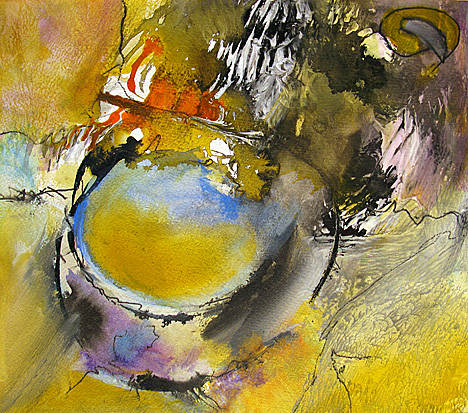
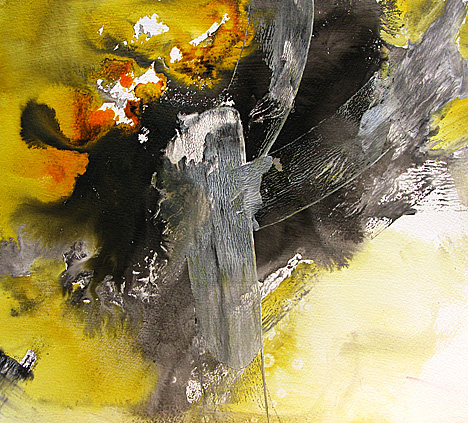
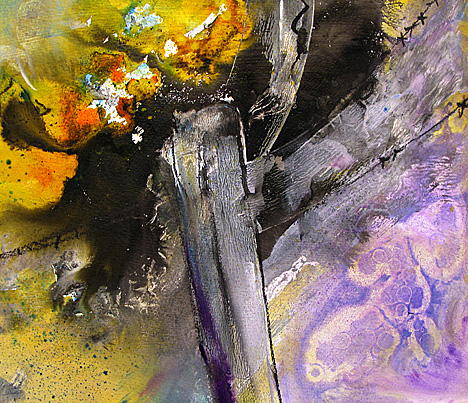
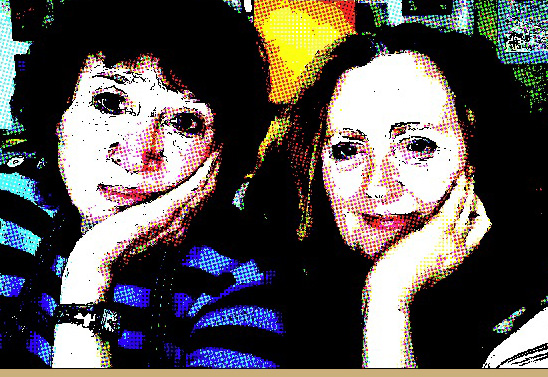
These paintings no longer exist. In our Four Hands project, Susan Cornelis and I live in a world of vanishing images. This is true of all painters, of course, but I have the feeling that the collaboration magnifies the process. The painting can change radically at any time. We can now note and record the changes as their own event; this is also part of our collaborative process.

Carpe diem! Seize the day, the moment, the painting as it exists exactly now.

The Opening Reception for the Four Hands Painting Collaboration will be held on Saturday, March 10, 2012 at the Phantom IV Gallery in Windsor, California.   Join us to see the latest versions of these shape-shifters.


Picasso, Braque, Susan, Suzanne, and the “Squirrel”

Painting Start by SE / Cornelis Edminster Collaboration

Our painting collaboration (Susan Cornelis and Suzanne Edminster)  is finding squirrels,  squawking bird things, skulls, and stubborn winged beings  in  our  paint .  Are they vermin or rare species?  Should they  be conserved or eliminated?  Here’s a wild start on a 24″ x 24″ canvas.  These starts are ephemeral: this one no longer exists, but has already changed.   Check the left corner.

Karina Nishi Marcus told me about Braque, Picasso, and the  Squirrel.  Picasso found a squirrel form in the middle of one of Braque’s paintings, and Braque struggled for 8 days trying to get rid of it.  I’ve included the story in a link below. It’s interesting that Picasso told Braque to kill it, get rid of it.  Braque’s squirrel was living in a painting of tobacco, pipes, cafe glasses.  Picasso said the squirrel didn’t belong there. On the other hand, Picasso, with his autocratic personality, might not have  ever allowed something to appear in his painting that he didn’t plan, sanction, or control.  

Our wild things emerge from splashes, spatters, and a short discussion of media and possible compositional forms.  Keep them and develop them?  Paint them out?  What about this fellow?

Detail, Upper Left Corner, "The Bird"

He absolutely hijacks the whole composition.  Paint him out in favor of more balance and harmony?  Here’s a detail of what we did to the painting.  The “squirrel”– the bird in the corner– is still there.

Detail, stages 2 and 3, of painting start Cornelis Edminster Collaboration

A lot of you are painters out there.  What do you think?  Thumbs up or thumbs down to the Bird Thing?

Mythic notes:  Read the full story of the Picasso, Braque and the squirrel .   These painting apparitions belong to either the world of projection and psychology, or the world of the dream.  Painting is dreaming out loud, lucid dreaming.  Change the dream?  Is it nonsense or an omen?  Do we let it pass like a cloud, and onto the next dream, or painting?  See more of our painting day from Susan Cornelis’ point of view.

Studio news:  Karina Nishi Marcus is having an opening at the Wine Emporium in Sebastopol this Friday.  Come and enjoy her masterful work. 

Artist’s reception for
Karina Nishi Marcus
Friday, February 10, 2012 from 5-8 pm at “The Wine Emporium.”125 N. Main St. · Sebastopol CA 95472
Phone: 707-823-5200 
 
http://www.the-wine-emporium.com/calendar/event?eventid=11995

Plan to meet the artist and enjoy excellent food, wine and music!The Wine Emporium is located at 125 North Main Street, in Sebastopol, a few doors North of Hwy. 12. Karina Nishi Marcus’ paintings can be seen on the sets of major motion pictures and TV shows including, Mad Men, NCIS, Parenthood, CSI: NY, Monk and House.

A Quick Peek at a Painting Collaboration Process

Ever had one of those brilliant midnight ideas and let it drift away?  Well, painter Susan Cornelis  had one and made it a reality, that rare bird,  a painting collaboration. Encouraged by B.L.T., the collaborative project of Lisa Beerntsen, Tony Spiers, and Bob Stang, Susan asked me to be her partner in an a collaborative painting series with abstracted themes.

We began on Saturday in Susan’s studio.  Making it up as we went along, we decided to start with smaller paper pieces to get a feel for a larger series on canvas.  Here’s a start by Susan Cornelis:

Susan Cornelis Gold Start 6

As you can see, the starts were so beautiful it felt very risky presuming to “finish” them!  I “finished” the start you see above  with this version below.

Suzanne Edminster Gold Finish 6

 Here’s  another one of Susan’s brilliant starts:

Susan Cornelis Gold Start 4

 And my finish below:

Suzanne Edminster Gold Finish 4

A secret: this kind of painting is addicting, riveting, and fun.  To see more of the project, including a few of my starts and Susan’s finishes, visit Susan’s blog, Conversations with the Muse.   Cooperators are standing by, so more to come.

Happy Couples and Girls with Horns: Archaic Art Friends from Rome and Naples

This is my image of true love: looking into the light of eternity, together.

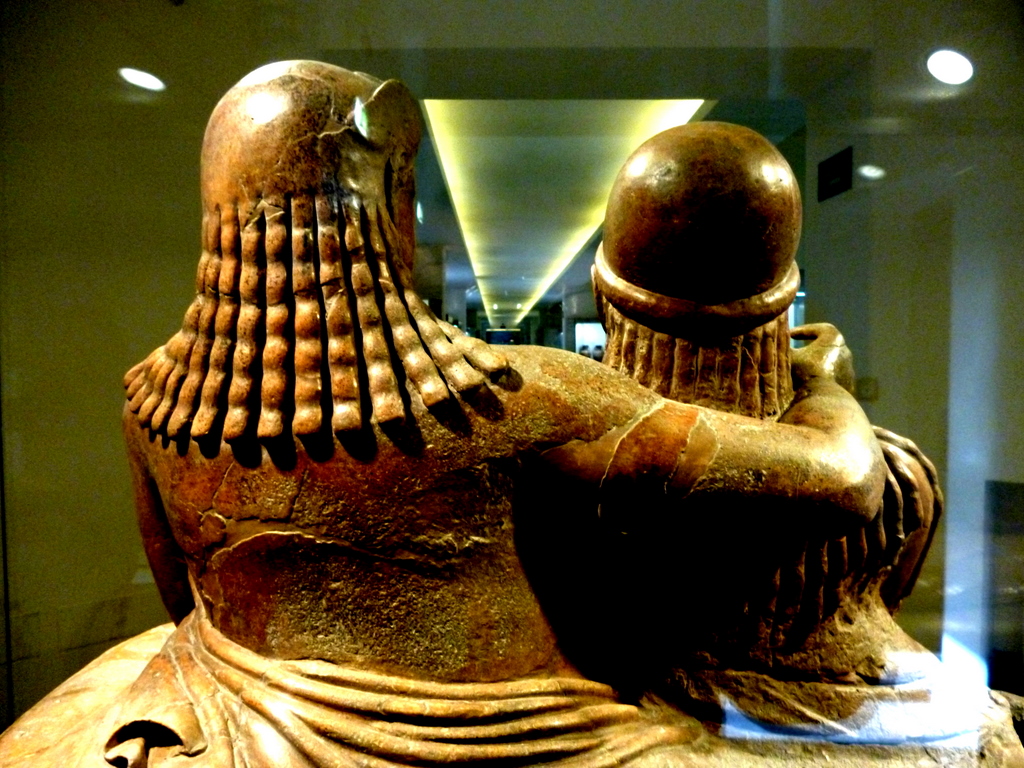
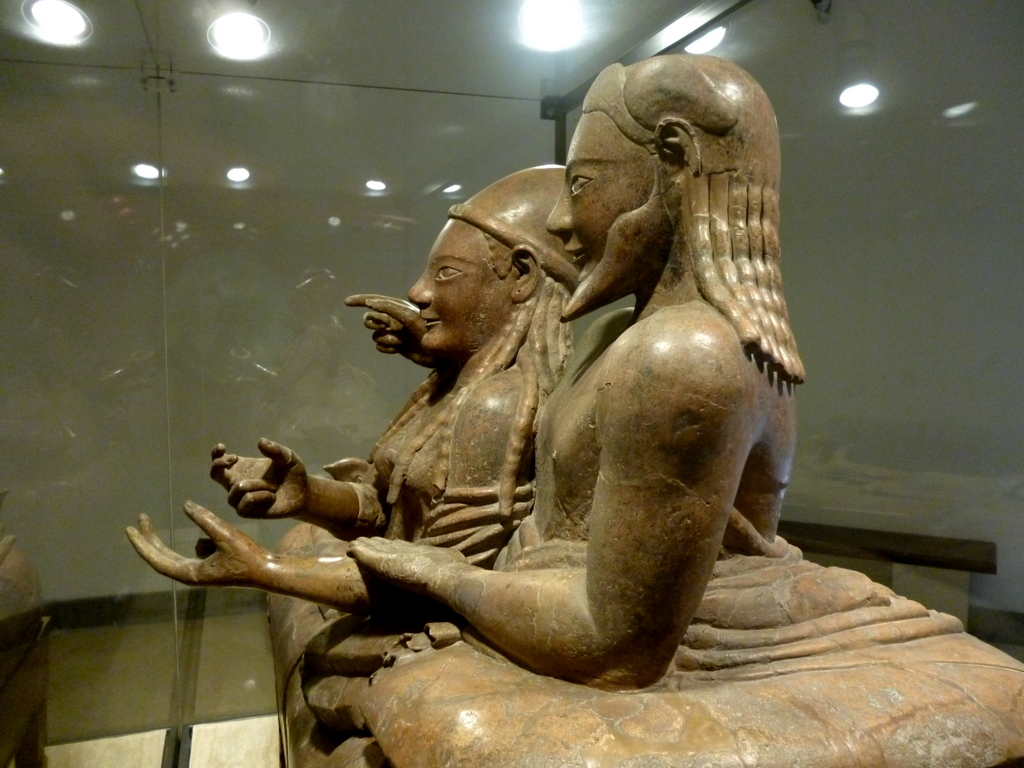
The Etruscan “Happy Couple in the Villa Giula museum  in Rome used to be painted and draped with fabric.  They had wine glasses and perfume bottles in hand and were reclining and eating at the same time– wonderful.  She had her earrings and jewelry on originally too.  This is the most famous of the tomb sculptures and is still incredibly moving for its feeling of affection and love. Not to mention the great “dos”, his and hers.
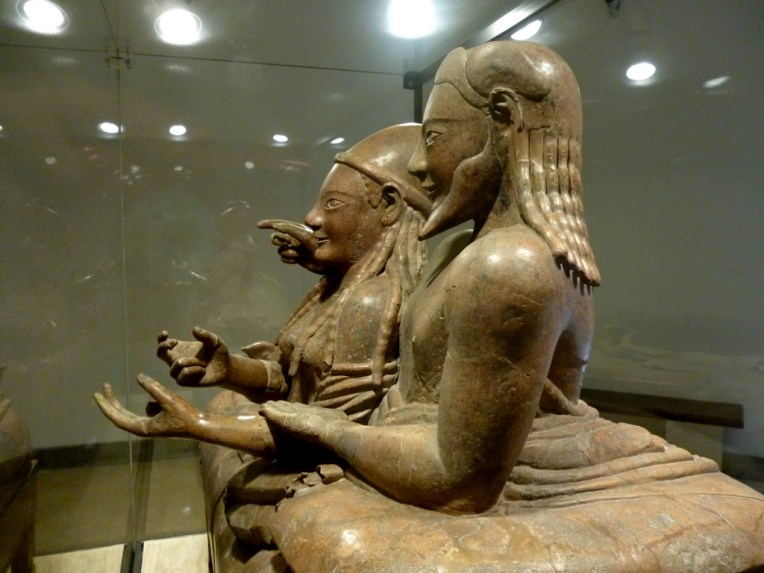
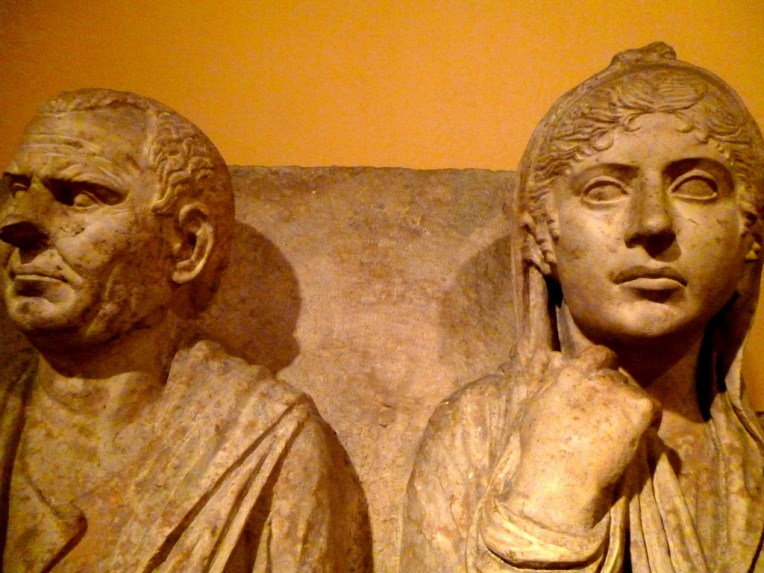
Then, the Romans invaded, and everyone started thinking about money, real estate, commerce.  Look at the new portrait of the married couple, Roman-style! Brood, worry, and scheme… not much trust there. And no more damn reclining in married portraits.
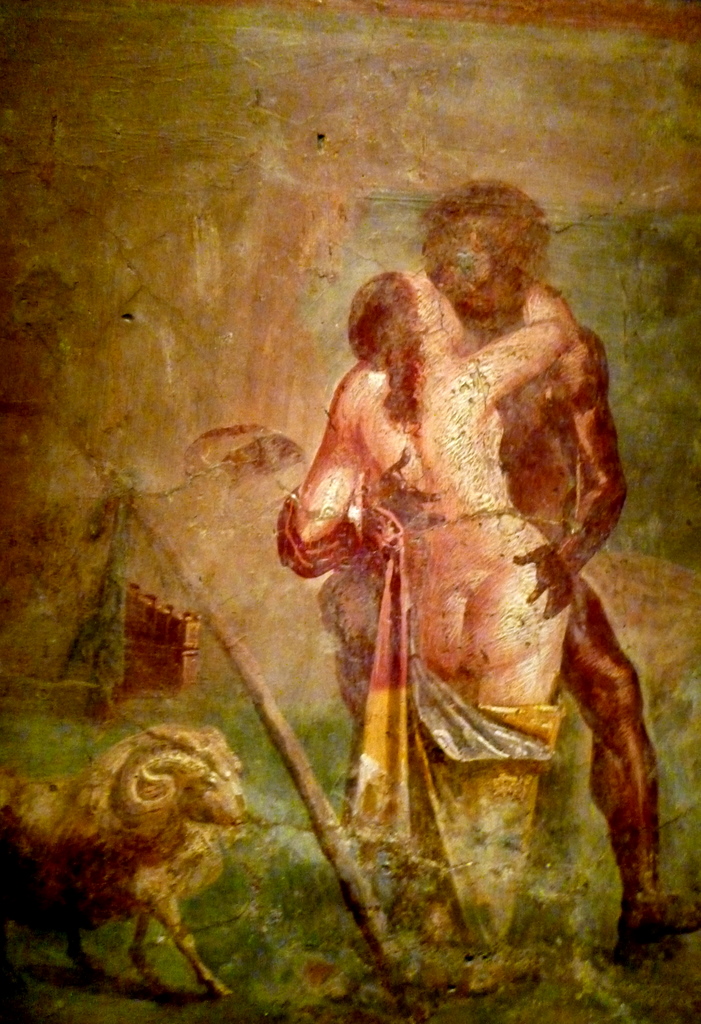
When not buying something or conquering someone,  in their spare time the Romans loved their soft and ahem, harder , images of sex.  This is a sweet one from the Secret Cabinet of Pompeii, a collection of erotic/ironic art  in the Naples Archeological Museum.  We did get in, though the guidebooks report this is often dicey.  It was deserted.  I think there’s a basic misunderstanding about what was erotic and what was common during the height of the Roman Empire.  Phallic-shaped signposts, lucky charms, and house decoration: common and boring.  Wall-painting series of  “menus” showing different sexual activities you could choose in the brothels, especially if you’re illiterate: interesting, erotic, naughty, not boring.  She’s light and he’s dark, showing the power of the guy, or something; this painting convention continued through the Renaissance and later in erotic scenarios. It’s Pan and his goat, but she seems happy.
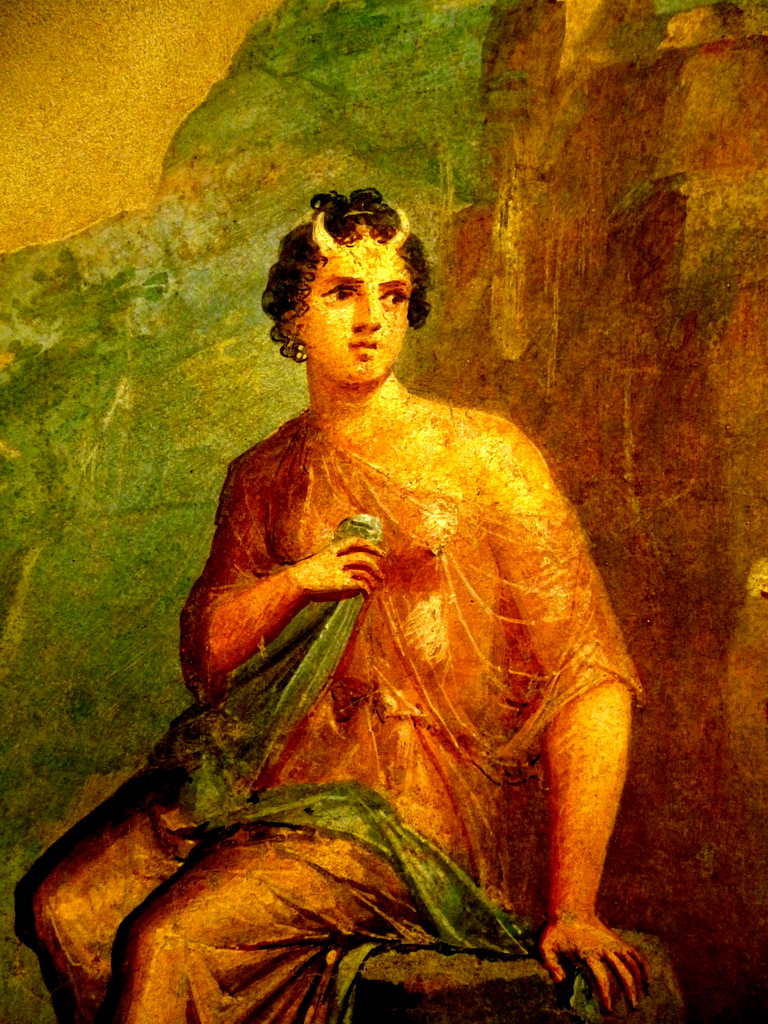
Girls with Horns!  What can I say?  You can check my Mythic notes at the bottom for more ideas.  Here’s an Egyptian version of girls with horns.  They seem to have water buffalo horns, an image seen still in Naples because of their wonderful water-buffalo mozzarella cheese.  You buy it from the deli, little balls swimming in a salty sea, and carry it home in a tied plastic bag like goldfish from the fair.  Mozarrella alone is a “secondi piatti”– main dish– in Naples.   It’s grilled a bit, served with bread, and that’s it.

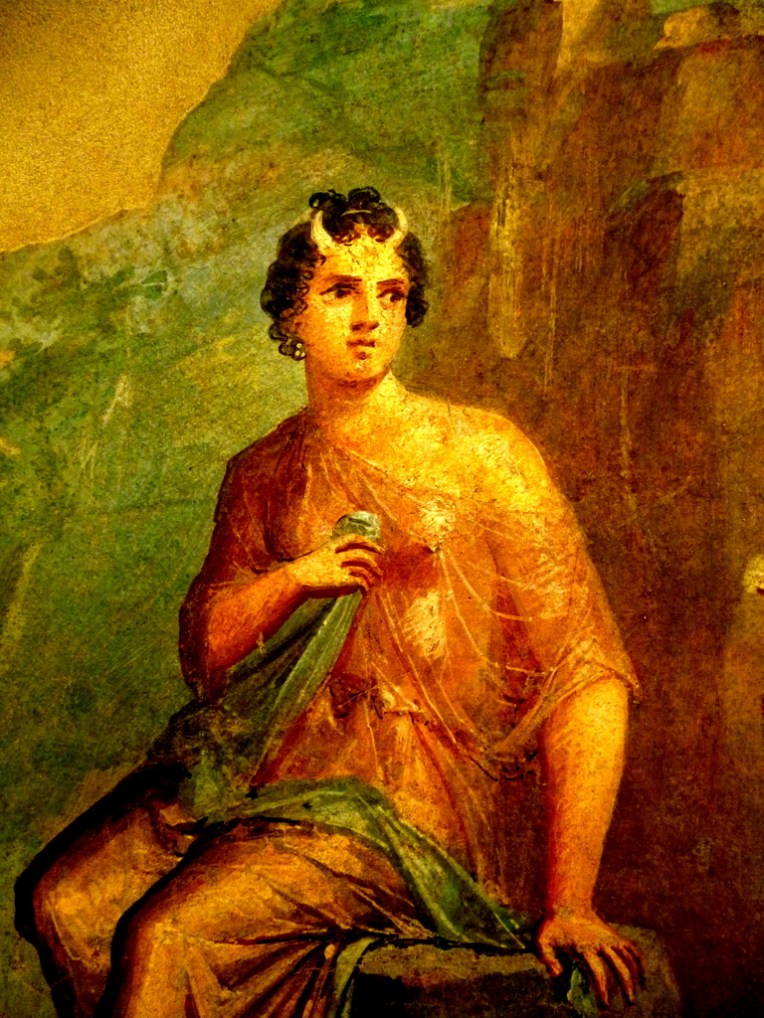
And now some Pompeiian paintings of girls with horns.  The “encaustic” they used included wax, but the paint actually used soap (lye-based) as the “caustic” medium binding the pigment  to bond with the walls.  These are not frescoes– the plaster was dry.  These are wet, slippery paint layers.  They then used the hot wax to seal the walls as a varnish on top, which they could buff to a high shine.  The first girl definitely has horns; the second may be more of a crescent moon, perhaps Diana.
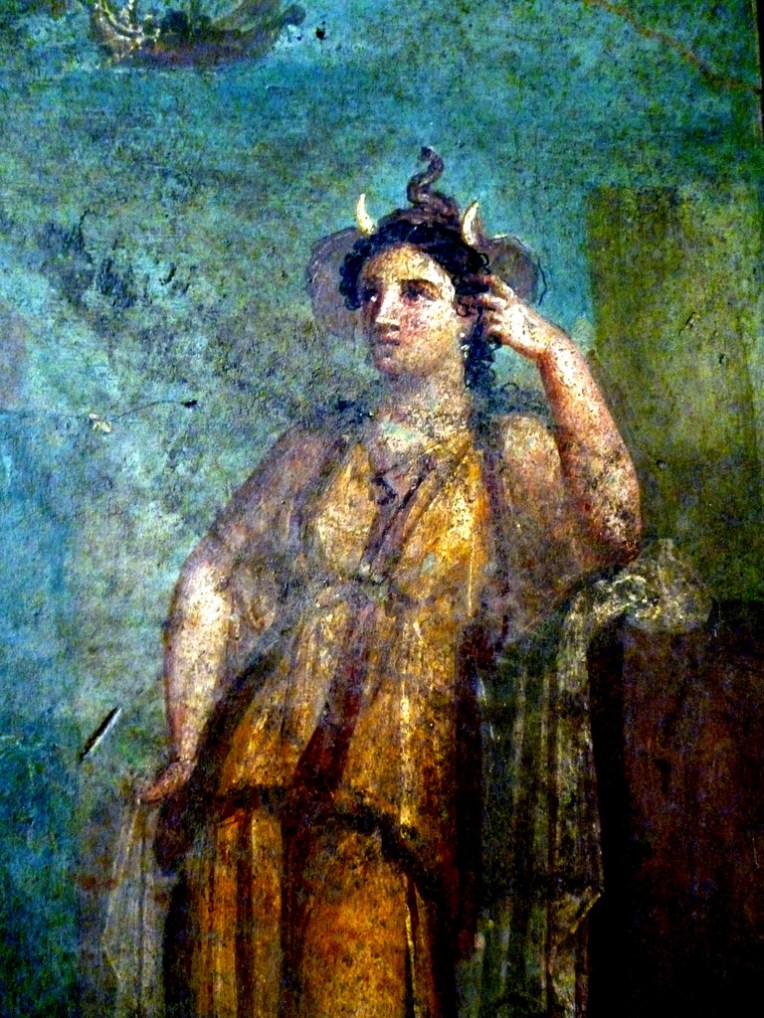
Horns or crescent moon?  What say you?

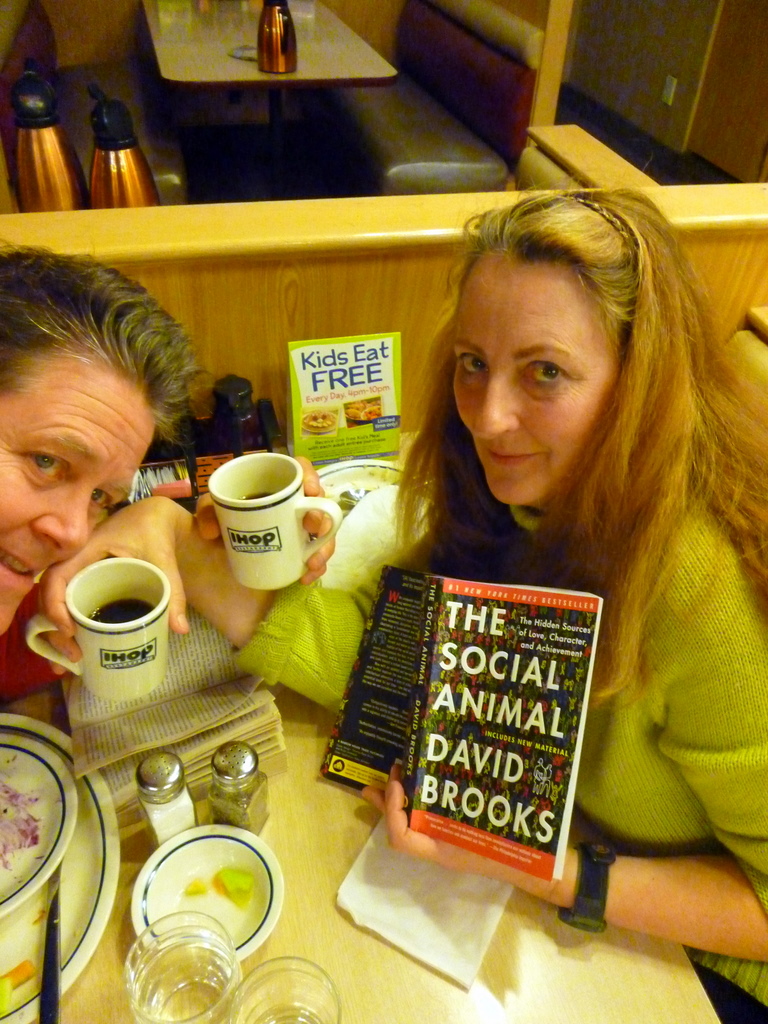
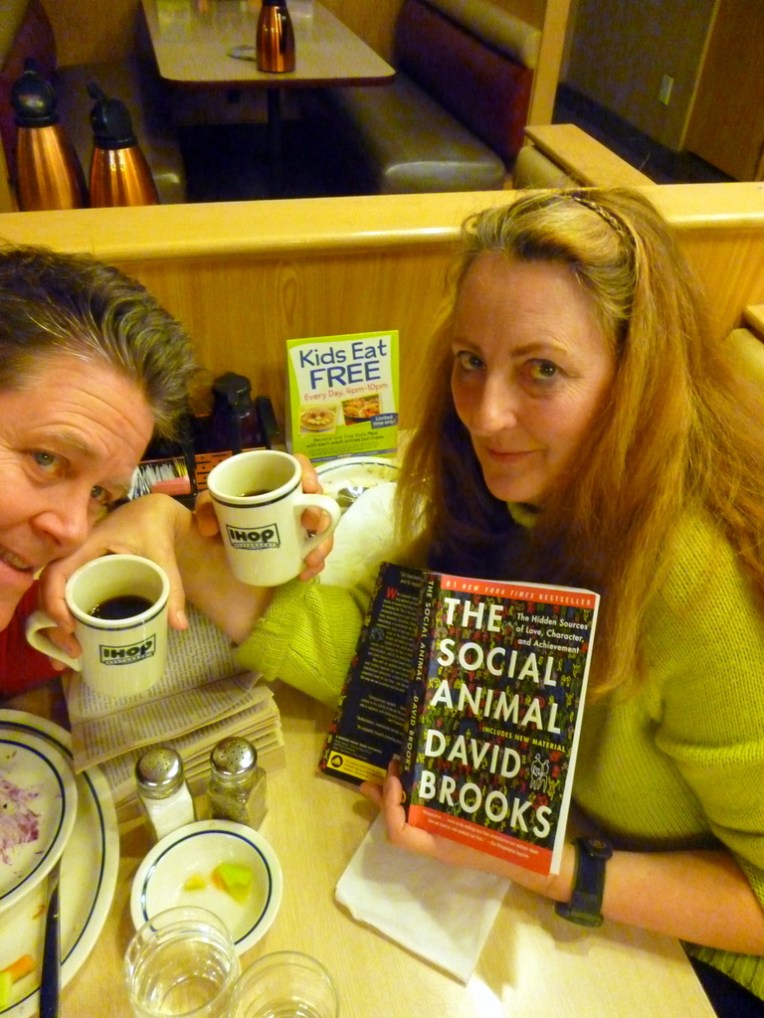
For the last happy couple, Scott and I, the morning after our arrival back, at the IHOP at 6AM.  We are not reclining and eating, like the Etruscan couple, but you see a soft upholstered booth, coffee, empty plates and cups, books, and happiness.  Good enough.
Mythic notes: I saw a lot of images of  Europa on the Zeus-Bull.  She was taken to swim on Zeus-Bull’s back through the Straits of Bosphorus– Bosphorus means ox-crossing– dividing Europe from Asia/Turkey–in other words, the Straits of Istanbul.  Europa and Io merge women with bull or cow, and then put them in water– a river or sea.  They might be a holdover from a more ancient cow -goddess, or metaphors for mass migrations and settlement of cattle people, but I just thought that the girls with horns were cool.  The Romans idealized the Nile as a source of fertility;  Roman matrons would buy vials of Nile water at the local Isis-temple  and douse themselves with it to increase conception.

Book notes:  The Social Animal by David Brooks was a great buy.  It’s trending sociological research, carried by his  made-up, somewhat borg-like characters named  Harold and Erica.  The characters provide a framework for reporting findings from everywhere.  Intriguing.  Many are saying that the creative/artistic mind is the big money earner in our new world. Well, let’s hope.  He lets Erica do art after she retires, and there are a few pages on the latest social research on music, painting, and other arts.   Recommended for a rousing non-fiction read and a juicy idea source.

Studio Notes:   I’ve done large paintings of both Europa and Io as abstractions.

My Marble Buddies: Hanging with Sculpture in Rome and Naples

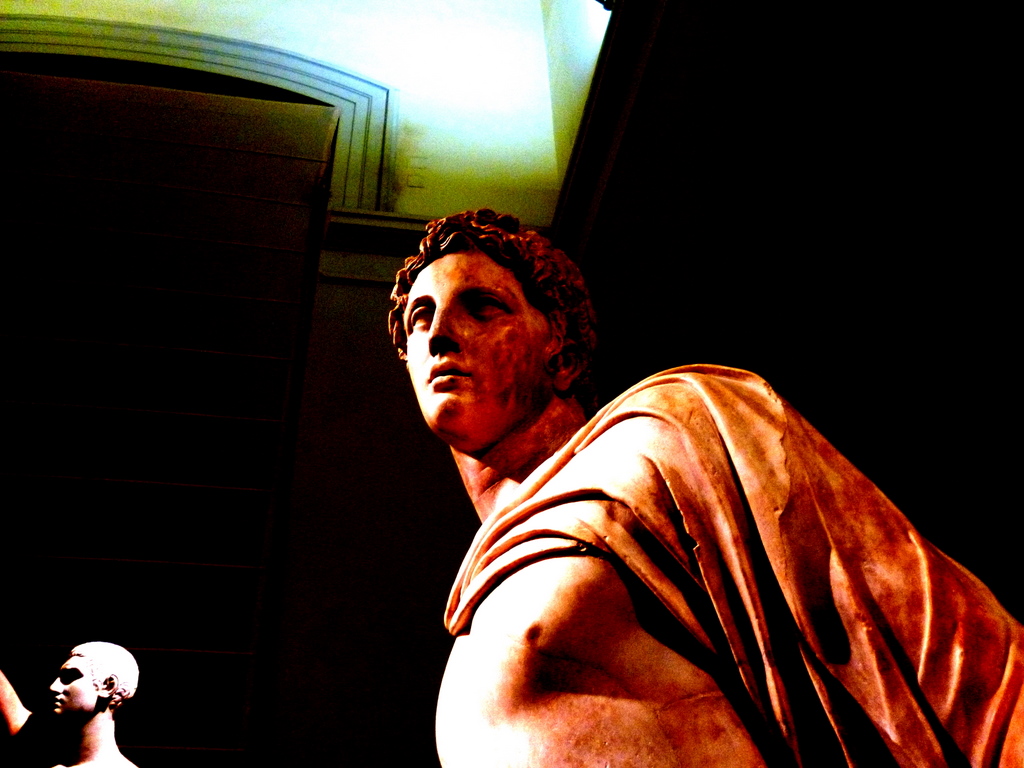
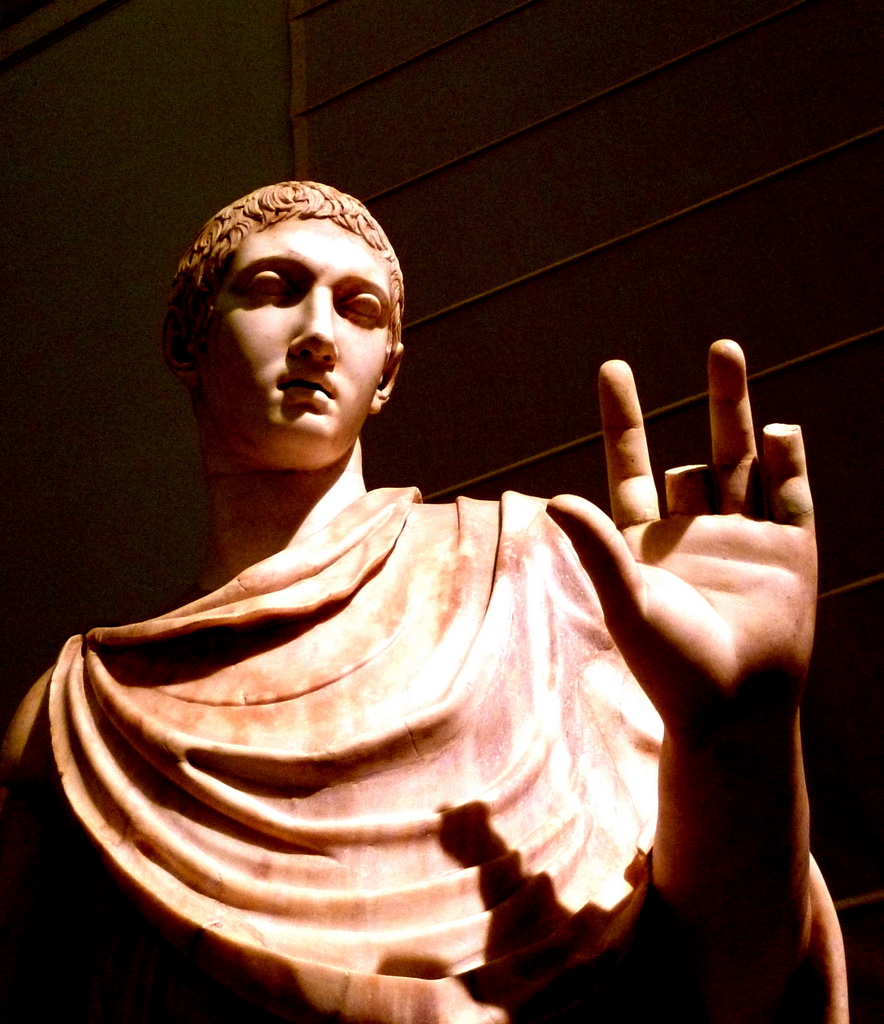
Three weeks in Italy! I felt like I was dipping my toe into a river of souls.  It was a time of borderlines and thresholds: old year to new,  marble to flesh, ancient streets filled with modern people, and classical beauty in the faces of people arguing, eating, buying stuff, driving Smartcars. The ancients seemed to live,  and the Christmas crowds of elegant Italians seemed temporary flickers haunting the alleys.  Meet some of my marble buds. 
The Capitoline Walls… this guy is great.  Is he a David figure?  To us he looked like he had 400 years of saying “Hey, Sailor” to his credit.   Cocky.  Just sayin’…


An achingly blue winter day, and I couldn’t tear myself away from the brilliant negative shapes against the stone. Youth and horse… stunning  contained force, and a tremendous face.  I like the entire Capitoline hill, and this museum piazza was designed by The Big Mike, Michaelangelo.

Capitoline Hill, sunset from the museum cafe terrace.  Murmurations of starlings, kinetic.  The whole Hill was formerly a nest of  state oracles and seers.  They liked the elevation so they could interpret flights of birds.  Nowadays the seagulls have invaded.   Oddly, they fly at night in the city, shrieks and white forms soaring in the darkness, a bit ghoulish.

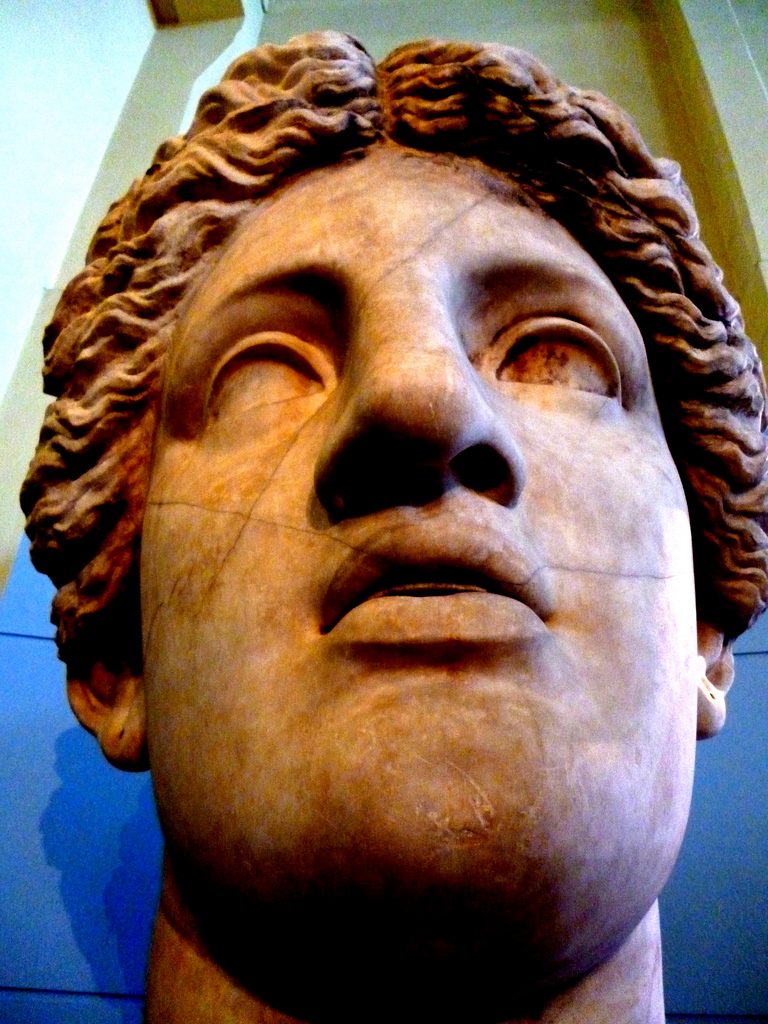
 Classical sculptures are virtually all knockoffs—copied from ancient Greek sources, now lost— or propaganda for the ruler du jour.  Some mighty bodies were made with removable heads so the next Caesar could just screw his own on.  The head of Constantine below is 5 feet high, so the whole sculpture, with pedestal and base, might have been 50 to 70 feet or more.   Statues of this mass can so easily verge on  Facist architechture.  But they impress.  Think of Lady Liberty!

What has that flawed eye perceived in its time? Think, too, of paint and decoration, fabrics and jewels originally draped around the sculpture.  The marble we see now is more a bone structure.  Ripped from their original colored and decorated context, they become evocative collage pieces.  But some still shine. I felt that it wouldn’t take long to develop a real relationship with them.  The more we like them, the more they come alive, like any so-called “object”, I suppose.  I’ll miss hanging with them.

Next: Happy Couples and Horned Gals: More Archaic Art Friends from Rome and Naples

Saltworkstudio Large Painting Class: 5 Clues, and Cool Painting Titles

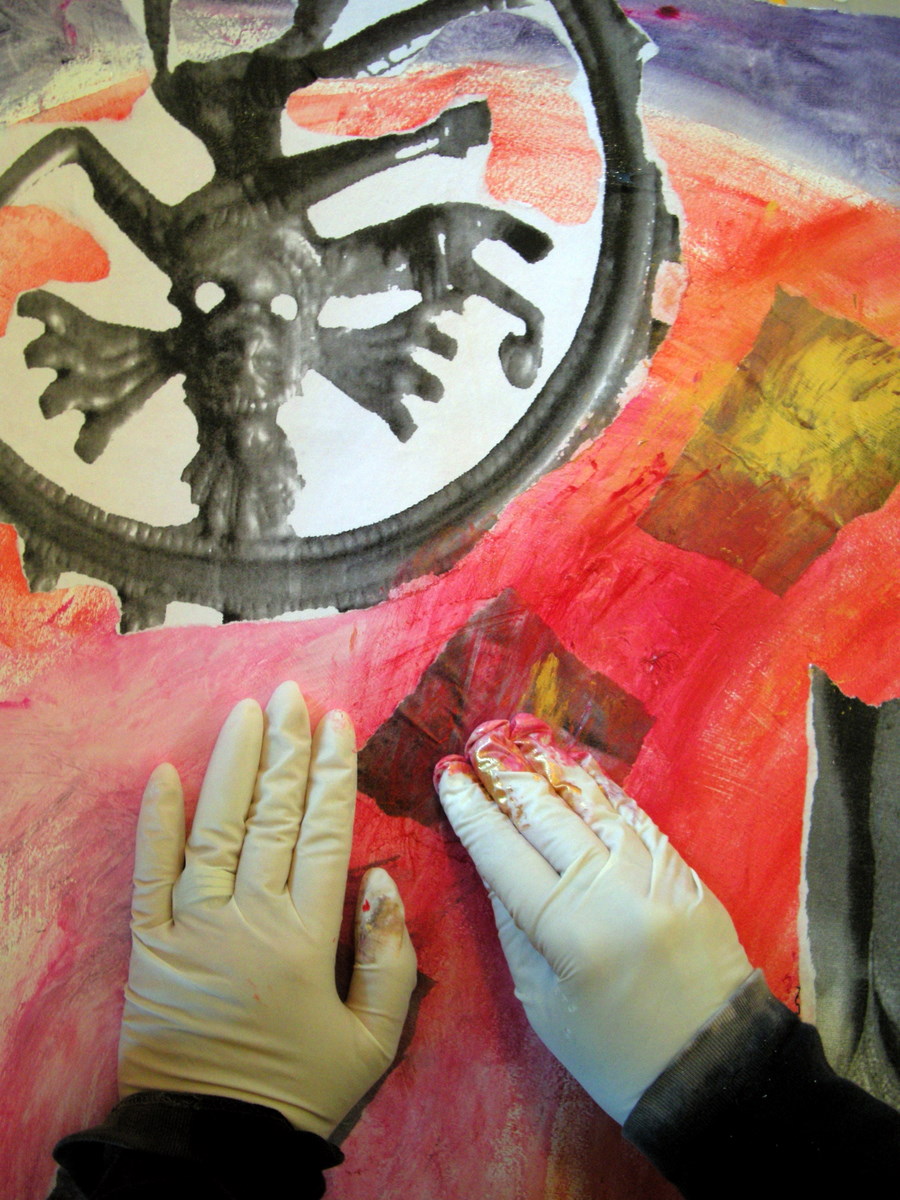
Cythia Heimowitz' s hands on her painting

What’s a large painting for you? 12  by 12 inches?  6 feet by 6 feet?  A mural? Anything on canvas? 

 What’s a large series?  Two paintings? A hundred?
 
In Sunday’s Saltworkstudio Paint Large class, our goal was to clarify our intentions for a series and begin to paint on larger surfaces.   For the purposes making headway in a four-hour class, I suggest students bring half to full sheets of watercolor paper, or three identical canvases up to 30 inches on a side.
 
I won’t share the entire process of the class, but it did result in the stunning headway on painting series you can see in the slideshow below.  All paintings shown were done in class on Sunday, and they are very fine starts. Some students came in with well-developed ideas, and some came in “blank.”
 
 I had to figure out how to model and convey my own process when working on a large series of big surfaces.    We used some of the  ideas below as guidelines.
 
  1. A large painting is not a small painting “blown up.”  Start fresh.  “Toto, I’ve a feeling we’re not in Kansas any more.”  You are in a new, large, foriegn country.  Explore it.
  2. Composition is critical.  Plan a minimal, flexible composition format or idea.  It could be “Golden Mean” or “Diagonal.”  OR it could be quirkier: “Large X-Ray Animal in the Middle”  or “Floaty Fractal Bubble with Connectors” or “One Line High Horizon.”  Vary each painting in  your series, but stay within one compositional “meme.”
  3. Texture your surface first, then put on large swathes of color or paint BEFORE “starting” the painting.  Keep it very loose at first.   You’re getting hold of your surface, getting acquainted with it…developing a relationship.  The start is like a first date.
  4. You need big ideas for large paintings.  Work in your notebook. Catch the ideas and desires that hang at the periphery of your conciousness. We’re like Adam naming the animals of our imagination into existence… and some of them are very odd creatures! Don’t be afraid of titling your paintings right at the start.  You can always change them later.
  5. Remember, it’s only paint and canvas.  Sure, you might fail.  So what?

Enjoy the slideshow!  The Mythic News and Studio News are after the slides. Students, please leave some comments about your process and your series concepts and names.  I’m amazed by your work.

This slideshow requires JavaScript.

 
Mythic News:  You can get great abstract painting titles from myths and legends.  I just bought the beautiful, witty book  American Indian Myths and Legends, selected and edited by Richard Erdoes and Alfonso Ortiz.  Here are some titles I’d love to use for abstract paintings: The Origin of Curing Ceremonies. The Well-Baked Man.  Blood Clot. Jicarilla Genesis. Emerging Into the Upper World.  Great Medicine Makes a Beautiful Country.  The Theft of Light.  A Trick of Moon.  And more.  At the end of his life, my father told me that my great-grandmother was Native American.  It was the skeleton in the closet and a family secret.   At last I had a context for my resonance with ancient art.  Is there a DNA for visual desire, the passions of the eyes?
 
Saltworkstudio News:  All my classes are full through March!  I’ll be posting the next Spontaneous Construction date and time in the new year.   
 

My Desert Vacation 2: Petroglyphs and Premonitions

Grey Magic, acrylic combined media on paper, 10" x 10", Suzanne Edminster

Premonitions, by definition, come first. But, like ancient oracles, you never know what they really mean until you get there.

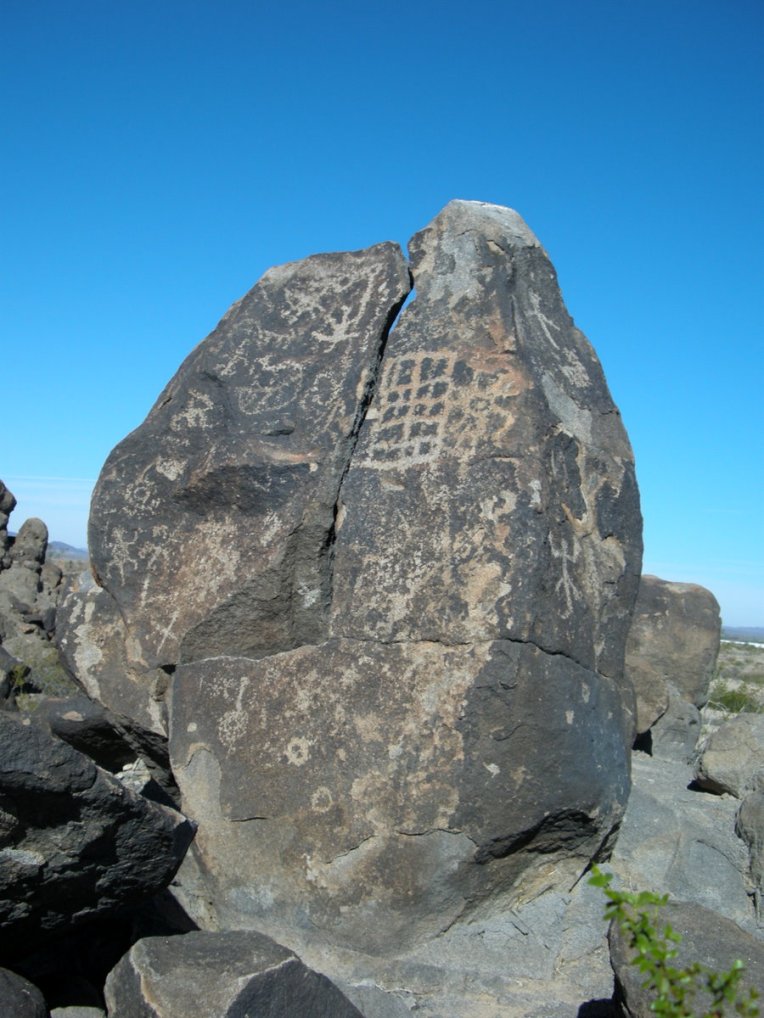
In hindsight, this little painting foretold our desert trip. I did this in October as a collage painting demo. Now it strikes me how much it is like the petroglyphs we saw at Painted Rock State Park, just outside of Gila Bend, Arizona, in late November. In fact, there’s a lizard spirit slithering gila-like through it.

Petroglyphs are the abstractions of the ancients. Were they a semi-precise writing or language, like heiroglyphs? Religious spirit encounters: “Hey, the Deer Dancer possessed me here!” Maps?

It’s interesting how there seems no real distinction between realism and abstraction in petroglyphs.  The deer with bulging belly seems so obviously pregnant, but the squared-off labyrinth delights  in the design-play of geometric abstraction.

Petroglyphs are vigorous and melancholy at once.  Here people met, prayed, danced, hunted, ate, and spent days and weeks creating with what they had– stone and imagination.

Boo!

My Desert Vacation 1: Angels in IHOP and Dead End Beauties

Angel of the Special, 5" x 7", Suzanne Edminster

How do we stay in touch with our art on the road? 

You don’t need to produce profound masterpieces, but it helps to ask the spirit that drives your art to go on the road with you: playfulness, or abstraction, or folk art, or even food.  It needs to be a break, so serious work should be avoided.

I took the Sprocket Rocket, but those old-style film photos will take a while to develop.   I enjoyed the play of my sketchbook… seed ideas seem to be what it’s about when you travel. It’s not good to be too ambitious, as anyone who has a pile of blank notebooks and sketchbooks lying around can tell you.

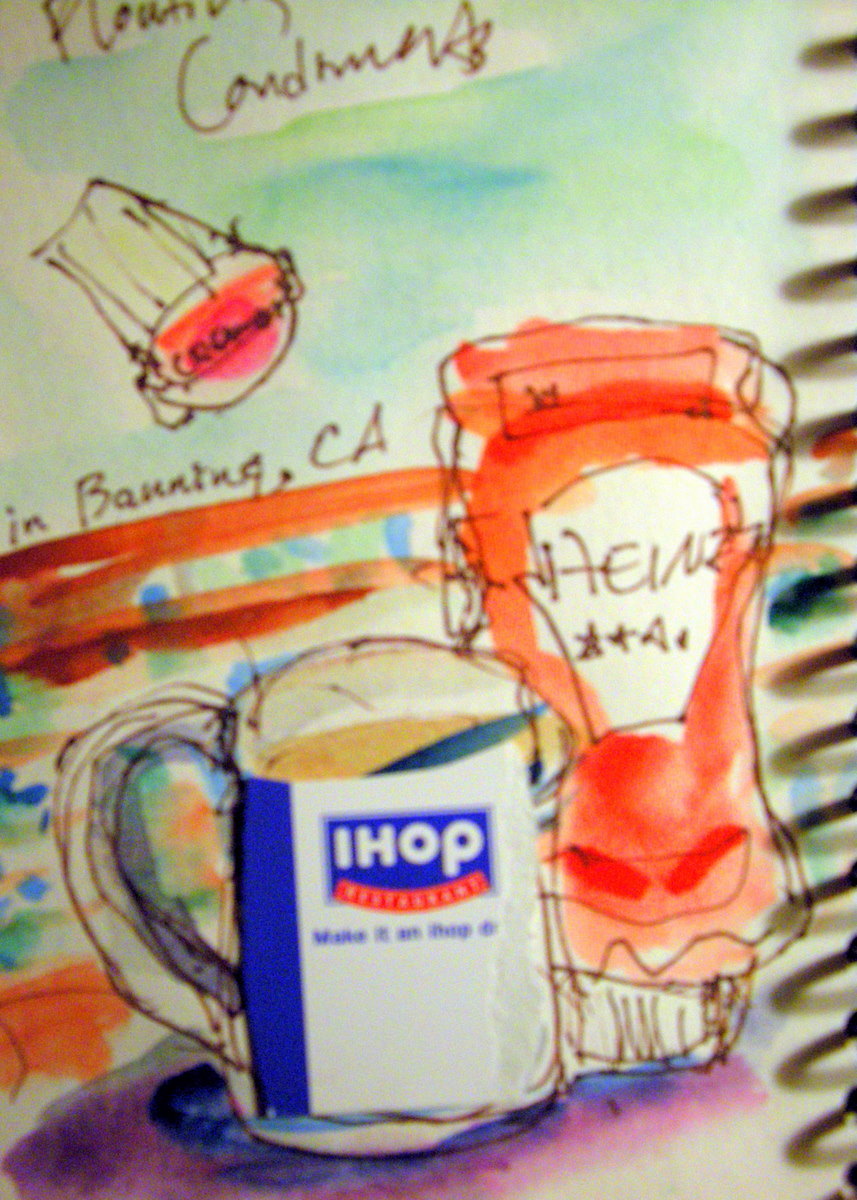
Floating Condiment

The “Angel of the Special”  in the IHOP picture was a statue across the highway that I could see from our booth.  The Floating Condiment was an extension of the notion of an angelic diner. Or maybe we had just been traveling too long, or had something funny in the syrup for the  Pumpkin Pancakes.  These little sketches, done in around 7 minutes each,  make me feel relaxed and at ease.  It seems to be important to paint them at the moment of making.  I never complete the ones where I say “later” to the color. 

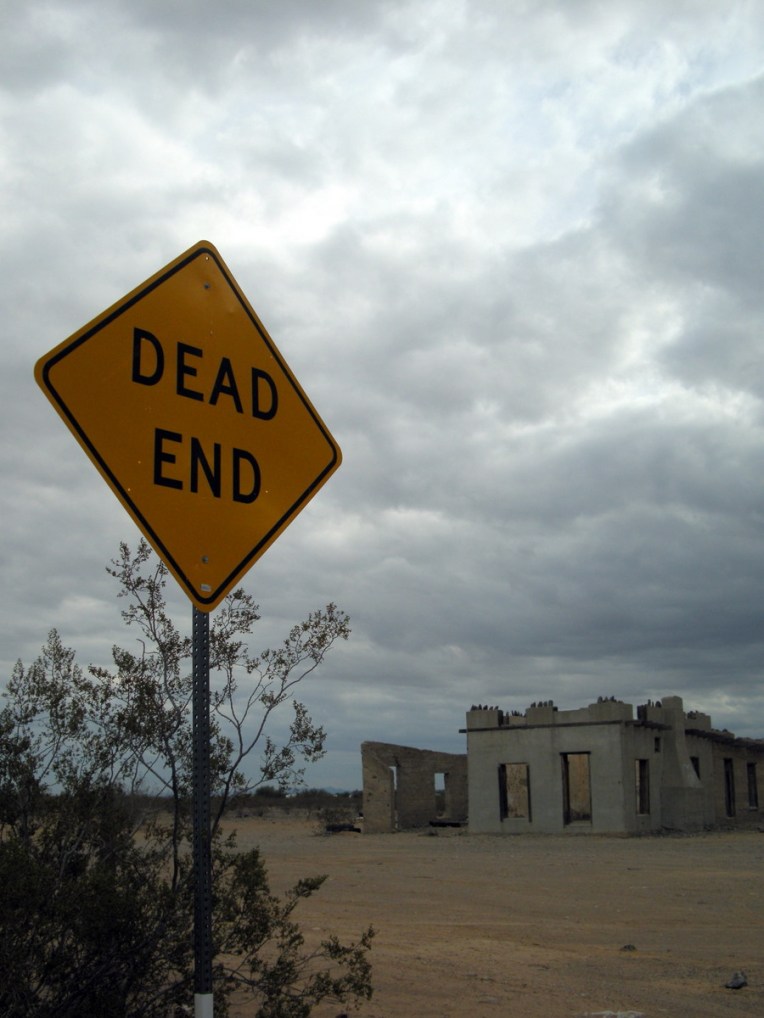
Beyond the End by Suzanne Edminster

The desert clears my head.  I like the monotony, and the inverted feeling of the landscape… with so little as a classical focal point, it practically begs for a kind of X-ray vision, an aboriginal approach.  I’ll write more on this in the next petroglyph post. The apparent “Dead Ends” of the desert lead to new perception.  Little or large things, sometimes quite alive, wiggle on up to communicate.

Daniel in the Lion's Den by Suzanne Edminster

I try to use the camera to record what I feel more than what I see.  These little arti-facts, the images, stir the pot.  We didn’t eat at Tonopah Joe’s after all.  We were invited to an impromptu, delicious potluck .  We ate in a reclaimed building near El Dorado Hot Springs with a fire outside and the stars really close. This beautiful meal, in the company of wanderers, was a real tribute to American hospitality.  We found  great Thanksgiving bounty, on the road and off; in the middle of desolation, a sudden bloom of fellowship.  For me, that’s the essence of the desert– a radical clarity of heart.

Mythic News: The Desert is the place where prophecies and prophets thrive.  Revelations abound, whether they come from an old desert hermit or a UFO visit.  Cowboy heroes themselves have a sort of monk-like quality.  First the White Hats fix the bad guys, then vanish, eaten by the endless horizon. The West is the place of death and sunset, and I did have the sense sometimes of crossing a great monotonous Purgatory.   But it is also the land where one can see forever.  Vision is both challenged and purified.   After all that, a cool beer tastes really good.

Thanksgiving Eye Candy for Your Virtual Feast

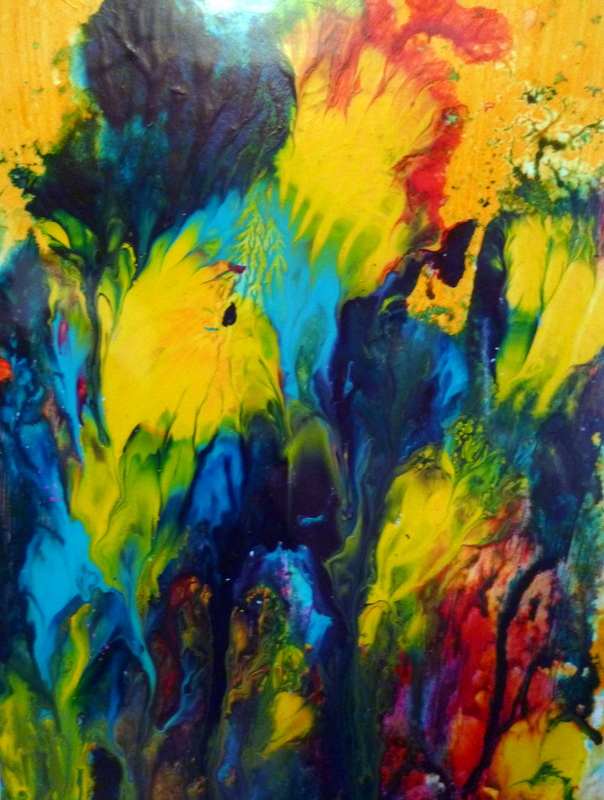
Sea Garden, acrylic on paper, 5" x 7", Suzanne Edminster

Dear reader, I wish you a delicious day.  I shall be dining in a truck stop in Arizona,  Tonopah Joe’s, made famous in the movie Alice’s Restaurant, with Scott, my husband, and other travellers.

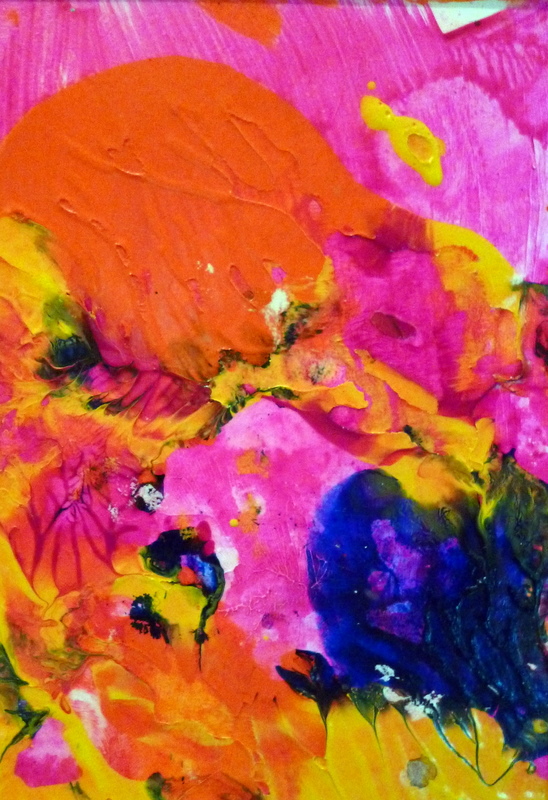
Pure paint is so enticing. I put these on your eye’s table, for your enjoyment.  I make them by painting a bright background, then squeezing on globs of color.  Then I press another surface on top of it, peel it off, and let it dry.  They are deceptively simple;  most don’t work, but when they do,  you’ve just received a chocolate from the candy box of Fate.  Now that I’ve told you how easy they are, do you still respect me in the morning?

We can celebrate with words as well.  I offer you synonyms for  giving thanks, from the lumbering Thesaurus: praise, benediction, paean, grace, recognition, bless one’s stars (archaic, but beautifully true),  acknowledge, appreciate. My thanks to all of you who have invited my work and words into your in-box in the last few months. Sniff. 

Meadow, acrylic on paper, 5" x 7", Suzanne Edminster

Mythic news: The Cornucopia  was the horn of the goat that suckled Zeus.  It overflowed with inexhaustable food and drink. Everyone who’s anyone among the gods loves it. Fans of the Cornucopia include Demeter for the harvest of fruit and vegetables, Dionysios for the wine, Priapus for the sexy fun, Flora for the flowers, Earth, Autumn, Hospitality, Peace, and Concord.  May we all dine at this table!  Hear, here.

Studio news:  I’m traveling in Arizona this week with my Sprockett Rocket in my pocket!  What’s that, you say?  More soon, when the images are developed for your pleasure.  Yes, it’s real film.  Remember those days?  Please comment if you like something here.  I’ll respond as soon as I am back in civilization.