World’s Oldest Painting in Spain: Abstract, of course

The world’s oldest painting is now found to be an abstract red “dot” or circle dated reliably back to 40,000 BCE. This makes it older than the previously dated Chauvet Cave paintings so eloquently documented by Werner Herzog. It’s also provoked speculation that Neaderthals may have been artists– the ultimate reversal of art from highbrow to lowbrow. Or perhaps abstraction is, once again, seen as “lower” art, thus the Neanderthal question… just kidding. Sort of. You can see the red area and the mouth-blown hand stencils below.
blogspain1
The work, age-verified last year in a series of North Spanish caves, seems to be a mixture of abstraction, hands, and animals. The figures below are called “seals”. Huh? Maybe. Or maybe female figures with a vulva mark at the end… or, even, abstractions. There is an assumption that the abstract is more primitive and came before the figurative, but if the exquisitely worked animals of Chauvet are only a thousand years off, I think it’s likely that all the styles, including the popular figuative animals, existed simultaneously, as they do today.
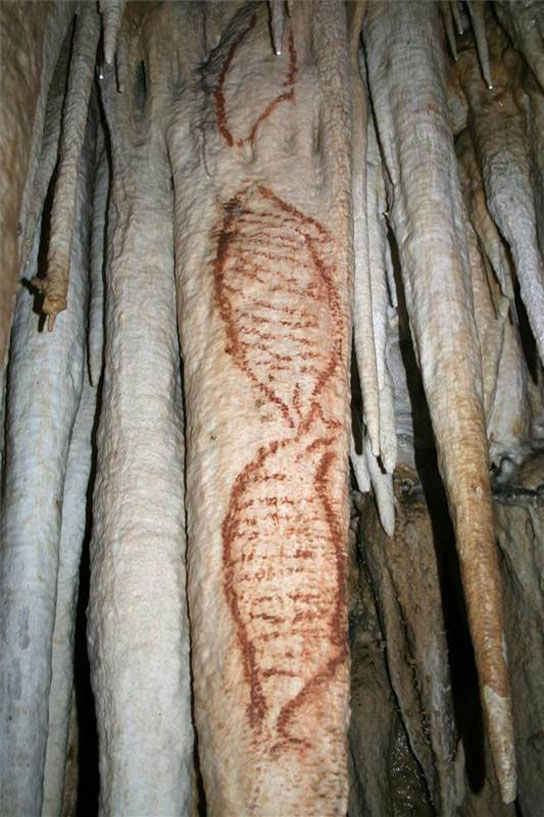
blogspain2

Here are horses, almost always found paired with aurochs. Look at the cute little zebra leg. It’s easier to love the horsie than the red dot, except for abstract fans. You have to interpret the dot yourself.

blogspain4

Let’s hear it for the red dot! A red circle is primal, like the sun, like hands, like animals.

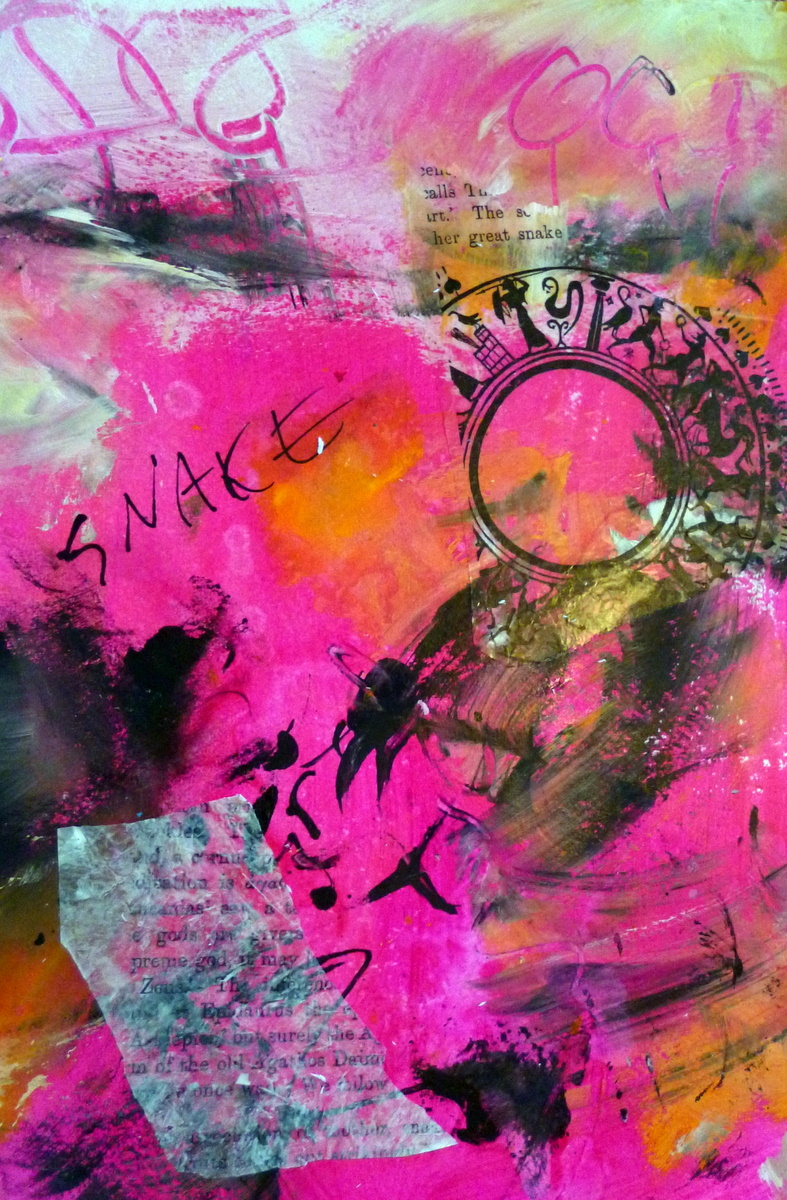
 A red dot also means the painting sold! Do you think it means he sold his wall of marks? Here’s my red dot– Over Underworld, a meditation on cave paint, civilization, and what’s underneath. You can see it during ARTrails this October in Studio 92. I hope to see you in my cave then. P1000487

News Release on World’s Oldest Art

Ancient drawings discovered in Spain have been crowned the world’s earliest cave art. Scientists claim the images date back 40,800 years and may have been done by Neanderthals. The find in 11 caves in northern Spain has beaten the previous record held by Chauvet cave in central France, which boasts drawings of animals thought to date back 39,000 years. Scientists say Spain’s cave art is now the oldest known in Europe, and probably the oldest in the world. The drawings feature animals, round red dots and a series of handprints known as a Panel of Hands. “We find one of these [handprints] to date older than 37,300 years on the Panel of Hands, and very nearby there is a red disc made by a very similar technique that dates to older than 40,800 years,” Dr. Alistair Pike, archaeological scientist from Bristol University explained to reporters. Working in the caves, scientists had to solve the difficult task of dating the ancient images. Pike explained that unlike bones or tools that can be carbon-dated and associated with artifacts found nearby, cave art is “not associated with anything but itself.” The team of scientists used a special technique to date the drawings. They analyzed the calcite patinas that form with mineralized water dripping over the art for thousands of years, just like stalagmites and stalactites form in caves. Over time, the calcite accumulates naturally occurring radioactive uranium from the water. Uranium atoms with years decay into thorium at a very precise rate. The ratio of the two different elements in a sample forms a so-called clock that can determine the sample’s age quite accurately.
Six Phases of Creativity

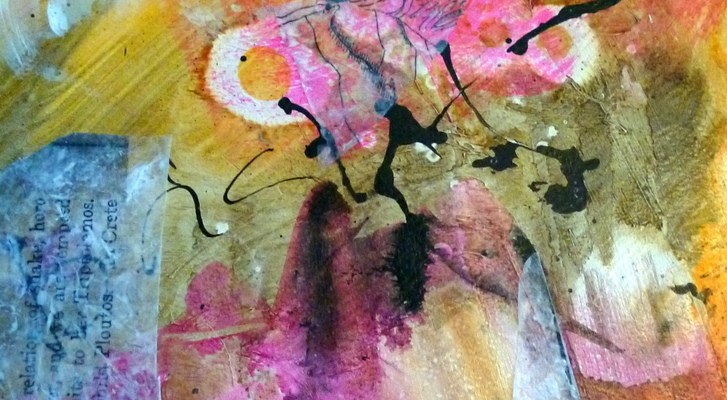
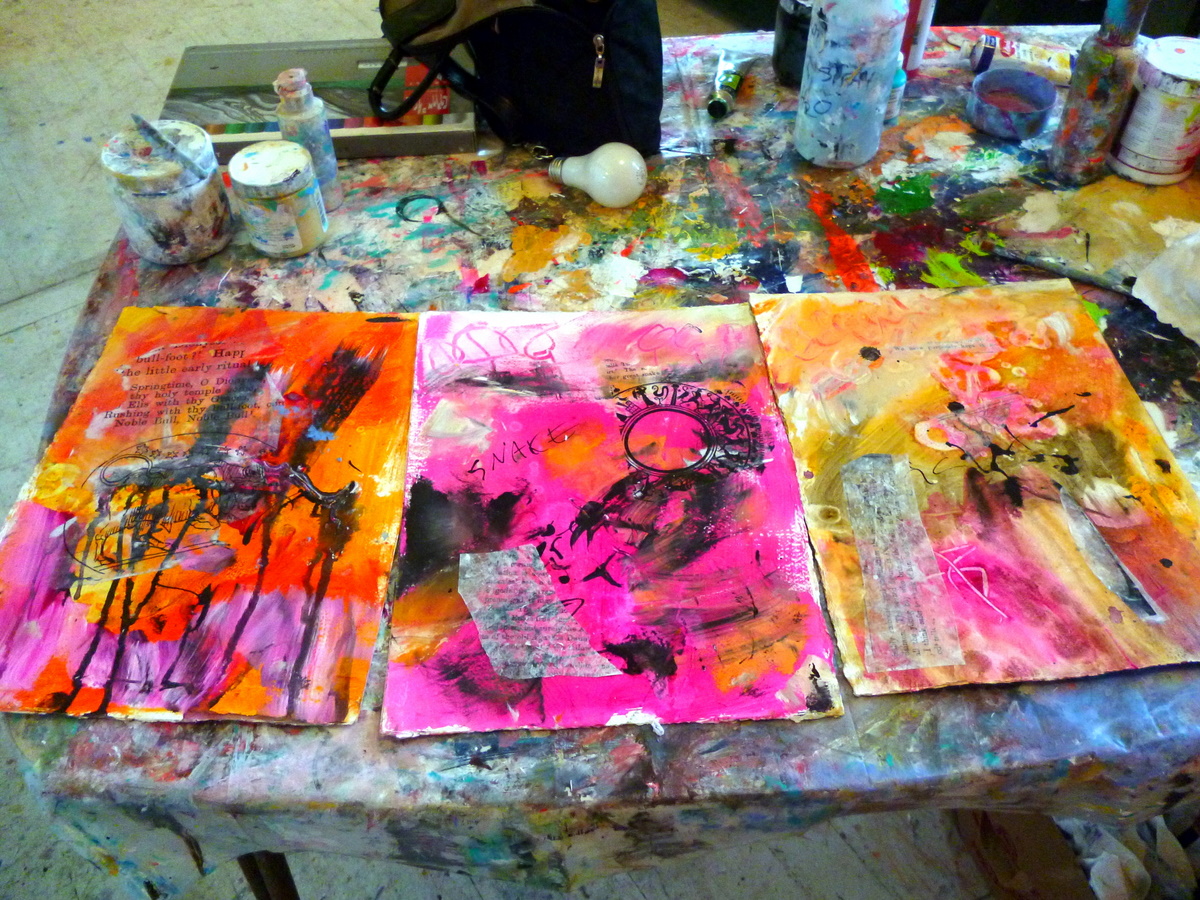
Worktable with 3 “Drafts” for Larger Paintings, Saltworkstudio

Where am I now?  What’s next?

I’ve been incubating this Dionysian series for a while. I have three 2 foot by 4 foot canvases waiting for paint to develop these themes, colors, and forms.  The starts shown above are meant to act as “thumbnails’ for the next phase of larger paintings on canvas.

I have the best luck with my finished pieces when I am purposely experimental, uncontrolled, and unfinished in my draft paintings. I’m groping in my own darkness when I paint.  I don’t want the whole process to happen even before I hit the canvas.  I don’t want  to pre-paint it in my head, my notebook, or anywhere else.

I found a useful new metaphor for thinking about any creative project, whether it’s painting or cleaning out the junk room. These ideas are from The Path of the Everyday Hero,  a book about mythic themes played out in life.  The six phases of creativity are preparation, frustration, incubation, strategizing, illumination, and verification (or manifestation).

Dignified, precise language allows us to reframe creative pauses or lapses. It’s interesting that frustration comes immediately after preparation, right at the start.  Frustration is the failure stage, the belly of the whale, the so-called “block”. What now?

My friend Karina Nishi Marcus is very clear on the idea that “block” should be eliminated from the artist’s vocabulary.  She says creativity is more related to nature metaphors, like “low tide” for the ocean, or “fallow” for the land.  It is a necessary part of the creative process.

“Noble Bull”, acrylic combined media, Suzanne Edminster

Frustration stops us from action, and makes us incubate our ideas, like an egg.  It’s on the back burner, in the nest, warming, passive on the surface but active underneath, mysterious, the seed under the ground.  To incubate properly we also need to strategize, to try things that might nourish or warm the invisible idea.   Some might work, some not.  But the passive time is needed, yin to the yang of action. Paintings can stay successfully in this stage for a long time, even years.

“The Great Ones”, acrylic combined media, Suzanne Edminster

The painter or artist may have to go back and forth in the frustration–incubation–strategy realm for a while, then illumination, the “aha moment” strikes, and elevates the venture to a different level, perhaps to completion.  The creative round, like the phases of the moon, will start again with a new idea.

“We Have Purposely Kept It”, acrylic combined media, Suzanne Edminster

These paintings are not done, but after some months of incubating, I am strategizing.  The notebook helps keep me on track.  When you find your way through an art dilemna, the solution often seems absurdly simple.  Still, it took time to get there.  The cycle may play out in one painting, or in series spanning decades.

The Dionysian metaphor is one of unbounded spring growth and ceremonial theatre, among other things.  Perhaps I should drink a glass of wine to Dionysios, and return to the paintings.    A flash of lightning,  a sprouting vine, or a Greek chorus might illumine the way to the next act of painting.

Mythic notes:  The Dionysian mystery cults tried to loosen the bonds between the worlds through sacred intoxication, theatre, dance and ritual.  The Pompeii Murals, with their glowing Pompeii red, were thought to have depicted aspects of this.

Pompeii Murals, probably showing Dionysian cult ritual

Happy Couples and Girls with Horns: Archaic Art Friends from Rome and Naples

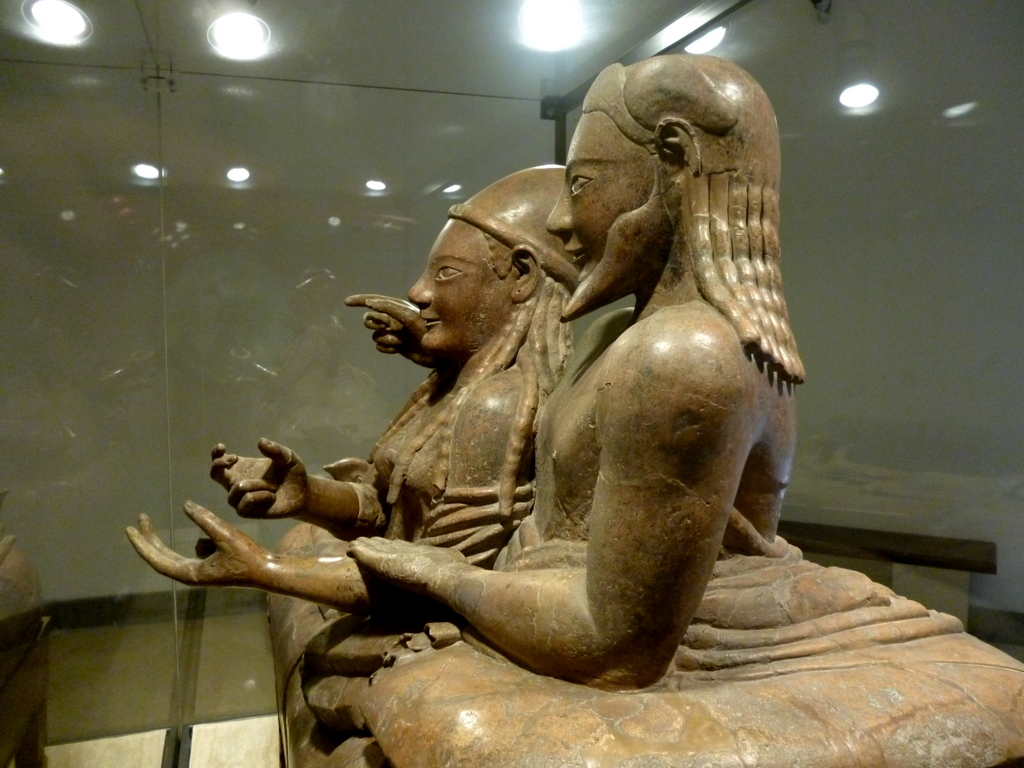
This is my image of true love: looking into the light of eternity, together.

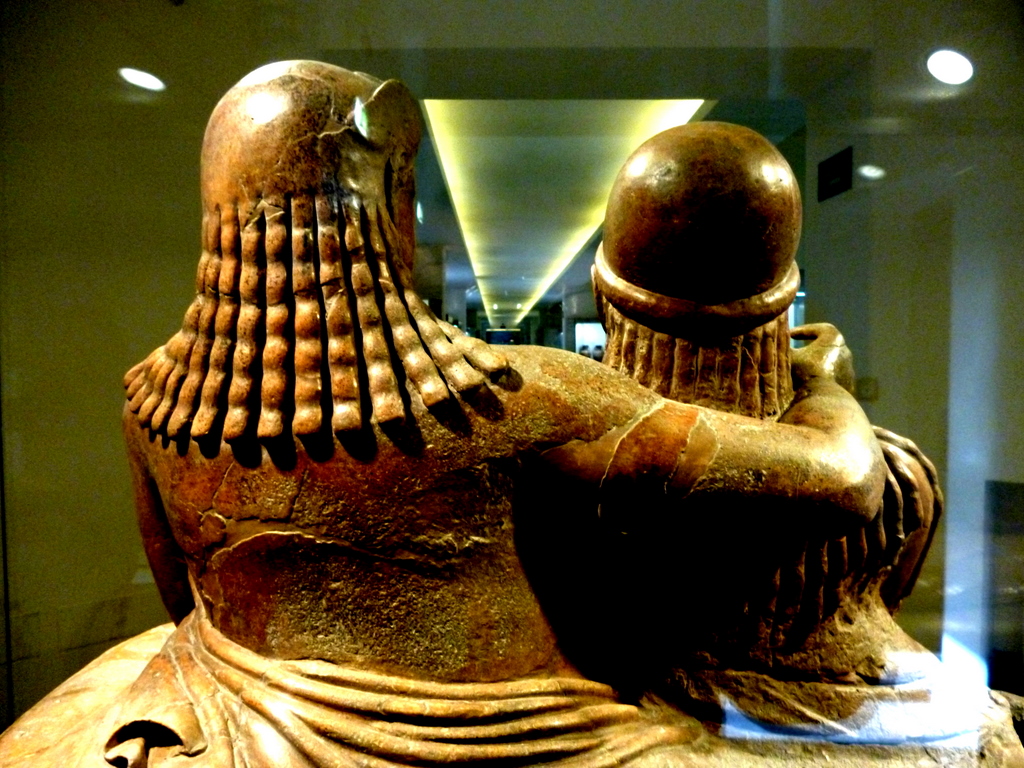
The Etruscan “Happy Couple in the Villa Giula museum  in Rome used to be painted and draped with fabric.  They had wine glasses and perfume bottles in hand and were reclining and eating at the same time– wonderful.  She had her earrings and jewelry on originally too.  This is the most famous of the tomb sculptures and is still incredibly moving for its feeling of affection and love. Not to mention the great “dos”, his and hers.

Then, the Romans invaded, and everyone started thinking about money, real estate, commerce.  Look at the new portrait of the married couple, Roman-style! Brood, worry, and scheme… not much trust there. And no more damn reclining in married portraits.

When not buying something or conquering someone,  in their spare time the Romans loved their soft and ahem, harder , images of sex.  This is a sweet one from the Secret Cabinet of Pompeii, a collection of erotic/ironic art  in the Naples Archeological Museum.  We did get in, though the guidebooks report this is often dicey.  It was deserted.  I think there’s a basic misunderstanding about what was erotic and what was common during the height of the Roman Empire.  Phallic-shaped signposts, lucky charms, and house decoration: common and boring.  Wall-painting series of  “menus” showing different sexual activities you could choose in the brothels, especially if you’re illiterate: interesting, erotic, naughty, not boring.  She’s light and he’s dark, showing the power of the guy, or something; this painting convention continued through the Renaissance and later in erotic scenarios. It’s Pan and his goat, but she seems happy.

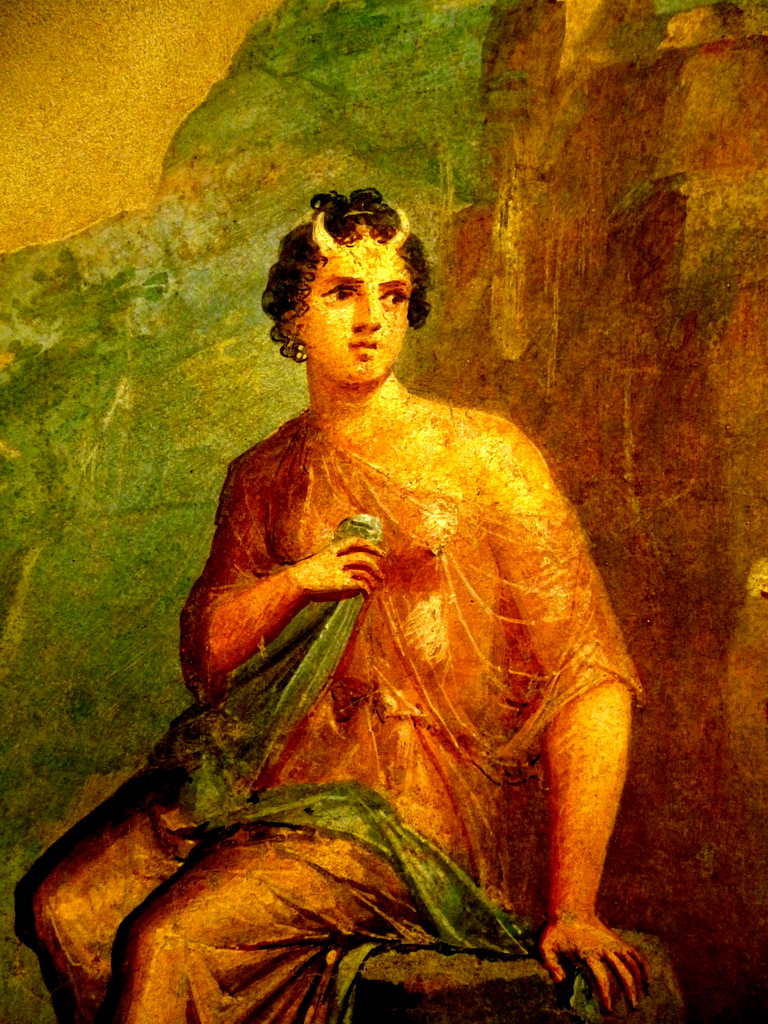
Girls with Horns!  What can I say?  You can check my Mythic notes at the bottom for more ideas.  Here’s an Egyptian version of girls with horns.  They seem to have water buffalo horns, an image seen still in Naples because of their wonderful water-buffalo mozzarella cheese.  You buy it from the deli, little balls swimming in a salty sea, and carry it home in a tied plastic bag like goldfish from the fair.  Mozarrella alone is a “secondi piatti”– main dish– in Naples.   It’s grilled a bit, served with bread, and that’s it.

And now some Pompeiian paintings of girls with horns.  The “encaustic” they used included wax, but the paint actually used soap (lye-based) as the “caustic” medium binding the pigment  to bond with the walls.  These are not frescoes– the plaster was dry.  These are wet, slippery paint layers.  They then used the hot wax to seal the walls as a varnish on top, which they could buff to a high shine.  The first girl definitely has horns; the second may be more of a crescent moon, perhaps Diana.

Horns or crescent moon?  What say you?

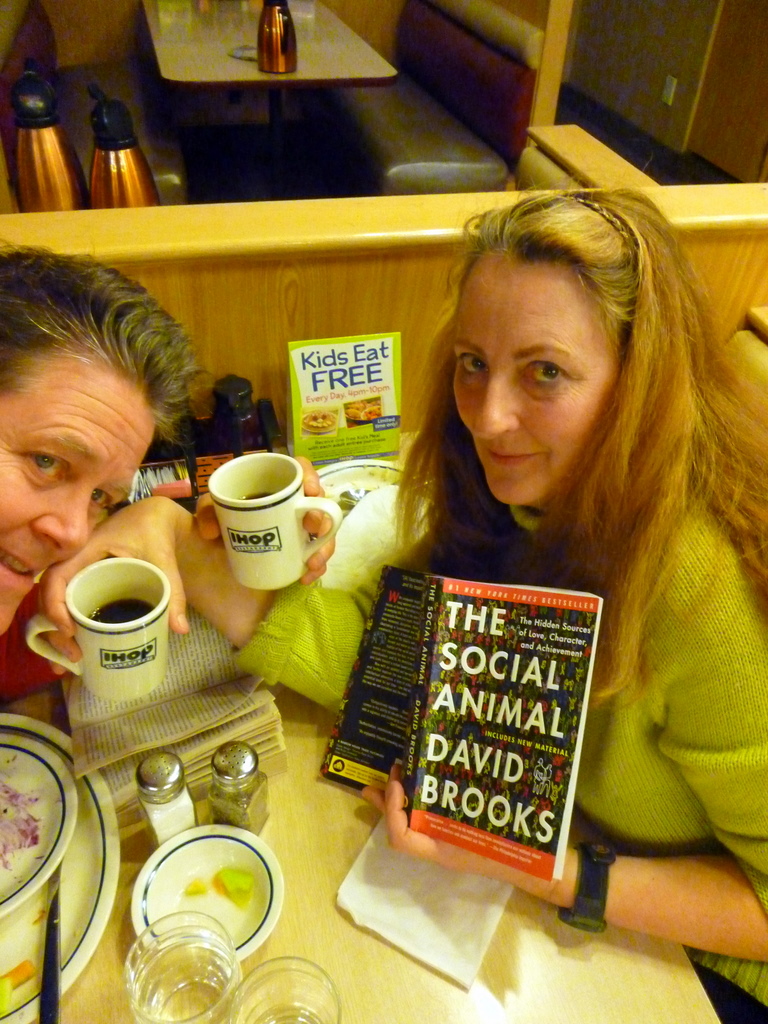
For the last happy couple, Scott and I, the morning after our arrival back, at the IHOP at 6AM.  We are not reclining and eating, like the Etruscan couple, but you see a soft upholstered booth, coffee, empty plates and cups, books, and happiness.  Good enough.

Mythic notes: I saw a lot of images of  Europa on the Zeus-Bull.  She was taken to swim on Zeus-Bull’s back through the Straits of Bosphorus– Bosphorus means ox-crossing– dividing Europe from Asia/Turkey–in other words, the Straits of Istanbul.  Europa and Io merge women with bull or cow, and then put them in water– a river or sea.  They might be a holdover from a more ancient cow -goddess, or metaphors for mass migrations and settlement of cattle people, but I just thought that the girls with horns were cool.  The Romans idealized the Nile as a source of fertility;  Roman matrons would buy vials of Nile water at the local Isis-temple  and douse themselves with it to increase conception.

Book notes:  The Social Animal by David Brooks was a great buy.  It’s trending sociological research, carried by his  made-up, somewhat borg-like characters named  Harold and Erica.  The characters provide a framework for reporting findings from everywhere.  Intriguing.  Many are saying that the creative/artistic mind is the big money earner in our new world. Well, let’s hope.  He lets Erica do art after she retires, and there are a few pages on the latest social research on music, painting, and other arts.   Recommended for a rousing non-fiction read and a juicy idea source.

Studio Notes:   I’ve done large paintings of both Europa and Io as abstractions.

My Marble Buddies: Hanging with Sculpture in Rome and Naples

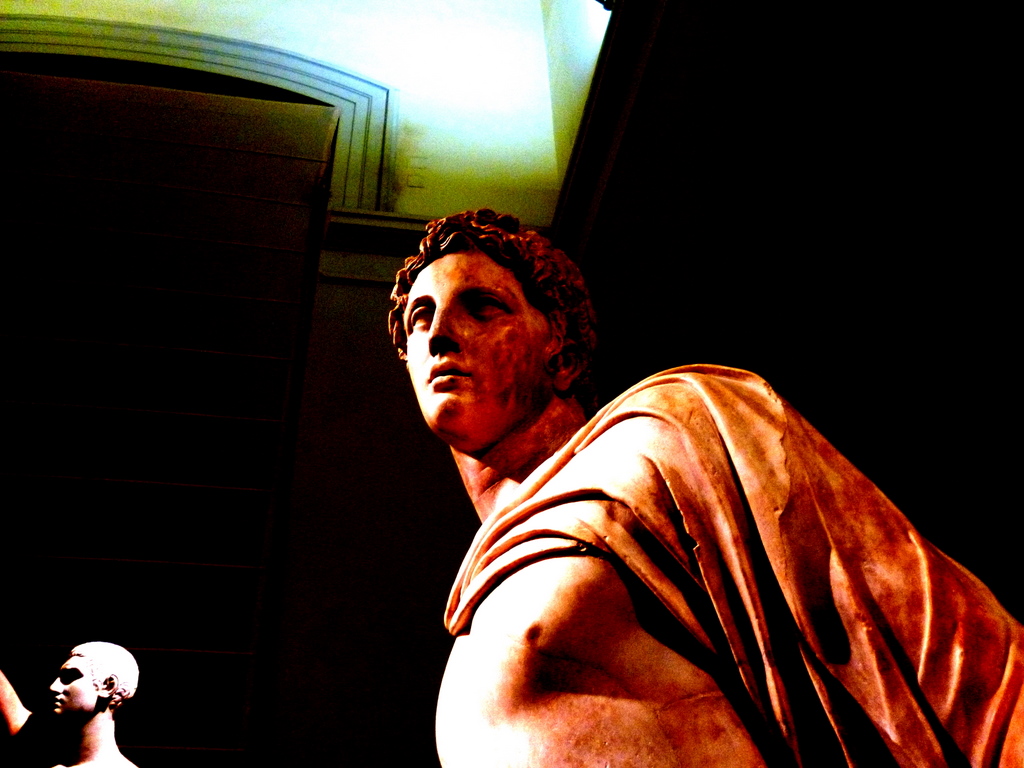
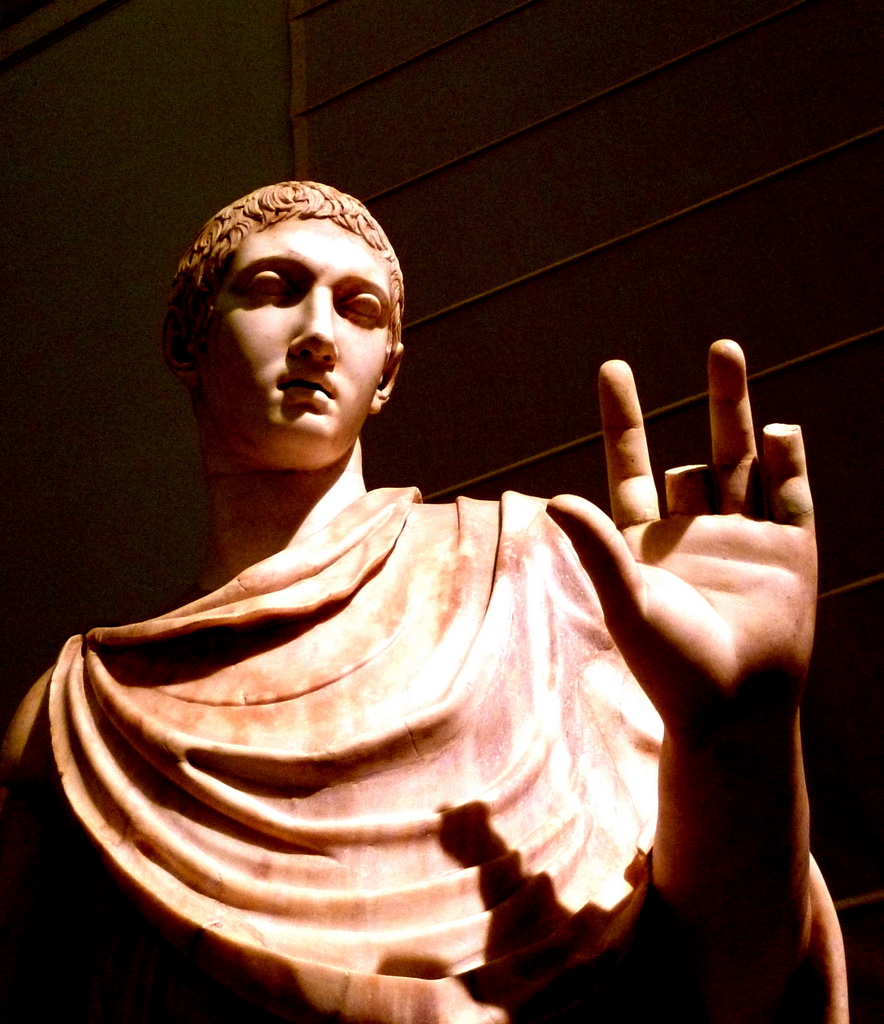
Three weeks in Italy! I felt like I was dipping my toe into a river of souls.  It was a time of borderlines and thresholds: old year to new,  marble to flesh, ancient streets filled with modern people, and classical beauty in the faces of people arguing, eating, buying stuff, driving Smartcars. The ancients seemed to live,  and the Christmas crowds of elegant Italians seemed temporary flickers haunting the alleys.  Meet some of my marble buds. 

The Capitoline Walls… this guy is great.  Is he a David figure?  To us he looked like he had 400 years of saying “Hey, Sailor” to his credit.   Cocky.  Just sayin’…


An achingly blue winter day, and I couldn’t tear myself away from the brilliant negative shapes against the stone. Youth and horse… stunning  contained force, and a tremendous face.  I like the entire Capitoline hill, and this museum piazza was designed by The Big Mike, Michaelangelo.

Capitoline Hill, sunset from the museum cafe terrace.  Murmurations of starlings, kinetic.  The whole Hill was formerly a nest of  state oracles and seers.  They liked the elevation so they could interpret flights of birds.  Nowadays the seagulls have invaded.   Oddly, they fly at night in the city, shrieks and white forms soaring in the darkness, a bit ghoulish.

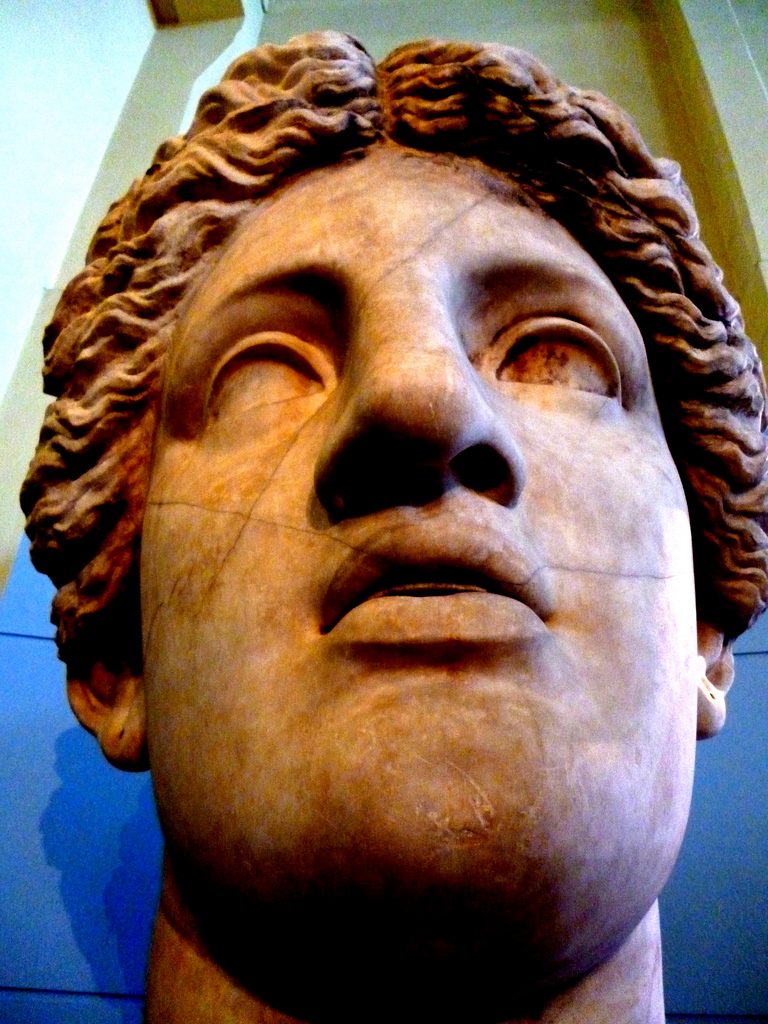
 Classical sculptures are virtually all knockoffs—copied from ancient Greek sources, now lost— or propaganda for the ruler du jour.  Some mighty bodies were made with removable heads so the next Caesar could just screw his own on.  The head of Constantine below is 5 feet high, so the whole sculpture, with pedestal and base, might have been 50 to 70 feet or more.   Statues of this mass can so easily verge on  Facist architechture.  But they impress.  Think of Lady Liberty!

What has that flawed eye perceived in its time? Think, too, of paint and decoration, fabrics and jewels originally draped around the sculpture.  The marble we see now is more a bone structure.  Ripped from their original colored and decorated context, they become evocative collage pieces.  But some still shine. I felt that it wouldn’t take long to develop a real relationship with them.  The more we like them, the more they come alive, like any so-called “object”, I suppose.  I’ll miss hanging with them.

Next: Happy Couples and Horned Gals: More Archaic Art Friends from Rome and Naples

Ekphrasis: Poet to Painter to Poet

Suzanne Edminster, Poetry / Sally Baker, Painting

Yes, I practice Ekphrasis, and I’m proud of it. 

Now that I have your attention, I’ll put the definition of Ekphrasis is at the end of the post. I have a Master of Poetics from  New College of California in San Francisco.  I was lucky to study with  Robert Duncan and Diane di Prima, among others.  It wasn’t a creative writing course.  The poet-teachers had the vision of sharing their  vast source materials with students, not to coach them. Rather than giving us fishing poles to catch our own fish, they set us adrift on little paper rafts to encounter whales, and make of it what we could.

It was extreme:  Writers Write. Harsh.  Unlike most academic programs, the poets supported themselves primarily through writing, publishing, and performing, not teaching in the tenured shelter of a respectable university.  They lectured in old morgue rooms on Valencia Street  with smudgy green chalkboards and circular drains in the corners of the classroom floors, formerly used to collect embalming fluids. 

I remember being  terrified to expose my own beginner work to the mastery of the teachers.  In hindsight, I wasn’t that bad.  But many of us remained writing- paralyzed in the presence of genius, or perhaps it was just romantic depression endemic in the 80’s in the Mission District.

My poem was written in response to Sally Baker’s painting Persimmon with Attitude . My poem invokes Gary Snyder, another poet who wrote about persimmons.  Snyder references Mu Ch’i, a 12th century painter of pomegranates.  Poet to painter to poet to painter to….  Here is Mu Ch’i’s famous painting.

 Ekphrasis:Ekphrasis or ecphrasis is the graphic, often dramatic, description of a visual work of art. In ancient times it referred to a description of any thing, person, or experience. The word comes from the Greek ek and phrasis, ‘out’ and ‘speak’ respectively, verb ekphrazein, to proclaim or call an inanimate object by name.

You can hear me read my persimmon poem at 3:30 on Sunday, December 11, 2011 at Graton Gallery in “A Picture is Worth 500 words [or less]” with Sally Baker, guest artists Taylor Gutermute, Sandra Speidel, and Martha Wade.  There will be a good group of writers as well:  the writing was curated by Toni L. Wilkes, GregoryW. Randall, and Colleen Craig. I’ll write publish the poem in a future post, but it really belongs with the painting.  Ekphrasis to you, too.

My Desert Vacation 2: Petroglyphs and Premonitions

Grey Magic, acrylic combined media on paper, 10" x 10", Suzanne Edminster

Premonitions, by definition, come first. But, like ancient oracles, you never know what they really mean until you get there.

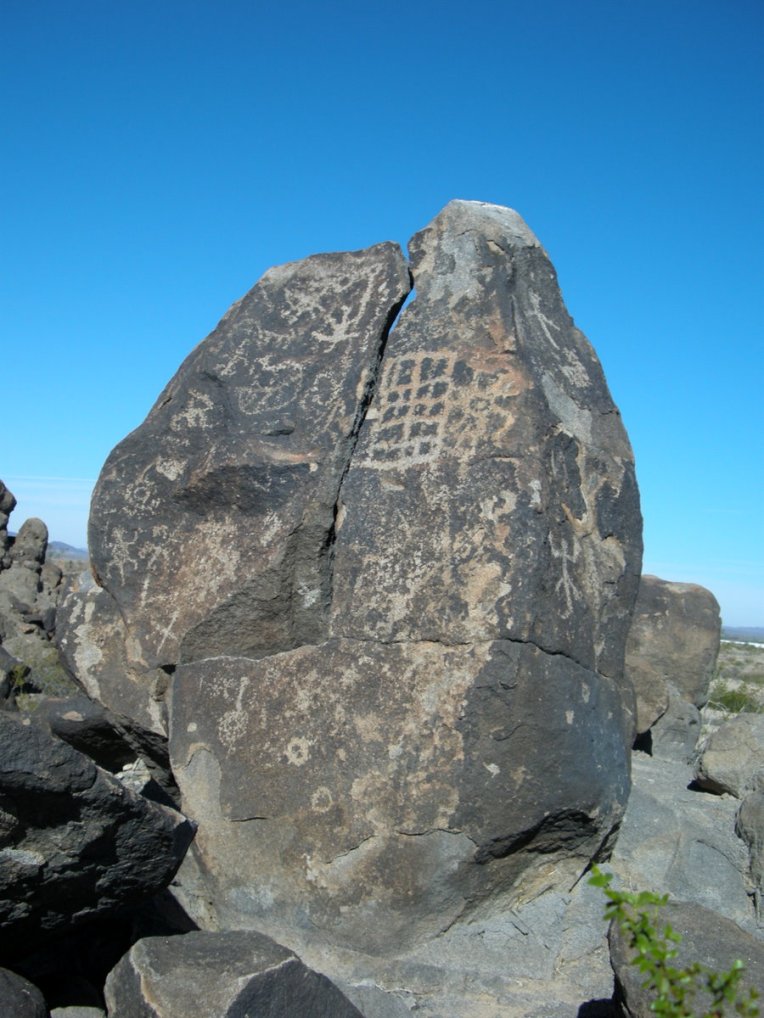
In hindsight, this little painting foretold our desert trip. I did this in October as a collage painting demo. Now it strikes me how much it is like the petroglyphs we saw at Painted Rock State Park, just outside of Gila Bend, Arizona, in late November. In fact, there’s a lizard spirit slithering gila-like through it.

Petroglyphs are the abstractions of the ancients. Were they a semi-precise writing or language, like heiroglyphs? Religious spirit encounters: “Hey, the Deer Dancer possessed me here!” Maps?

It’s interesting how there seems no real distinction between realism and abstraction in petroglyphs.  The deer with bulging belly seems so obviously pregnant, but the squared-off labyrinth delights  in the design-play of geometric abstraction.

Petroglyphs are vigorous and melancholy at once.  Here people met, prayed, danced, hunted, ate, and spent days and weeks creating with what they had– stone and imagination.

Boo!

The Cave Painters Were Really Pretty Good Artists, for Cave Men!

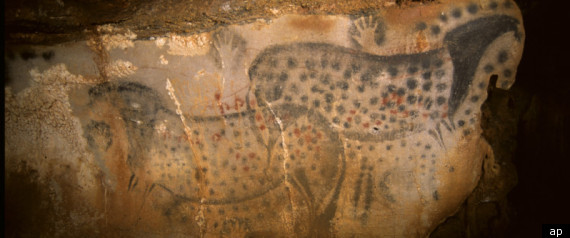
Spotted horses probably existed way back then, says a new genetic report.  This means that the cave painters weren’t just having a great time making a cool, fun, repetitive dot pattern on their creations, but were somehow representing AN ACTUAL HORSE.  DNA now proves that the cave painters were “good.”  Good means realistic in painting.  We wouldn’t want cave painters painting their dreams, now would we?

I salute  the writer,  Alicia Chang,  for pursuing this connection. And the article in the NY times is more fleshed out… or more boned out, because that’s where they got the DNA.   But these articles proceed from a  number of assumptions that make me a bit crazy.  Here’s a list. Ancient artists couldn’t paint realistically.  Ancient artists make “primitive” art.  Ancient artists just sorta prayed to animals or grooved on them but didn’t observe them.  Ancient artists didn’t really know about paint application, media, and drawing.  Ancient artists weren’t da Vinci, or even Dali (who is actually a super-realist using the images in a surreal way).

In fact, recent research strongly implies that ancient people observed the animals so closely that they recorded the small changes in appearance and behavior in different seasons and during mating times.  They applied paint with brushes, air, organic materials like moss or hide, and fingers. They always used as many colors as they could, including greens and purples.  They used lamps and scaffolding to paint in high places.  And as Werner Herzog’s new film Cave of Forgotton Dreams  shows,  they clearly used the three-dimensional stone as part of their media, as well as animation techniques and a convention called “twisted perspective.”  Which I love, because it’s twisted. 

But the thinking remains either/or.   Was it realism or surrealism?  Science or art?    Why not both?

  And now I have  an excuse to put in my favorite little spotted horse, the Dawn Horse from my dad’s 1963 high school science textbook.  I also found newly released Lascaux cave photos from the 1940’s in this amazing Life photo essay.  I adore Lascaux with all my stone-and-iron-oxide  heart.

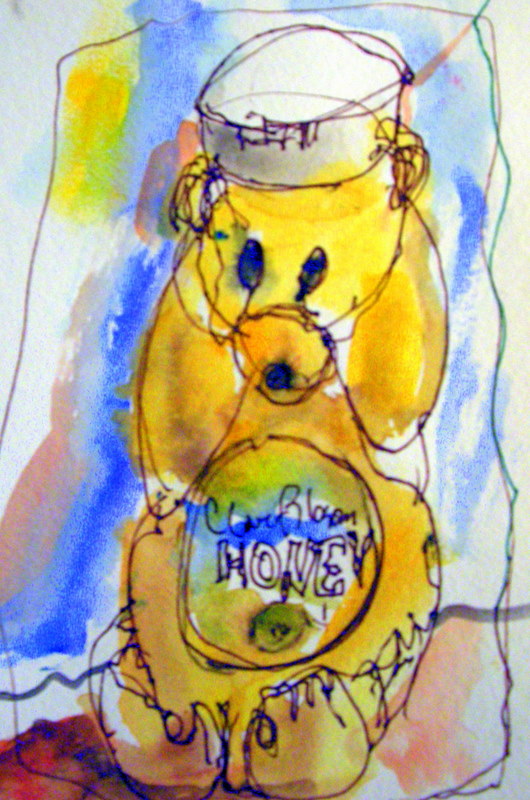
 I did a little Honey Bear sketch of  to honor Hezog’s cave bears, whose skulls decorate the floors of Chauvet .  My father, Bob Edminster, who passed away this year, loved  honey and told a mean Eeeeeeyow Bear bedtime story.  This picture is for you, Werner Herzog and Bob Edminster.

  Mythic News:  Hey, it’s 11-11-11! I give you here a link to my favorite visionary, Caroline Casey, who talks about eleven, and de-apocolizes the day.  Eleven is a threshold number: go ahead and step over.

Studio news:  the divine Laura Hoffman, along with her ladies, women, folk-art motifs, resins, and power tools– yeah, baby– will be our guest artist on the blog next week.  Don’t forget the A Street Studio’s innocent-yet-decadent Winterblast! Tomorrow!

A special thanks to Susan Cornelis, who has been encouraging me to sketch and shared her super-secret material list with me.  See her wonderful travel sketchbook-collage techniques here.