Lucid Art Foundation: Critique as Mentorship

Suzanne Edminster

It’s easy to make fun of abstract artists. You only have to watch some TV to see the cultural perspective on abstraction.  In sitcoms, Hal from Malcolm in the Middle throws so much paint on a canvas in his garage that the whole painted surface crumbles off in a paint avalanche.

Hal as abstract artist

In Grace and Frankie, a recent Netflix sitcom, space cadet  Frankie (Lily Tomlin)  paints two dots on a canvas and stares at those two dots for three days, stuck. (This fictional studio led Tomlin’s co-star Jane Fonda into trying painting and ceramics.)  And in Mad Men, Don buys a painting, under pressure, and sits wondering what it is and whether he’s been conned.  (This painting  was created by my friend Karina Nishi Marcus.)

blog mad men painting

No one really can tell you what abstraction is.  You’re doing this passionate, ridiculous, solitary, incomprehensible, contemplative, snake-oil-salesman of a job.  Who can advise you?  Where can you go for professional critique or discourse outside an MFA program?

This Saturday I loaded up my ancient truck with 4 paintings, all large, two new and two older.  I had been accepted as a participant in an ongoing seminar sponsored by the Lucid Art Foundation.  The seminar was held at The Dance Palace at Point Reyes Station,  a renovated church in an idyllic setting.  It’s not a painting seminar:  it’s critique provided by professor and painter Jeremy Morgan.

Morgan verbally examines and critiques your paintings.  I found it more of a mentoring process.  Much of the critique is devoted to sources and origins, or possible artists to research that might have resonate with your own style.  In this way the critique widens its viewpoint  from the art at hand to encompass an expanse of history and connections.  His examination leads not so much back into the paintings as outward from  them into the next possibilities.  My critique took about 35 minutes. Three people were critiqued in the three hour segment.

All participants were handed index cards to write their own notes or observations for the painter.  At the end of the critique, these cards were handed to the artist.   This allows the whole group to participate, but not interrupt the critique.   Some of my cards are shown below, but it was really the critique from Jeremy that felt like a light shining into my process.  I felt my art had been seen.  And looking at others’ art for a long stretch of time felt both intense and satisfying.  We so seldom spend more than a half an hour just being with a painting, unless you’re the one painting it.
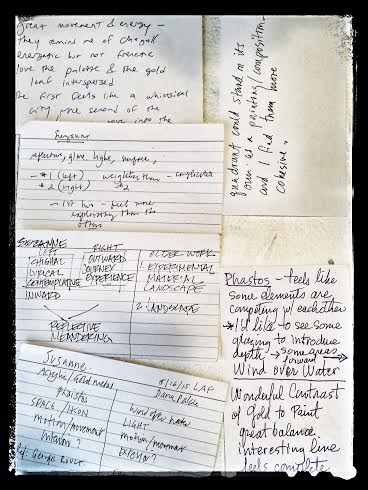
Comments on my work from other artists at the seminar

This reminded me of my arts education in poetry.   I studied in the New College of California Poetics program with poets Diane di Prima, David Meltzer,  and Robert Duncan (partner of the artist Jess), and others.  The poets chose NOT to teach in a creative writing format.  Instead, the classes were devoted to examination of poets and their root sources.  It was assumed that if you were a writer, you would write, independent of a program.  Instead they wanted to offer the heart of their practices, their source material: myth, Kabbalah, deconstruction, archaic history, visual arts, Hermeticism, alchemy, other poets, natural history.   These were the only treasure they could bring us; the rest was up to us.  Poetry is the most abstract of the written arts.  In a strange way,  this odd education equipped me to enter the wilderness of  non-objective painting.

Robert Duncan and Jess


Point Reyes Station is idyllic.  I went with Nishi.  Before the class we hit a bookstore and  went cheese tasting at the Cowgirl Creamery, where I bought Red Hawk and membrillo, which I had not tasted since Spain.  The day was beautiful.  The town borders lagoons, meadows, riparian forests, and everything is walkable.  At sunset, eating sandwiches in front of the view, we both said that Turner would have been right at home, notebook out, getting that Claude Lorrain smudge of eucalyptus on the windy horizon.

Point Reyes Station Barn

Find more information on the Lucid Art seminar with Jeremy Morgan.
The Goose Game: Painting by Chance

Suzanne Edminster

I decided to compose two large abstract paintings for The Goose Game series using rolls of the dice and the old European board game, the Goose Game.  I’d let chance dictate the process.

DSCN0855


I used notebook pages and wrote either thematic or painterly elements in a list , randomly numbering them 2 to 12 to correspond with dice rolls.

You can see it’s a real mix: all the way from “use neocolors” to “holy spirit.” This way of working does have a lineage. John Cage used the I Ching to compose music, notably “Music of Changes”, including the notorious Roaring Silence segment. I found out about this during the eighties in New College, San Francisco, where a teacher, either Robert Duncan or Duncan McNaughton, friends of poet and musician Lou Harrison, who apparently also used the I Ching to compose, brought it up in class. Less known is that John Cage also used it to compose prints, monoprints and lithographs, during the seventies, at the end of his life.

john cage two


The best article on this I’ve found on John Cage and his use of the I Ching  is on S J Marshall’s fine site, Calling Crane in the Shade.  For painting,  I found the process beautifully meditative.  Quiet and slow, it let each element unfold by itself until I was done with it, with little anxiety or the press of “I could do this, I could change that.” Most important, it gave comfort to be rid of the tumult of “What should I do?”

It was calming and centering to give away the control to a larger element, as I did when I was walking the Camino de Santiago.  The Goose Game is an ancient European board game that has many metaphors for pilgrimage, which is why I chose it. This all sounds so odd.  I find it interesting that abstract composers and artists are drawn to chance in creation.  Something larger moves through us.

I’ll be happy to share more about my process at the opening of The Goose Game, Friday May 1st, 2015, 5-8 PM, in the Backstreet Gallery.  I’m located down Art Alley in SOFA Santa Rosa.  I’ll give an artist talk at 7 PM.  You can play the Goose Game if you visit.

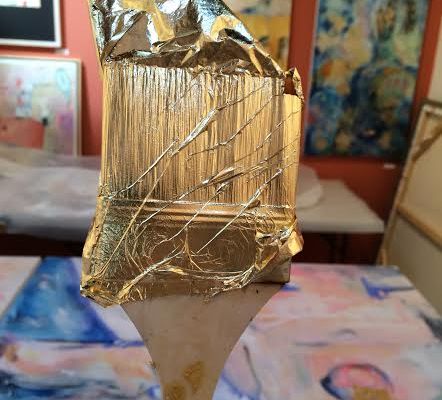
Suzanne Edminster, Wind Over Water, The Goose Game Series.  Acrylic and gold metal leaf on canvas, 45 x 60.
Suzanne Edminster, Wind Over Water, The Goose Game Series. Acrylic and gold metal leaf on canvas, 45 x 60.


From Catbird Quilt Studio: New Museum Art Resources

This excellent blog post contains a list of recently available images and resources from the American Folk Art Museum, the J. Paul Getty Trust, the Guggenheim, and the Metropolitan Museum of Art. Thanks so much to Melanie at her excellent art site, Catbird Quilt Studio.

Melanie McNeil's avatarCatbird Quilt Studio

This is Week #6 of my Power Builders creative links. If you’d like to see last week’s, you can find it here.

I call this series “Power Builders” because that’s what these little items do for me. They make me more powerful in my art and in my life. I hope they do the same for you. Some of the links will be about how other creative people use their time, structure their work, find inspiration. Some may be videos, music, or podcasts to inspire you. Some of it will be directly quilt-related but much of it will not. What you see in Power Builders will depend on what I find. Feel free to link great things in comments, too.

Last week I gave you the link to J.J. Audubon’s free, high-quality downloadable art. This week there’s even more free stuff! Via Quilter’s Newsletter, here are links giving free access to some amazing…

View original post 359 more words

Creative Manifestos and Monolithic Maidens

The “creative manifesto” is a popular idea right now.  You’ll find a good variety, and they’re fun.   But I have a problem with the word manifesto, which has a political agenda.  A manifesto is to unite a group under a banner, to inspire.  I suggest a creative “declaration”, from the old Latin, to make clear.   The root has implications of brightness, to call out clarity,  to make a contract– thus “declaring” taxes. It is a commitment, not a call to action.

Rather than another bullet point list, it’s challenging to try to condense your artist statement into a sentence or two. This should be a statement that will always return you to the authentic reason why you make art.

“My creativity feels like a divine gift to me, and I honor the gift by making my art about Spirit. I want to express the numinous quality of life, where the elements of nature and the stories and the stones and the places of power come alive and speak to us on a deeper level. ”     Caren Catterall

“I paint from a longing to give form to what is hidden, even to me, until I paint it.”  Susan Cornelis

“I work spontaneously to grow paintings as Nature creates, looking through the visible world to the undercurrents of inner forces.”  Karina Nishi Marcus

And mine:

“I explore archaic worlds to forge ancient metaphor into contemporary vision.”  Suzanne Edminster

Suzanne Edminster Saltworkstudio Mixed Media

As Americans, we can’t hear the word “declaration” without the word “independence” implied.  But these concise declarations, with their brevity, clarity and commitment, are at the foundation of creative structure.  Fuzzy, overused “creativity” differs from demanding, grounded creation, where the spark is made, however imperfectly, manifest.

A thanks to Melanie at Catbird Quilt Studio for bringing up the idea of creative manifesto!

Art from Art

In Santa Rosa Junior College’s beautiful print show, 30 Years of SRJC Printmaking, I came on students doing drawings of Caren Catterall’s Giantess series of prints.  They drew in the manner of illustrated journaling, with notes and impressions on the page along with the sketches.  Art ripples out.  You can see the prints on Caren’s website.


Screwtape for Artists, Letter 3: On Originality

Monotype experiment, Suzanne Edminster

Even in literature and art, no man who bothers about originality will ever be original: whereas if you simply try to tell the truth (without caring twopence how often it has been told before) you will, nine times out of ten, become original without ever having noticed it.

C. S. Lewis

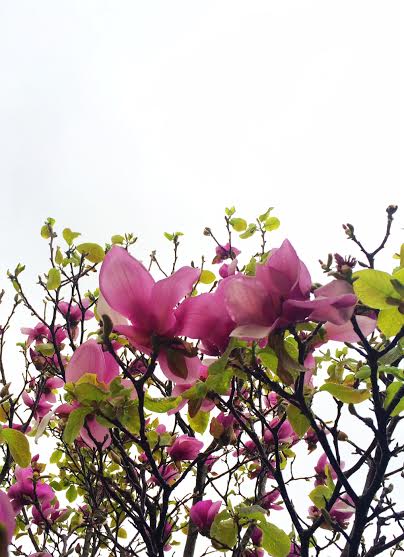
Stormy weather outside, for California, that is. There’s a beautiful grey light against the too-early bloom of the magnolia petals outside the classroom door. magnolia

This C.S. Lewis quote really spoke to me, especially as I flounder about in a new media for a while. Reduced to the status of a beginner, questions of originality pale against simple technical ignorance. As I get older, I feel less unique and special, less original, as a person. I share experience with so many, and, as and adult, know it.

Dear Wormseed,

Congratulations on  the recent sale of the Gauguin for 300 million dollars. A flood of artists will feel discouraged in their own art, and the price obscures the painting itself completely, making it nearly impossible to view with fresh eyes.  Corruption rules!

The Subject-Artist recently proposed making a tableau of dream images.  This is very dangerous, as these inner vapors carry far too much information and spirit, and may speak to others as well.  Keep her in the familiar territory of easily understood beauty, like your recent Artist-Subject Thomas Kincaid.  You earned a sizeable bonus on him, did you not?

You are on still on shaky ground with the daily studio visits.  You must redouble your efforts to keep her away, or you will feel the consequences.  Keep your team on the streets with graffiti– it was brilliant to unify the art impulse with vandalism.  Keep it up.

In Venom–

Screwtape

Archived:  Letter 1 and Letter 2


On Value and Being Seen

This is an amazing blog by the extremely perceptive Summer Pierre. Her “three reasons” were a gift to me that helped clarify why I am an artist. Her notes on commissions, pleasing others, and the Internet are invaluable. This was republished by WordPress in freshly pressed and recieved a lot of well-deserved attention. Enjoy.

summer's avatarPaper Pencil Life

Tara Brach

Longtime reader Sarah asked in the comments on my post about Edith Pearlman if I could share my thoughts on how I skate the inevitable line of doing work for work sake and doing work to be seen.  To which I say:

Oh boy–how much time do you have?

Every artist I know struggles with this dynamic–don’t you?  Isn’t this at the very core of wanting a life in the arts?  You have something to say and don’t you want someone to hear it/see it?  This seems like a very simple idea, though we know it is not.  The minute someone DOES hear/see/notice your work is when things get really FUNKY.  

View original post 789 more words

From Camino to Collaboration

Four Hands Susan Suzanne
Four Hands Painting Exhibit Information and Facebook Invitation
Dear Friends,

This is a belated thank-you note for following me on my Camino  journey, both inner and outer. Many of you have asked how the Camino has changed me. I am just three months out of it now, and have resumed my art life. Events have “followed fast and followed faster,” as Edgar Allen Poe would say.

What changes are showing up at this point after the Camino?  I feel lighter and more complete with my life as it is.  I am more able to celebrate who I am, rather than mourning who or what I don’t have, or focusing overmuch on my mistakes.  This change seems subtle but profound.  I have created some new paintings, filled with gold leaf and gold light, that  may have emerged from the many gilded churches of Spain. Projects are coming to completion, including the Four Hands Painting collaboration with knockout artist and close friend Susan Cornelis.  Our show is called The Golden Thread– the thread that leads us out of the labyrinth.

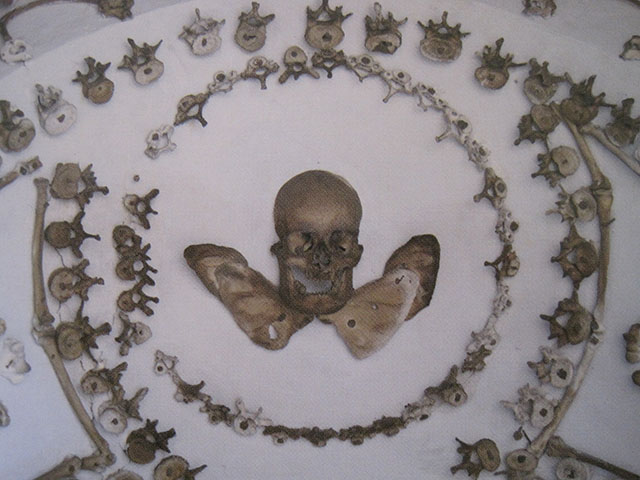
It’s not all sweetness and light, though.  My world seems to be full of beautiful, artistic women who have contracted cancer.  If I were the kind of person who reads omens– and you know I am– I would say that life is issuing a kind of Carpe Diem announcement, a Tempus Fugit warning.   I remember the wonderful Franciscan chapel of Rome filled with little skulls and hourglasses of time flying by, made of browned bones mounted on sky-blue crypt walls.  Scott and I visited this crypt, and I was surprised at the beauty and delicacy of the art.  Part of my life feels like this.. a skull with butterfly wings.skull with wings

So what’s it to be?  Bliss or bones or golden thread,  skull or butterfly wings, or some delicate combination of all these?

I’m glad to be on the road with you again.    This time, the road is my life. Yours, Suzanne

Getting soaked and warming up

No pictures today. The heart of Celtiberia here in Galicia rejects internet waves, just as the Templar church would cut off any phone reception. I can’t put in pictures so I will have to, as Ruskin put it, word-paint. I have been reading Ruskin and Yeats, the kind of books you can get from Gutenberg. org, the source of thousands of copyright-free books. I loaded a lot of classics I had never gotten around to before I left. I did have a few KIndle books I bought, but I knew the classics were lurking. It’s sort of like eating all the junk food in the house first and then being left with actual nutrition.
Today I walked for four hours in a windy, chilly downpour in the middle of June. Heading down the mountain I climbed with the steed Carlotta, I felt like I was paying for the angelic ascension by a sort of hellish descent. It must have been in the forties, with horizontal rain and pretty good winds. Once again, I seemed to be walking alone for hours. I felt like the giant black slugs I saw on the pavement… moving soooo slowly. I just had a quick coffee before I started, so at a certain point in the morning I found myself with a hot chocolate, bread and cheese from yesterday, one hardboiled egg, a soaked travel salt, and a small glass of cognac to warm up… brunch. I got back on the road and the rain got worse. I slowly soaked up water, wicking it up from extremities as my shoes filled with water.
And yet… it’s all so beautiful. Spurs of a brilliant fuschia foxglove flower are everywhere, and hidden waterfalls are running. Because this is not a plain old backpacking trip, I am working on a good outlook as I walk. It’s not to Pollyanna up an uncomfortable situation– walking alone on a strange mountain in a big storm– but to try to notice the beauty around in the middle of my discomfort.
The first room I tried to stay in didn’t work out, and I’m glad it didn’t. I’ve landed in a solid country paradise, with a huge wood stove pumping out heat, home made Galician soup, chickens pecking among the tables, and heaters in the albergue room that are actually pumping out heat. This reminds me of the Wanderhutte my former in-laws, Hans and Paula, used to run. That place was always full of farmers and travellers, like this one. The so-called town has about 50 people so it’s the only game in town. It’s a throwback, the kind of country place that hardly exists any more in California: real, hospitable, cheap, a grandma in front of the fire, and local guys from town at the bar. They’re discussing things in Galician, yet another Spanish language.
Ruskin would say, if you can’t actually draw, paint a picture with words. Shoes and boots are drying in front of the cast iron stove. I watched someone take off their shoes and their socks literally steamed! An orange rocker is reserved for the grandma. A Swiss youth who looks like the hope of the blond nations is chatting with a dismayed middle aged German couple. The chickens were let out of the bottom of the farmhouse as soon as the rain stopped , and are pecking and crowing among the plastic outdoor cafe furniture. The plain molded plastic chairs sensibly have holes in the seats to let rain run out. Now why don’t we do that? The hostess yells at me, not because she’s angry, but because if you yell, the foreigners understand better. Three huge, dispirited German shepherds are lying sadly in the courtyard, too tired to interact with guests, A black and white kitten is in the woodpile. And behind it all, the beautiful hills of Galicia loom, spotlit with gathering thunderheads filtering the late afternoon sun.
I could never have found such a perfect place to stay if I had spent days on the internet and in guide books. I am working on abandoning myself to the travel spirit, intuition, and guidance. I have good friends in the books I’m reading.
The poignancy of this journey is that it can hold so many emotions, and so much beauty and fatigue, in a single day, or even a single moment. Last night I saw one of the historical contenders for Holy Grail, a golden chalice with a golden sun like disk in it . It was lovely, and the setting was amazing… the original 9th century church, arguably the oldest church still in original form on the Camino. I watched people kneel before it and pray, while outside, drunk tourists were posing and singing. What use can this ancient myth have for us?
In the churchyard, the cemetery, the graves are raised slate boxes, one for each family. I have also seen tombs that look exactly like vertical bank or gun safes, including a lock and stainless steel handle. While the revelers sang, an old grandma went into the churchyard and spoke quietly to someone who lived in the slate box of her family. Her ancestors may well have lived in the same place for over a thousand years.
Yeats, in Celtic Twilight, said, that it was not so much what one believed, but that one’s beliefs can somehow be knit together, to make a cloak that keeps us warm. Here in this Celtic land, I am willing to believe a bit in fairies, virgins, and miracles. I am traveling through and inside a landscape of rich metaphor. And I am so glad for the soulful spirits that knit me together and keep me warm. It’s really cold here, and I’ll need it. Suzanne

Soupa Magica

The thunder rolled down the valley like waves crashing on the beach, with lightning flashing an irregular strobe. We didn’t care, tucked away into the smallest (10 people), most magical albergue, an ancient village building where all the rooms slope and exposed beams are not a designer fashion.

20140621-061502-22502466.jpg
The village has only 50 souls and no stores. The Pan (bread) truck, a white van I’ve seen everywhere in Spain, skids into the plaza and begins earsplitting honking. For many minutes. Bread is a matter of urgency.

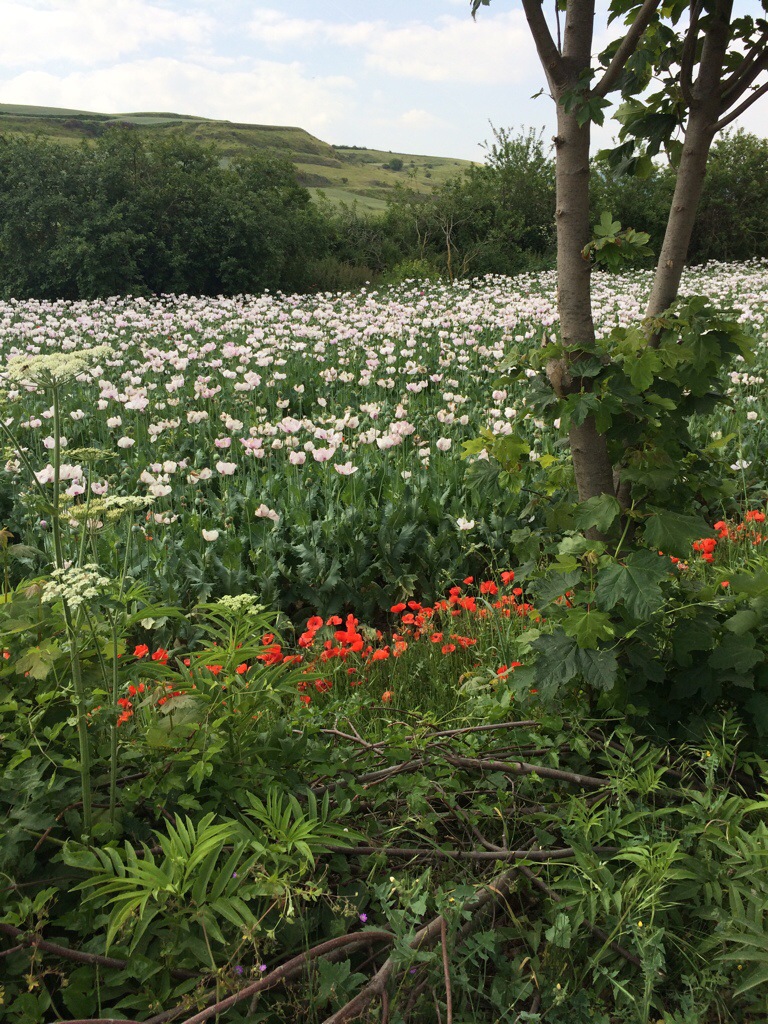
I’ve had the feeling this whole trip of being enclosed in a kind of bell jar of bird song, and even more strongly here. Swallows thread the sky with the invisible silk of flight. The village is cradled in rolling farmland, much of it in poppies. I walked through many fields of blossom today. I could not help but remember the Wicked Witch of Oz crooning “Poppies…”

20140621-062236-22956767.jpg

20140621-062237-22957116.jpg
This albergue is the home of Acacio and Orietta. They are good friends with the author Paolo Coelho and there’s a book in which you can leave a message for him. Their business is run entirely on donation. Both of the couple have walked he camino many time. Their house is full of books, warmth, easy chairs, and superb hospitality.

20140621-063128-23488612.jpg

20140621-063128-23488221.jpg
Cameras can’t catch the implacable golden sweep of the wheatfields, and a photo can’t convey the warmth of that dinner. “Soupa magica” is Acacio’s term for pilgrim soup, a combination of soup and the Portugese sopa.

It’s difficult to write about the Camino. A lot of your inner experience is private. The writing tends either to become Shirley Maclaine-ish or degenerate into a kilometer-sore foot-lodging blog. Orietta told me that a way a pilgrim can give something back for all the kindness extended is by the sharing of experience: being hospitable and open in your heart to sharing what you know.

Thank you, Acacio and Orietta. Acacio is an passionate advocate for the inner necessity of the Camino. He also has much hidden knowledge about the history and soul of the Camino, but you’ll have to ask him yourself, over a bowl of Soupa Magica.
Suzanne

20140621-074315-27795572.jpg