Open Studios, Open Hearts: 24 Barracks Artists in Santa Rosa

 Opening a studio is like cleaning  a window into the inner life of the artist.  Down the rabbit hole we go!
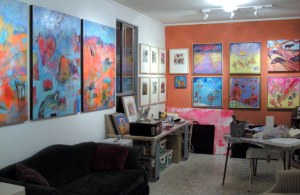
Saltworkstudio Nov. 2011

It’s more intimate than having people into your home, because you give your hospitality to everyone.  They can luxuriate in your colors, drink in images, and dine on your line.   The public sees the traces of your best effort and your worst nightmares,  the deep and superficial.  The artist tries to be fully with each question, from sublime to inane,  without falling into the pit of sales obsession. It’s quite the wine-and-cheese marathon.  Unless your heart is open, it can be nerve-wracking .  But when someone really sees your art– and really loves it– there is no greater high. 

 A few times people have burst into tears in front of one of my paintings.  James Elkin explores the phenomena in his Pictures and Tears:  People who have cried in front of paintings.   The book is a strange and fascinating  exploration  reactions to art when the eyes in our hearts have opened.  Museums used to have nursing stations where patrons overcome by art could recover… I think the Louvre still does.  Have you laughed or cried over a piece of art?

 Turquoise Window World is a sort of threshold or sill where the everyday table starts to tip over into the extraordinary, like the tables that the spirits move.  Strange fruit converse.  Flowers march and sprout angels, and a grove of spirits wavers in the background.  The painting expands domestic motifs as an un- still life , animated.   The turquoise paint, that bright opaque, came from my time living in India, where houses are unabashedly brilliant blue as a Kodachrome sea.   

Saltworkstudio and my friends the Barracks Artists are open  November 5-6 at 3840 Finley Ave, Santa Rosa, California.  Drop by to visit 24 artists in one location.  I’ll be painting.

In a Mythic News today, I introduce  Jeremy Joan Hewes, Caren Catterall , Mardi Storm, Paula and Cliff Strother, Kathryn Kelsey, Maris Peach, Claudia Rhymes, Monica Lee-Boutz, and Chuni Anello. We will be having a party on Saturday between 4 and 6. All our studios will be open.  Join us!

Jeremy Joan Hewes

 Jeremy Joan Hewes is a dynamic, subtle printmaker, photographer and my friend.  In her words: Sometimes you walk into a room and a discover an alluring mystery. That’s how I think of this image of subtle colors, dynamic pattern, and silhouettes, which I made at a recent workshop in Coupeville, Washington. I kept returning to that room as the day wore on and the light changed, each time taking more photographs. Color and light, with a little bit of “what is this?” thrown in.  Come see this photograph and some new mixed media pieces in studio 250 at the Barracks Artists open studio on November 5 and 6 – this weekend!

Caren Catterall ,  master printmaker, is a guiding star at the studio.  She produces a wonderful moon calendar  for gardening , as well as her  mythic prints.   Visit the beautiful print studio  for goddesses, coyotes, ravens and giants.  For a treat, relax with a cup of tea and her delightful video, The People with Spirits Strong as Stone.

Mardi Storm’s art is colorful and ethereal, with delightful Animal Angels.  She just started a new Etsy store.  Her partner’s group, Outlaw Dervish, will be playing at the reception at 4 on Saturday. See her new studio next to Caren and Jeremy! Visit Mardi Storm Artworks for a preview.

Don’t be fooled by Claudia Rhymes’ pixie glasses or shy demeanor.  Her new series of urban landscape grids over bright backgrounds rocks, and she’s a gifted, secret graffiti artist. She also has one of the new, larger downstairs studios.  Claudia is our hidden wonderchild in this Open Studio.

Paula and Cliff Strother share the studio with the most beautiful outlook on the hills.  Paula paints in acrylics and Cliff in oils. Visit this newly established studio to enjoy lush landscapes in a room with a view.

Kathryn Kelsey’s fascinating mixed media work changes every year.  Dedicated to wild animals, the environment, and indigenous peoples, her textures and materials are a delight.  I love her mixed media with dried radishes.  She is the Editor of the Barracks Bulletin and writes a blog.  Her downstairs studio is filled with the calm green light of nature, one of my favorite places to sit and relax.  

Maris Peach is our very own Joseph Cornell. I own a piece she made, the Alchemist’s Arcade.  In her words:  I tell stories using the flotsam and jetsam of life’s leftovers. Sometimes I begin with an object, sometimes I build from a concept, sometimes I fiddle and nuture a dream memory until it becomes an elaborate narrative. Othertimes the story is sparsly simple or even hidden, revealing itself through the beholder’s eye. Don’t miss her intricate, fascinating workshop and studio.

Monica Lee-Boutz is an energizing force of nature!  She paints in watercolor, is an accomplished collage artist, and has had several recent exhibitions.  Visit her studio upstairs across from Paula and Cliff.

Chuni is from Madrid, has a new studio downstairs, and absolutely unique mixed pieces using fabric, fiber, and wool.
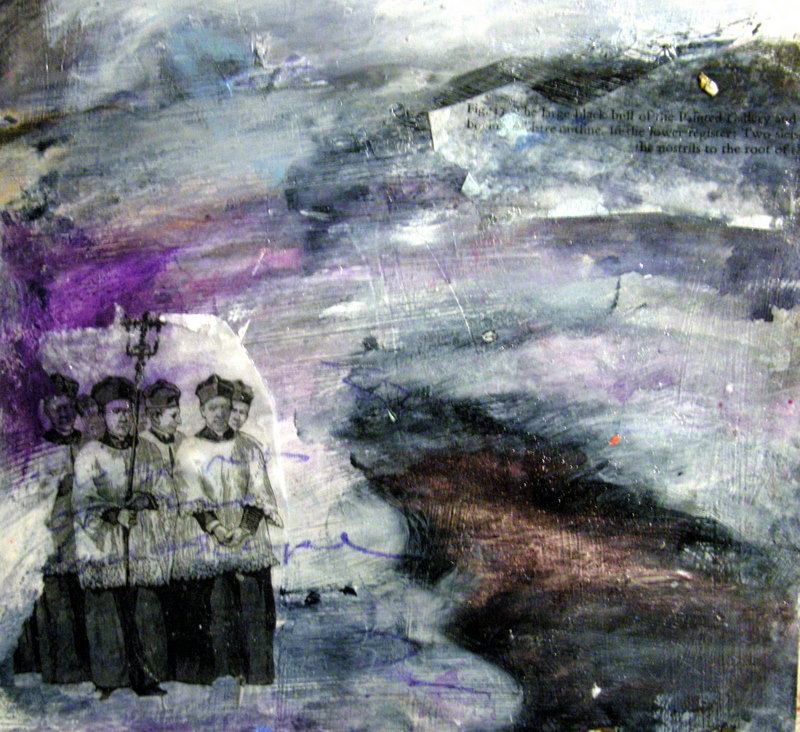
Hade’s Choir: Mixed Media Collage Paintings in B/W

Collage is a natural for Halloween, the dark hinge in the year that creaks as something opens the door.  The bits and pieces of  paper are ghosts or forlorn spirits, no longer “alive” in their original context.   You cut them, dismember them, rip them up, seek underworld messages from scraps of text, and bury theme in paint.  You can “skin” them as well. Then, like good little ghosts, they march out and live again, speaking in paper whispers.

 Yesterday,  in the class I teach at Sebastopol Center for the Arts,  I was trying to model how to develop a series theme.  I shared to the class that in my notebook I had written that I wanted to do a series that was like “Edgar Allen Poe on acid.”  I like to read horror stories and murder mysteries;  husband Scott actually prescribes them for me as an antidote if I get too bound up in art books or my secret indulgence bonbons, preachy self-help books, which I love but invariably depress me with how much help I still need to add to Self.  I had been hanging on to scratchy black and white compositional studies for years; liked ’em but didn’t know how to take them further.    The Choirboys had been altered into a very damaged acrylic skin. I tore them up into two pieces and mounted them on two paintings, paired with a quote from a cave painting book,  and  my landscape transformed itself into the River Styx.  Mixed media included Utrecht Pro Gesso as my white paint… love the opaque chalkiness… and Derwent Inktense pencils for the purple automatic writing marks.   Payne’s Grey makes a gorgeous blue/black.  If this little group comes to your door tonight, I wouldn’t open it.

Mythic News:  Avernus, a crater lake of Italy near Naples, is supposed to be the entry to the Greco-Roman underworld.  Our own Crater Lake in Oregon is creepy enough… dead, because not fed by springs.  Dead, because the volcano crater goes down, down to the center of the earth, or near enough.  Birds and fish often avoid these lakes as well.  I’ll see Avernus around Christmas on our Italian trip.

Saltworkstudio events:  We have our annual Open Studios this weekend, November 5 and 6, 2012, at the old naval airbase , 3840 Finley Ave, Santa Rosa.  I have a new series of B/W paintings and you can see the top of a WWII bunker from my studio window.   Drop by Saltworkstudio.  I will be doing demos and would love to visit with you.

Aurochs Moon: A History of Home

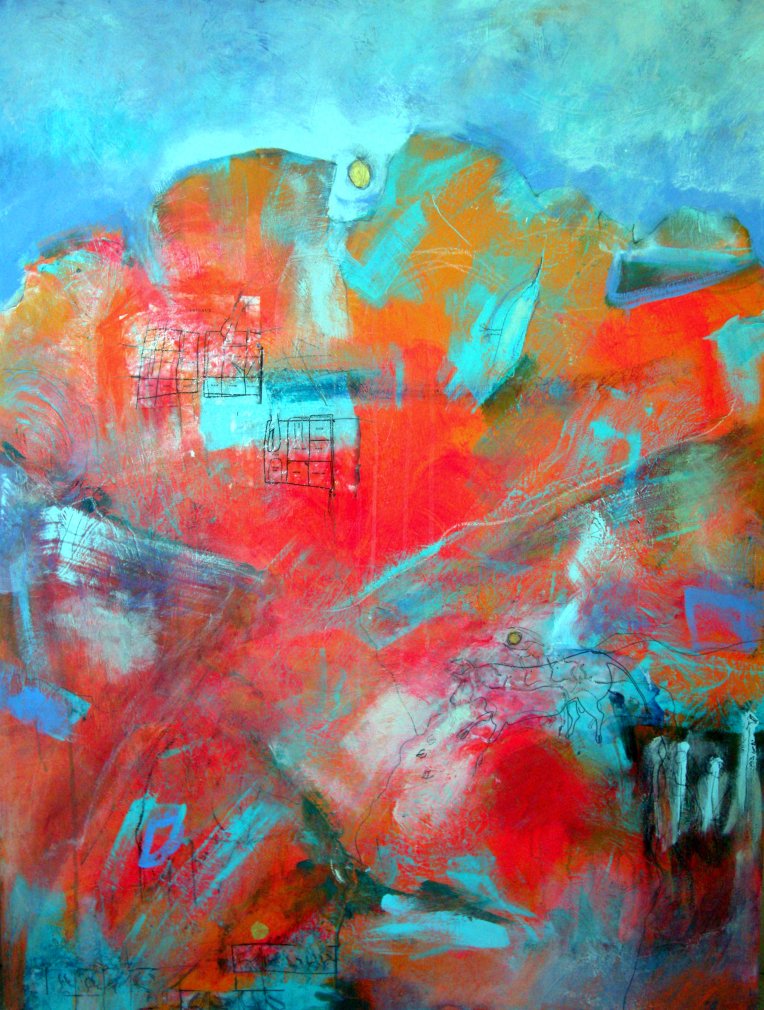
A History of Home, acrylic combined media on canvas, 36" x 48", part of the Terra Incognita series

Ahhh, home sweet cave. I wanted to do an imaginary landscape that was like a child’s drawing, an aboriginal painting of mythic locations, a bright map with line engravings of the entry to inner worlds.  This painting, originally titled “Aurochs Moon”, shows various signs upon entry to the cave or just inside it.  The Aurochs was a cow almost as large as small elephant. Aurochs are the bulls and cows of the Paleolithic cave art.  They lived on until the 16th century in the forests of Eastern Europe, where the last one was eliminated as hunting game for the rich.  A variety has been genetically re-bred in France as Heck Cattle

This painting, one of a triptych called High Pastures, transformed several times.  I wanted to keep the heat of the bright orange underneath, to do a map with impossible colors.  You’ll see transfers of line drawings over all, petroglyphic elements using the paint as a wall that lets images emerge from another realm.

Why the cave? I think the cave is our brain dreaming, our true home, the hearth that underlies any location we happen, temporarily, to live. The alternate name for this one is “A History of Home.”  My own history of homes is a long one. I’ve lived in rural California (Los Banos and Merced), urban California(San Francisco Mission District, pre-gentrification),  coastal California (Santa Cruz), and now northern California (Santa Rosa).  Urban Hawaii (Honolulu and Waikiki) and rural Hawaii, Na’alehu near South Point on the Big Island.  Munich and Freiburg, Germany, and southern Norway. Bangalore, South India.  When I lived there it only had four million people, but now it has topped five million— definitely urban.

Wherever I went, there I was.  Each place had a dream at its centre, realized or not. And you, dear reader? What’s your history of home?

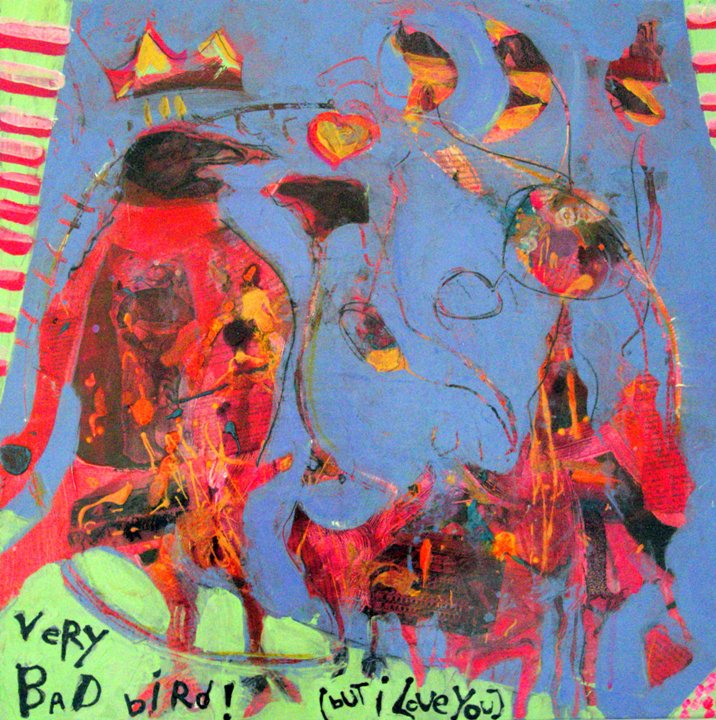
Very Bad Bird! (But I Love You)

Copyright Suzanne Edminster

Oh, that Bad Bird. Have you had a naughty-boy dog? cat? boyfriend?  (I know you have.)  I painted this as an homage to that thing in us that seeks a little bit of darkness.  Even if they’re not good for us, we love them.

I started this painting by collaging a Matisse book that fell out of its binding to the 24″ x 24″ canvas.  I like painting on substrata that is almost fully obscured.  The Bird is the Raven King, a  black-feathered emperor of darkness, impossibly charismatic.  There’s a girl bird suggested in there.  You can see ravens underneath in the collage layer, but I meant this painting, with it’s little pink and green “curtains” on the side, to indicate a tragicomic scene in the drawing-room comedy of our love lives.

I gave him a crown, because he rules.

Who’s your Bad Bird?

News: a two-blog day! Woof!  Thanks to great friend, writer, cook and painter Sharyn Dimmick of the Kale Chronicles, who was kind enough to feature my Sonoma Pears Poached in White Wine, and a painting of a nocturnal pear.  Don’t miss her unique style: original art paired with each recipe.  She is that goddess, a woman who knows how to use her both her CSA veggie box and her paint box.

Cow Licks Up Universe

Here’s your myth for the day, dear readers.  Did you know that in Norse mythology Auoumbla, the primaevil cow, actually created mankind?  She licked away the icy salt blocks of the first creation, sculpting them with her warm tongue until first a man’s hair appeared, then a head and a whole man.  I love making cows with abstract shapes rolling around in them like their complex factory stomachs.  On my last visit to the Central Vally I photographed cows right outside our house, their shining, massive flanks moving like hot mountains.

In last Sunday’s studio class, we painted flourescent pink and cadmium orange underpaintings, then spattered them with Golden Acrylic liquids.  This is just pure play to loosen up.   I like hot, bright underpaintings because I sometimes think they make the painting breathe and heave a little, generating imaginative form.  Then you carve with opaque paints like the cow’s tongue on the ice and things pop out.  Primitive creation is fun, letting us regress to being mucky little kids with cosmic questions.

Wierd creation myths and wrong, kitchy color give a wild spin to the day.  Abstraction and mythology read the world through metaphor. Auoumbla says, take a lick at eternity.

October Underworlds

October is the month where the borders and boundaries between the worlds become a little thinner.  I love the lengthening days and cooler weather.  Growing up in the Central Valley, October provided the first respite from stifling heat. It’s been a long year… my father passed away in August .

 I painted these for my June show, wanting to evoke the flow between the thin crust of overworld and the bulk of the underworld, how we are a skin on a much larger being.  I started with spatters and the determination to use interference paints over large areas.  In the end, I kept them near the top horizon, where the “city” is.  I liked the look of my studies mounted at the top, but wanted these pieces to be all paint and no collage elements.

I’m reading Greek mythology now, realizing that there are many entrances to the world that is not our waking world:  a dark lake, a crack in the earth, a dream, or a painting.

Interference Paints and Alchemical Acrylics

In my last Saltworkstudio class we experimented with interference colors.  Painters are often suspicious of these paints, harboring a worried feeling that incorporating them is the equivalent of a child dumping a mound of red glitter on Mom’s homemade Christmas card, an instantaneous road to kitschy work.  They do have that same quality of toylike holographic change as you shift angles, like Jesus’ eyes opening and closing as you move the 3-D postcard: unnerving and  miraculous. Interference colors are the colors of outer space, in a sense anti-colors, because the show up only by floating on a dark background. Think nebulas, deep space, and the formless cloud Captain Kirk sees pulsing on the galactic horizon.

 On a white surface, they virtually disappear. Nancy Reyner does large-scale, moving abstracted landscapes with layers and layers of them.  If you can make a “value” painting, that is, a black-grey-white grisaille or painted cartoon that has large areas of darker background, you can use them for mystery and emphasis.  They have that phantom quality: like ghosts, they can barely be photographed.  Like ghosts, you have to see them to believe them.  I

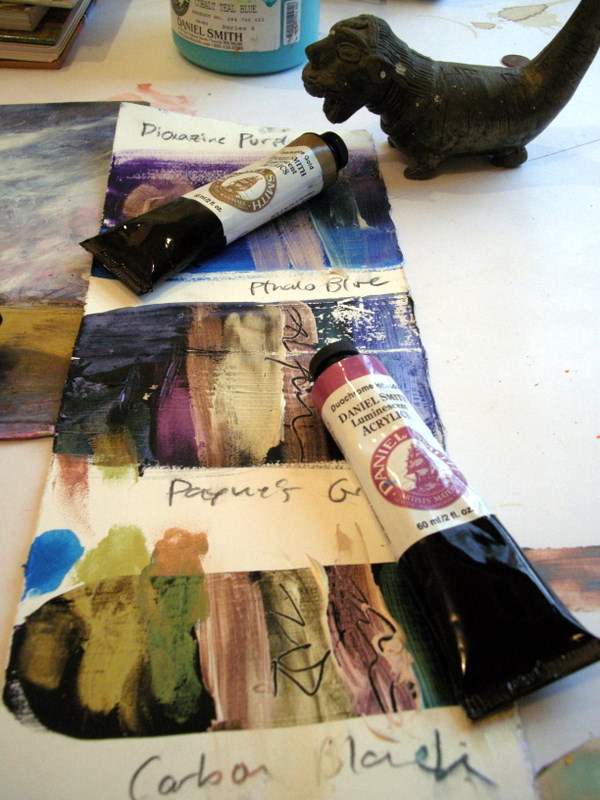
Daniel Smith has always excelled with iridescent, interference, and their own Duochrome line.  I particularly loved the Interference Gold and Copper over black.  The colors are sophisticated neutrals with that alchemical edge.  Scratching into them to reveal the black underneath with heiroglyphic marks made me feel like I was creating texts and tablets from a lost continent.  For strange landscapes, I think Daniel Smith’s color Iridescent Topaz is amazing… a sort of tarnished gold over soft grass green.  And I love the Duochrome Electric Blue… a startling shade that can be used for sky or a bird’s wing or for the brush of thought through the space of a mind.Paint an anti-landscape or a stellar event or decorate your dark-surfaced mood. For more interference paintings, visit www.saltworkstudio.net and see class and event photos.


Dover Image Joy

Call me a fool, but I love Dover images, even if I don’t use them often.  A baboon, a lizard, and choirboys lead the way, while a mammoth skull bellows.  I rushed into the studio, took down a large painting start (orange with flourescent paint) and made a quick assemblage of things to inspire.  Dover images have a rich, black and white web of texture.  I like to enlarge them at Kinko’s on regular copy paper, then rip them freely.  In pieces, you can’t tell what the original image was, but I always think that somehow, the network of lines “remembers.” Paste them down right on the canvas, or, if you’re patient, use an image transfer technique.

Dover Images are a metaphor machine.  Just place any two side by side and see what they tell you.  The choirboys with the mammoth skull?  Well, in the old days we worshipped the animal world, especially those that could kill you.   The skull and the lizard?  We’re immediately in the desert the desert, or the underworld. And, by the way, they’re not copyrighted… they have officially entered the realm of the archetype, the eternal.  Forge your bonds with the archetypes.   Invite a Dover book to dinner.