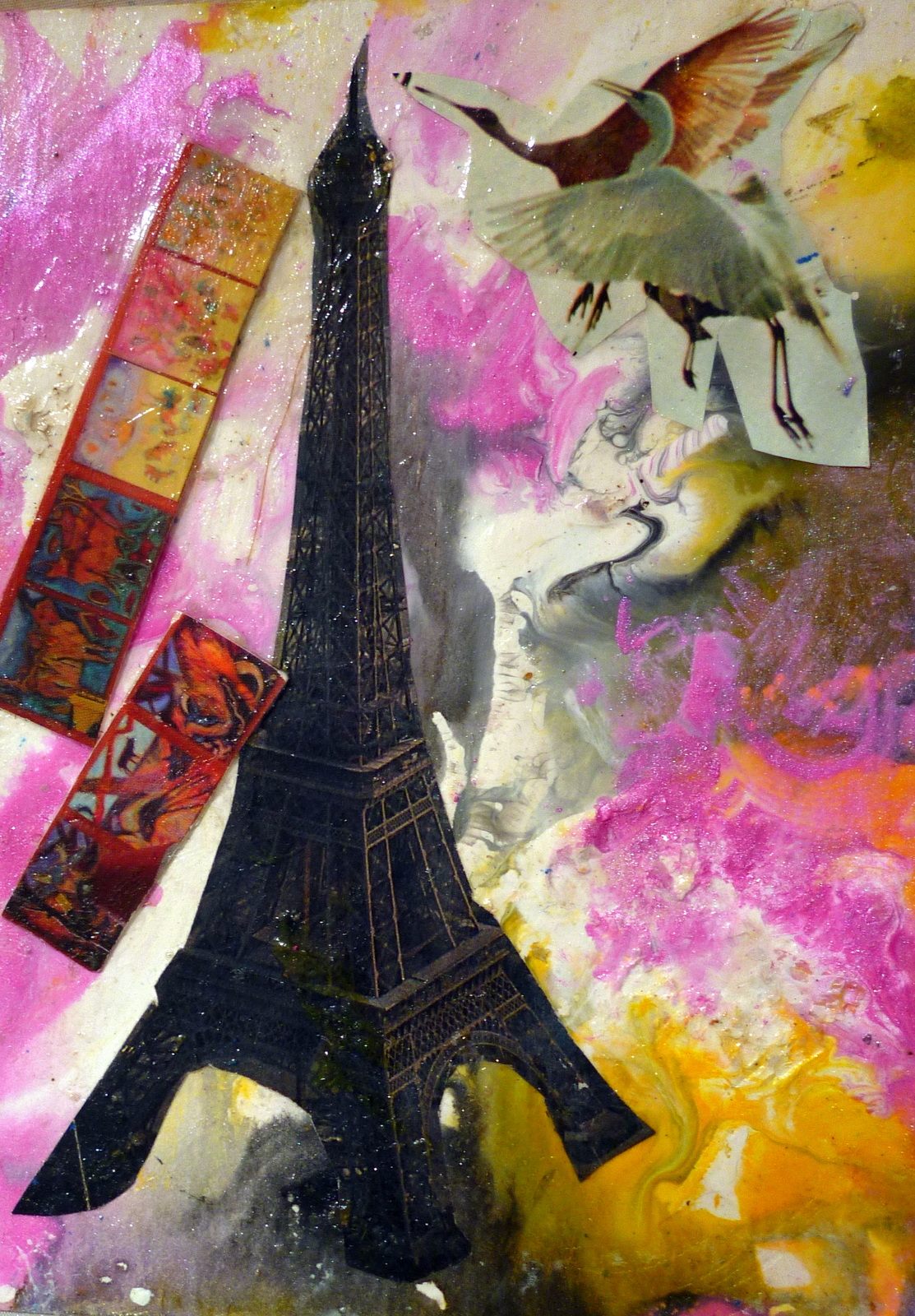
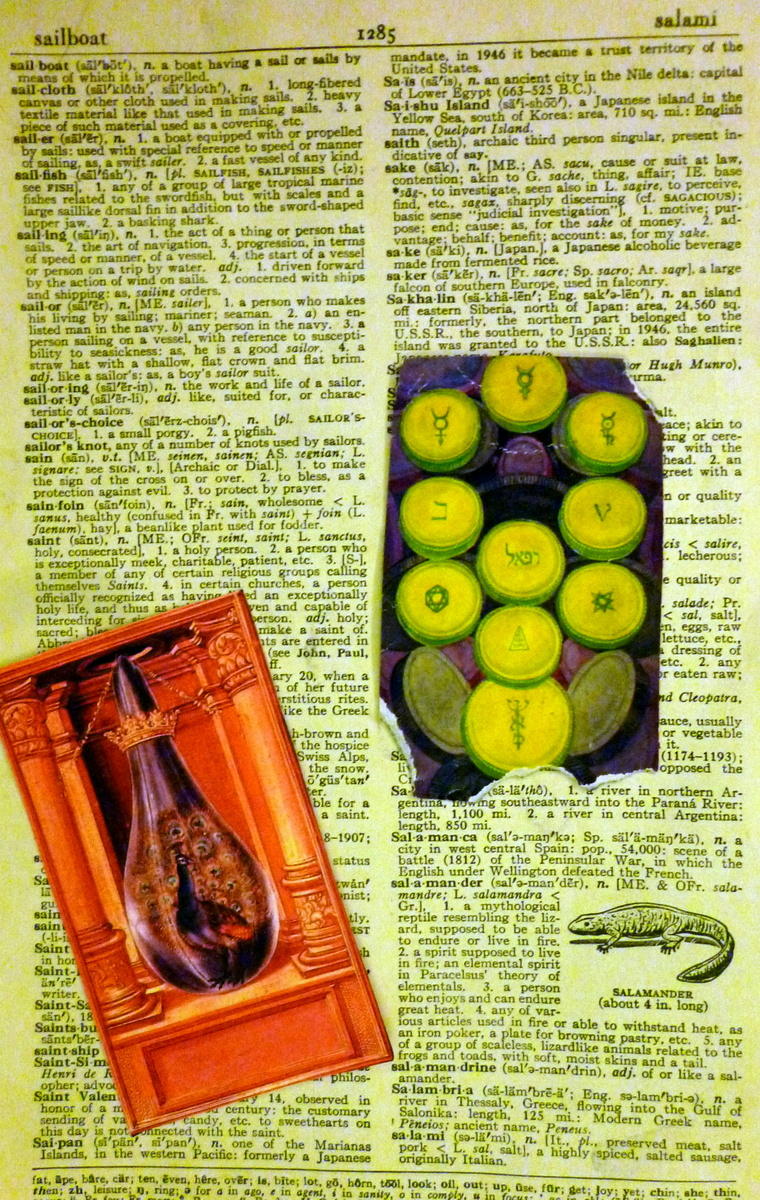
What the heck is a Metaphoracard? Laura Foster Corben and I invented these small (5″ x 7″)collage paintings on matboard to provide art play for Wavy Gravy’s Adult Camp Winnarainbow. I’m the Metaphoracard Girl and Amuse Grove Reader.
In the tradition of side amusements for The Players– the musicians, clowns, dancers, arialists, stiltwalkers, magicians, storytellers and poets of the cosmic, comic Circus– the cards provide diverse diversions, a little taste of trickster mind at play.
As in my Saltworkstudio classes, we work in series, doing three at one time, and follow one of the Almost Unbreakable Cardinal Rules–Paint First. Getting the mark of the hand, paint, brush or ink down before applying images is vital. I’m not sure why, but it seems to transform the cards from stiff constructions to flowing, “wavy,” spontaneous combustions of dreamy image.
They are meant to be entertainments, in the way that some novels are called “An Entertainment.” There is no number to the deck. The deck is temporal and temporary, created in time by a group, played with, and dismantled after. Because they call forth a certain bubbly synchronicity, their accuracy can be astonishing, but unrepeatable. Like an appearance of a Loch Ness Monster, they leave splashy traces, but can’t really be nailed down or captured in a net of a single meaning. And they dissolve after the week at camp, each player claiming their own trading cards of vision, dream, and just plain weird stuff.
A little handful of art magic to play with.
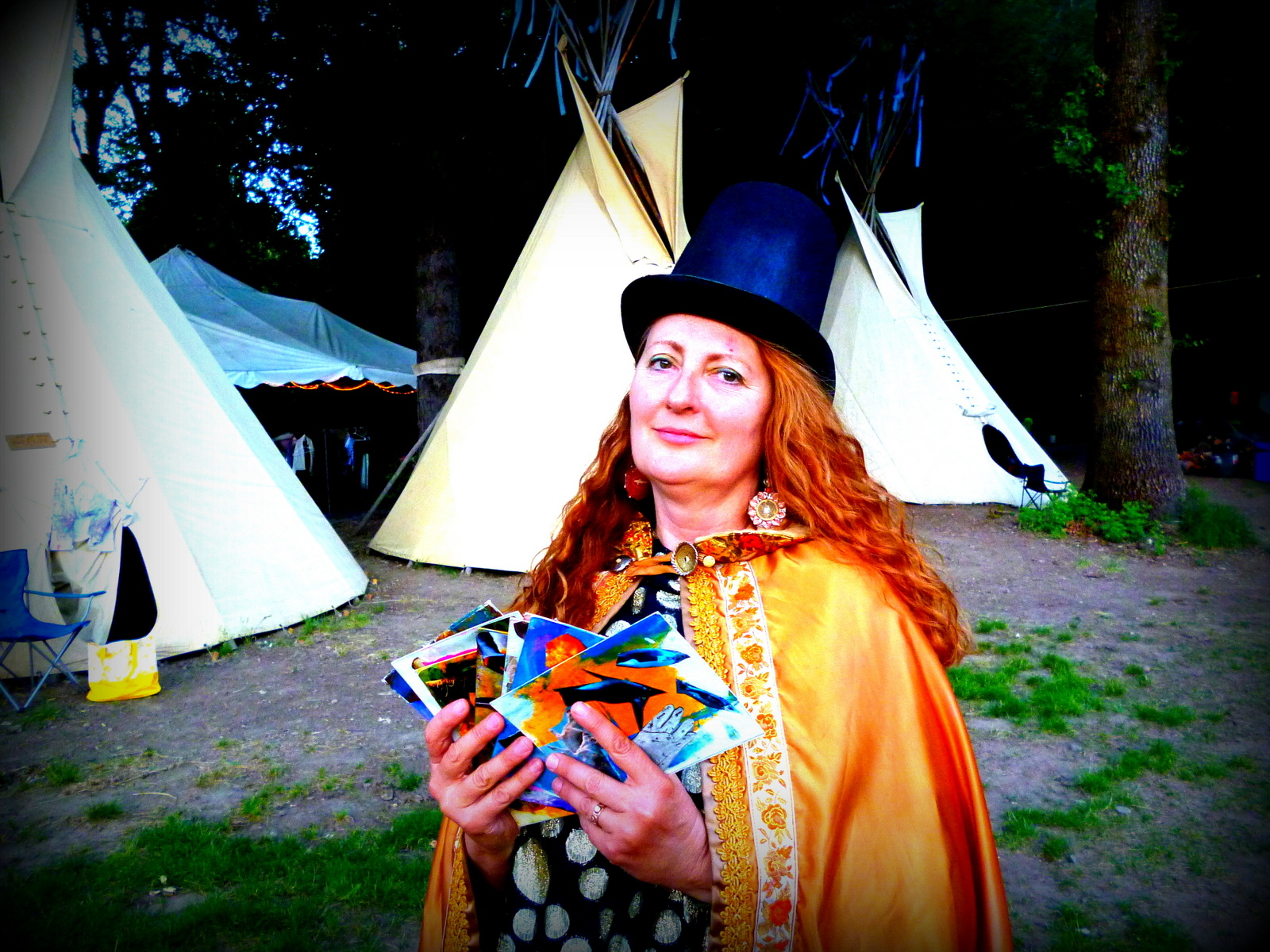
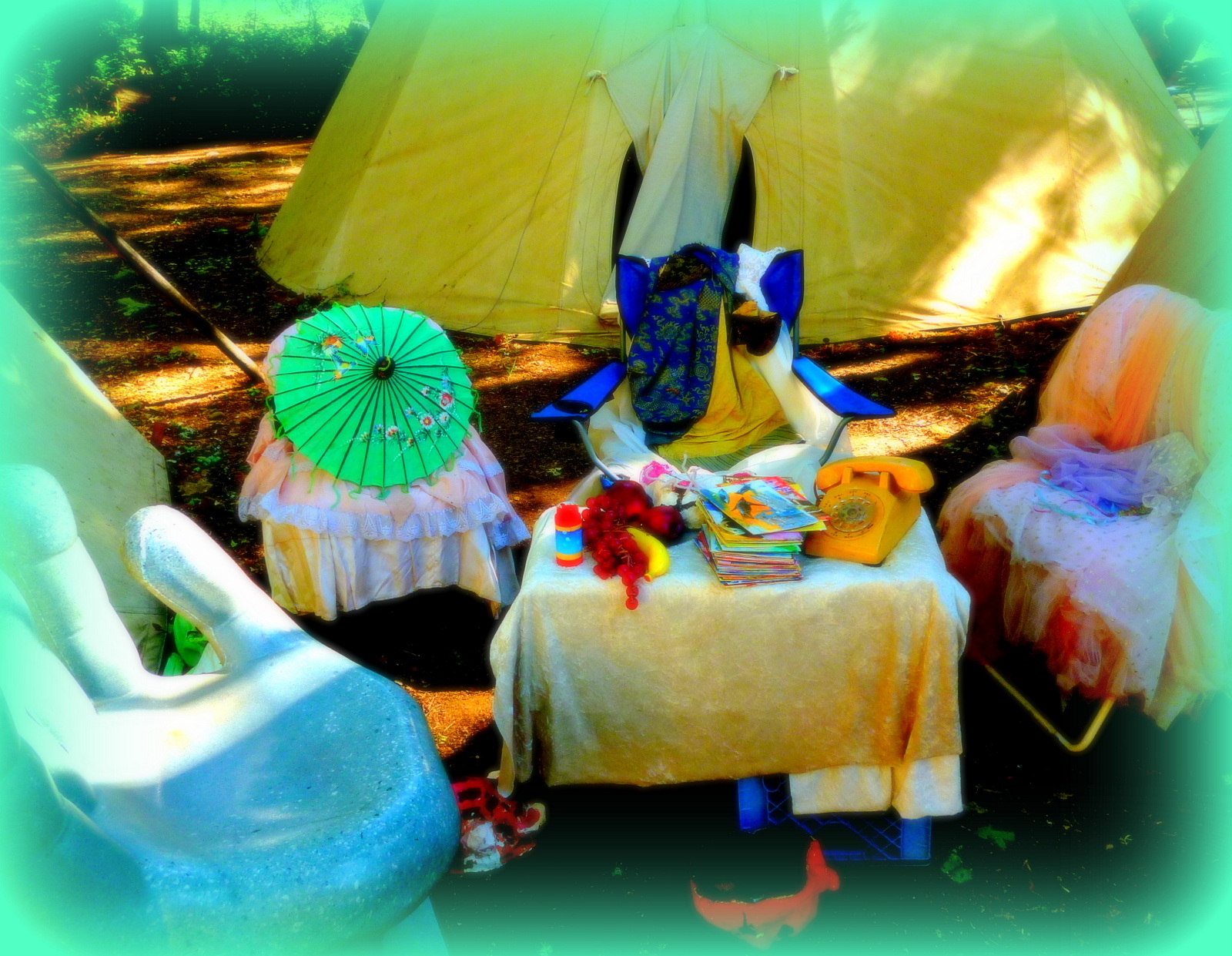
Since Camp Winnarainbow emphasizes fun, play, and performance, we wanted to create a recreational visual art form that would give satisfaction in the both in the making and in active use after. The cards were read by a raggle-taggle Amuse group in the temporary Amuse Grove you see below. There’s a Cosmic Phone for when we get stuck. We just dial up the Demigods to get an anwer. The chairs are decorated with old wedding gowns from the Costume Tent.
Instead of the Muse Grove, the Amuse Grove.
Metaphoracards require a community. You need a group to get a deck, and you need someone else to read your card. It’s the rule of the Cosmic Trickster that you can’t know what your image might say. I puzzled over my image of Faulkner, doggies, and a flower, until my husband Scott said, “That’s easy. It’s Power: dog power for the body, Faulkner power for the intellent, and the flower is pure vegetative power, an idea bursting out.” Huh, and wow. Flower power?
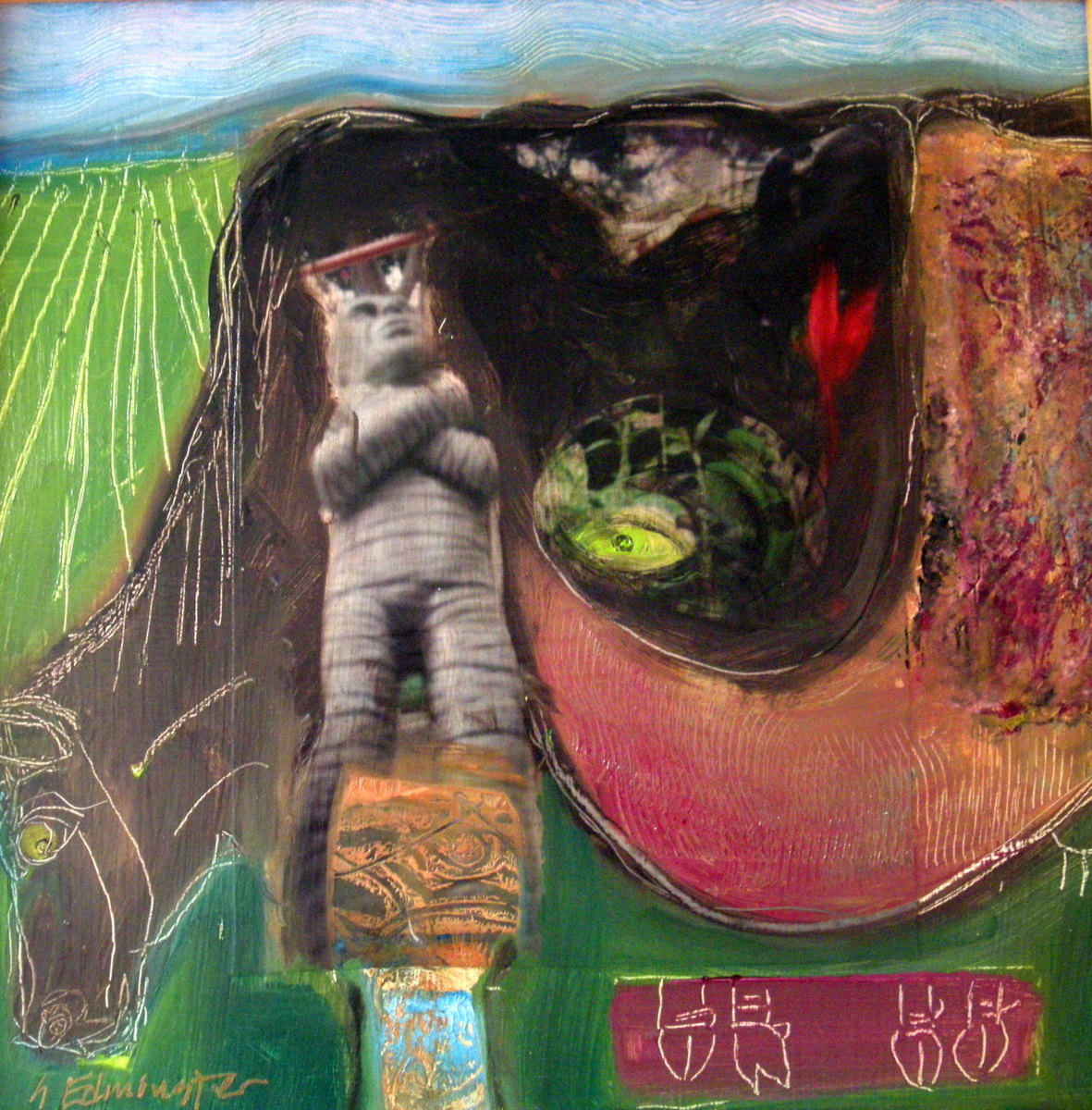
Nature Walk, 12″ x 12″, oil paint over pinhole photos, Suzanne Edminster
Painting can take you to strange places. I offer these older paintings as a travelogue of a surreal journey through spontaneous image.
Some years ago I mounted blown-up, cut-out photocopied images of my own pinhole photos on Masonite. I had a photo series of a small, two-inch Mummy, an Invisible Man model, a Barbie doll, and a plastic toy lizard. Keep an eye out for them, as they pop up in various combinations in all four paintings.
I varnished the black and white photocopy mounts with clear acrylic varnish as a protectant, letting it dry. I then covered each panel completely with oil paint. The images disappeared. That was scary! We love our figurative images, and to cover them makes us feel like we have lost our way . But it is important to completely cover the surface, so you can’t see the original images any more. Just choose a few analogous colors to start.
Oil paint stays open, or wet, for quite a while. Using a soft rag, I would rub parts back to the original photo, then add more paint, and repeat this, over and over, until new images started to form. It was like watching a mysterious image develop. I had no plan for the original mounts. The images just appeared. The first one was Eye Boat, below. You can see the guts of the Invisible Man, and the lizard became a sort of surfboard. They are led by the Eye Boat–led by the eye, or vision–which tows three fish. Maybe they’re the next three paintings.
Eye Boat, 12″ x 12″, photos under oil paint, Suzanne Edminster
Okay, I had a start: two figures in a sort of journey. The second painting was Nature Walk, at the top of the blog. A giant gorilla peered over the horizon at the two small figures enjoying a stroll, and the Mummy got a cigarette. I loved the thick, greasy, slippery feel of the oil paint, and the sharp smell. Shapes and images surfaced and submerged. It was mesmerizing. It took a long, long time. Apply, rub away. Add, subtract, change, cover, lose it, reclaim it: hide-and-seek with images.
The Sacrifice, 12: x 12″, oil paint over pinhole photos, Suzanne Edminster
The Sacrifice is the darkest of the series. The couple becomes androgynous, with the partner becoming a sort of butler or servant. A table appeared in a desert. Hooves and feet were scratched into cartouche forms. A smiling cow head appears on a table with two glasses of red wine. This has a forsaken feeling; I thought of Shelley’s poem Ozymandias. Motifs kept repeating: the high horizon, the pillars, the animal forms. I was dreaming in paint.
Belly Thoughts came last. A world of landscape appears inside a cow, and the Mummy has become a sort of householder or landlord, surveying his domain. There’s a snake in the garden, though…
Belly Thoughts, 12″ x 12″, oil paint over pinhole photos, Suzanne Edminster
These turned out to be important paintings to me. I think they may have actually foretold my future: a kind of before-sight rather than hindsight. Obliterating the image is very freeing, and moves the painter rapidly toward increased abstraction. Meaning won’t be lost; it reasserts itself constantly . You never have to worry about that.
Studio notes: This is my favorite method of painting with oils, because it fully exploits their oily quality and reluctance to dry. Oil paints have a mystery and resonance with film– all those chemicals! (Black and white photos used to be colorized with oil paints.) I did these during the last class that Holly Roberts ever taught at UC Santa Cruz. The painting studios had a view of the Pacific, and I had a key to the studios to come early and stay late. She taught us how to paint in oils without turps, using linseed oil as a medium and baby oil as a brushcleaner. Holly’s work is superb: mysterious, intelligent, passionate, and completely expert. I am grateful for the series of classes I took with her.
Spidermen Original Holga Photo, Suzanne Edminster. Pre-Instagram!
As I was going through my overcrowded art storage area, I came upon my nemesis– the art collage box. It was full of things I collected at one time. I was sure I would use them some day.
I won’t tell you everything I found, but there was Monopoly money from a broken antique set, German fortune-telling cards, a work on rice paper by an artist from Bangalore, India, and Mexican loteria cards. Out fell ancient notes and antique photos, a Virgin of Guadalupe print and a Holga photo of Spidermen, and a paranormal magazine I got in Prague in the 90’s.
Collage Box
I thought I might tell you what I kept and what I discarded, but I found I was reluctant to list things I threw away. Hey, it felt like a taboo. Why?
I’ve always said that collage itself had some connection with destruction and death, the dark side. Things are dismembered and removed from their original space, time and context, often by cutting or tearing, actions that have an air of violence. There’s an air of secrecy about them. That box felt like a coffin for dead ideas combined with a treaure box, a graveyard for things that had once compelled me.
Someone would be sure to ask, “Why did you throw that out?” Even worse, they might say, “You could have given that to me. I would have liked that.” I would be responsible for disappointing someone. Another person would become implicated and entangled in my decision. I’ve encountered this a lot. People really do not like it when one simply disposes of things. A taboo has been broken. Improper burial? Disrespect for objects? Then the discarded object comes back to haunt you through the remonstrations of others. And now, with the advent of eBay, all junk has been acquired a false patina of consumer value.
I bought this in Bangalore when I was rich. Now I’ve lost the artist’s name. Perhaps Rashika Thakur?
Each item is really the representation of a certain dream, experience, or longing. An object then has become a literalized metaphor, carrying meaning far beyond itself. If I discard the object, do I discard the idea? Or does the object become a substitute for fresh experience? Each item becomes a love letter from a past idea-affair.
Nowadays I use only two kinds of collage: text and black and white non-copyright photocopies of drawings or my own photos. Often the collage vanishes completely, or is torn to become an area of texture that may have figurative associations for me, but not for the viewer. I’ve never liked using “old” or “failed” paintings as collage parts. It seems disrespectful to the original impulse, a Frankenstein construction that I am forcing to life.
I think I’m just as happy putting this flotsam on the floor and photographing them, and then letting them drift back to the strange ether of discarded objects, or the garbage. But then, again…
There, I’ve revealed my collage underbelly. What’s in your boxes?
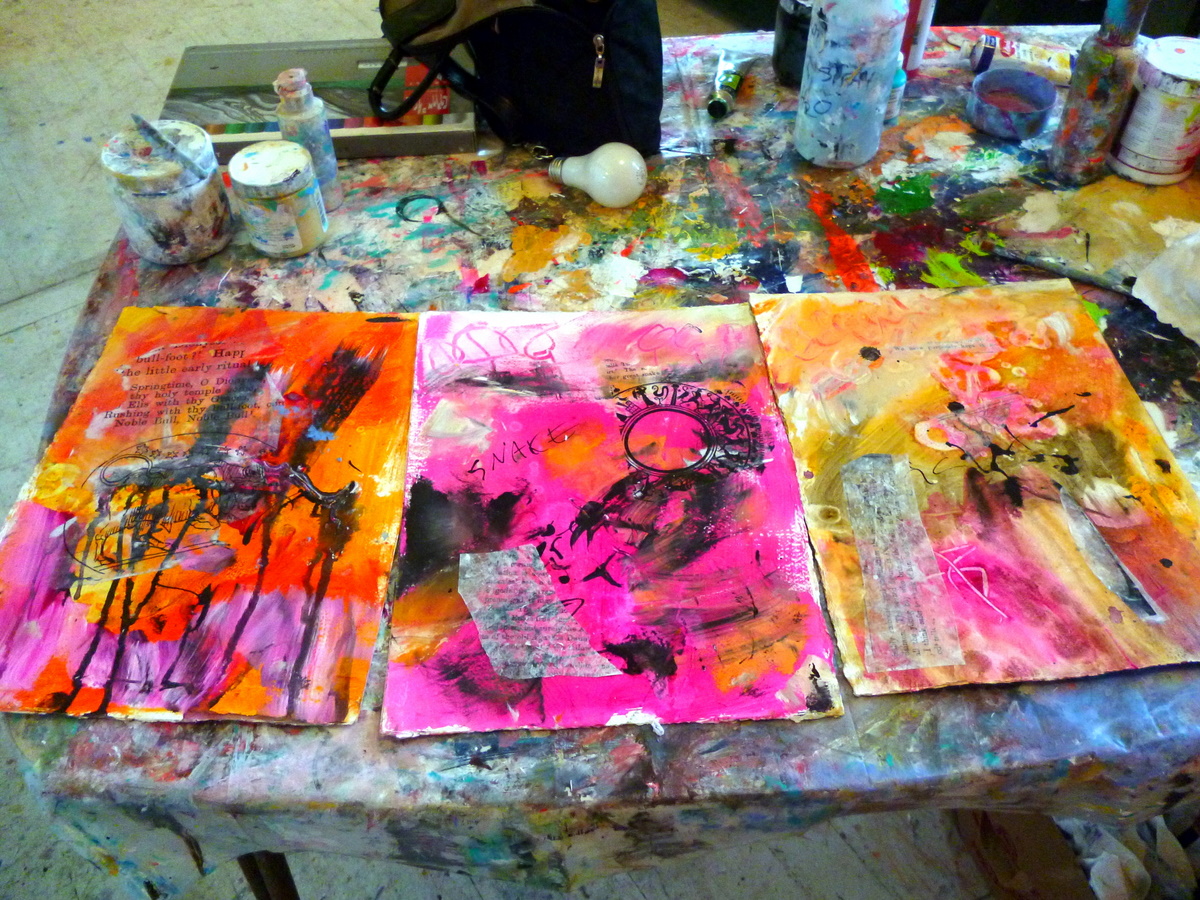
Worktable with 3 “Drafts” for Larger Paintings, Saltworkstudio
Where am I now? What’s next?
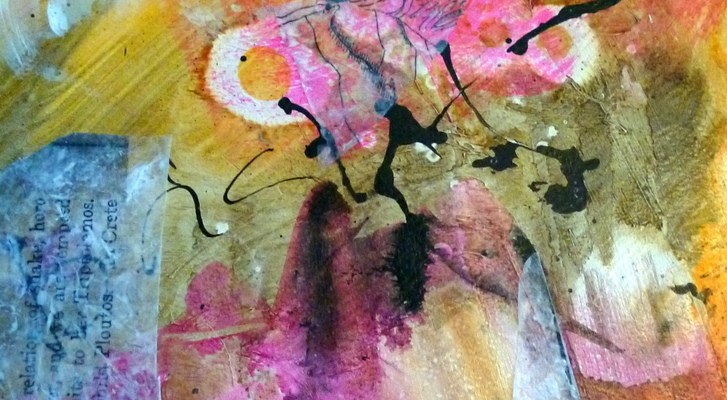
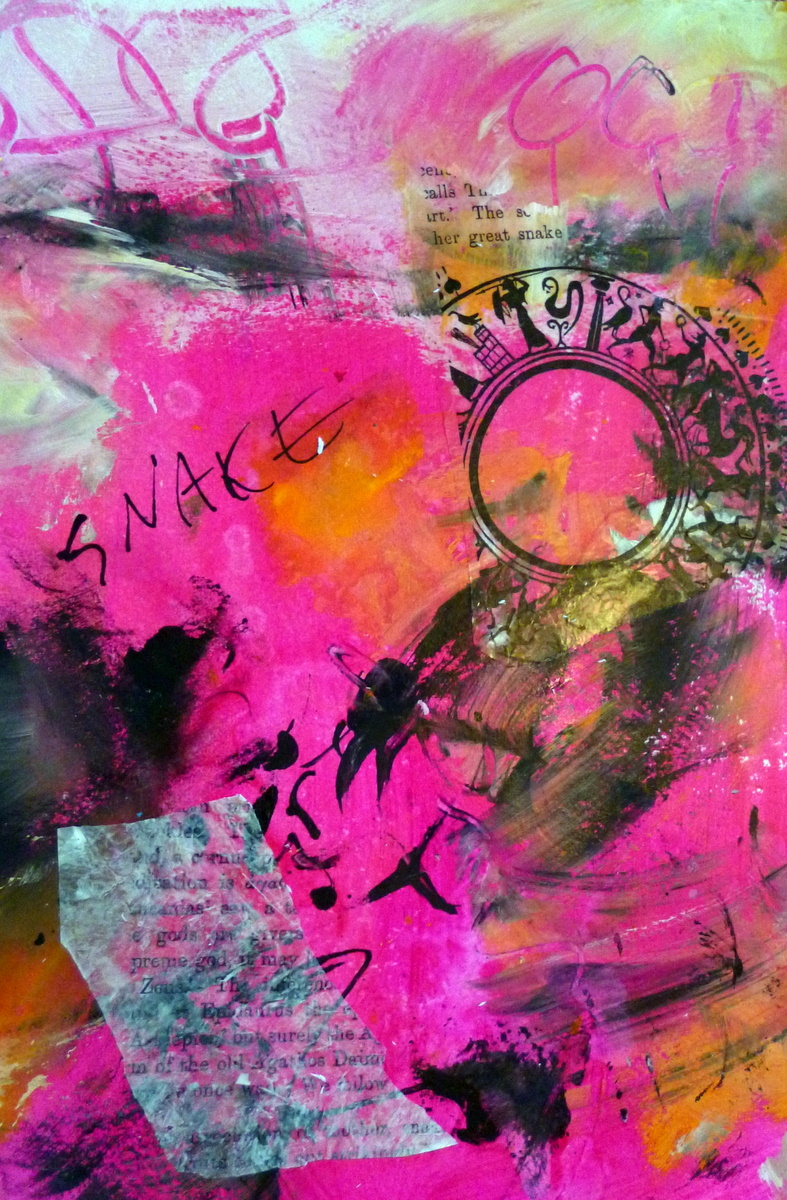
I’ve been incubating this Dionysian series for a while. I have three 2 foot by 4 foot canvases waiting for paint to develop these themes, colors, and forms. The starts shown above are meant to act as “thumbnails’ for the next phase of larger paintings on canvas.
I have the best luck with my finished pieces when I am purposely experimental, uncontrolled, and unfinished in my draft paintings. I’m groping in my own darkness when I paint. I don’t want the whole process to happen even before I hit the canvas. I don’t want to pre-paint it in my head, my notebook, or anywhere else.
I found a useful new metaphor for thinking about any creative project, whether it’s painting or cleaning out the junk room. These ideas are from The Path of the Everyday Hero, a book about mythic themes played out in life. The six phases of creativity are preparation, frustration, incubation, strategizing, illumination, and verification (or manifestation).
Dignified, precise language allows us to reframe creative pauses or lapses. It’s interesting that frustration comes immediately after preparation, right at the start. Frustration is the failure stage, the belly of the whale, the so-called “block”. What now?
My friend Karina Nishi Marcus is very clear on the idea that “block” should be eliminated from the artist’s vocabulary. She says creativity is more related to nature metaphors, like “low tide” for the ocean, or “fallow” for the land. It is a necessary part of the creative process.
Frustration stops us from action, and makes us incubate our ideas, like an egg. It’s on the back burner, in the nest, warming, passive on the surface but active underneath, mysterious, the seed under the ground. To incubate properly we also need to strategize, to try things that might nourish or warm the invisible idea. Some might work, some not. But the passive time is needed, yin to the yang of action. Paintings can stay successfully in this stage for a long time, even years.
“The Great Ones”, acrylic combined media, Suzanne Edminster
The painter or artist may have to go back and forth in the frustration–incubation–strategy realm for a while, then illumination, the “aha moment” strikes, and elevates the venture to a different level, perhaps to completion. The creative round, like the phases of the moon, will start again with a new idea.
“We Have Purposely Kept It”, acrylic combined media, Suzanne Edminster
These paintings are not done, but after some months of incubating, I am strategizing. The notebook helps keep me on track. When you find your way through an art dilemna, the solution often seems absurdly simple. Still, it took time to get there. The cycle may play out in one painting, or in series spanning decades.
The Dionysian metaphor is one of unbounded spring growth and ceremonial theatre, among other things. Perhaps I should drink a glass of wine to Dionysios, and return to the paintings. A flash of lightning, a sprouting vine, or a Greek chorus might illumine the way to the next act of painting.
Mythic notes: The Dionysian mystery cults tried to loosen the bonds between the worlds through sacred intoxication, theatre, dance and ritual. The Pompeii Murals, with their glowing Pompeii red, were thought to have depicted aspects of this.
What’s the difference between selling out and simply selling?
I found myself arguing with myself over this post when I put it up last week or the week before, feeling oddly insecure and conflicted. I ended up making it a draft again, unposting it and pulling it offline. Yes, there were typos, but I think it was more that I had some problems with feeling authentic addressing the issue. My success in the arts is modest and my own skills at using the internet to market are certainly not advanced. Who am I to tell you what to do? Some of my advice goes against common consensus on internet marketing.
That said, I found that I had the most conflicts with the section called post and publicize carefully, so I’ve included the original draft and some revised thoughts below.
Sometimes I feel sickened by using the internet to publicize my paintings. It gnaws my brain into small pieces and inflates a sort of Virtual Persona Girl who has a crabby, fragmented, and narcisstic ego. That is certainly one form of selling out, and a dangerous one. That said, I’ll begin again…
What’s the difference between selling your soul and simply selling your art?
Many of us can envision– or have experienced– life before or without a television, but few younger people today can reconstruct the era of a world without internet. The Web now reaches its tentacles into every moment of our lives and every part of our bodies. ( I have a theory that cellphones are the new cigarettes, but that’s for another day.) Artists are engulfed in a tsunami of information and marketing possibilities. It has become harder and harder to decided what to do, or decide if what you’re doing is worth it. Here are a few ideas for those who feel adrift in the flood.
The route to success is not soley through the internet, or through sales. Many masters were obscure in their own time. I’m not suggesting that this is the way to go, or that you shouldn’t bother to try to publicize on your own behalf. But I will say that the artwork has to be strongly felt, beautifully crafted, and cohesive to make a mark. Artwork that is well-made will find an audience and buyers of some kind, with or without Twitter. You do need to clarify what success is for you. There’s a wide range on the spectrum. Are you Vincent Van Gogh, Matisse, Thomas Kincaid, Bouguereau? Are you looking for a small circle of people who love your work, or do you want to make big money? Somewhere in between?
Don’t chase genre. “Landscapes sell.” I’ve heard this too often to count. The other thing I’ve heard is “I’d love to do more abstract work, but it won’t sell.” The flood of images now available online and print has sensitized us to cliché and to inauthentic artmaking. Now more than ever, it has to be your own, even if your own work is very odd.
Find your own relationship with internet marketing. Marketing online will periodically change, and you’ll have to master new skills. It will repeatedly and radically shift its form, and you will have to find your own way through the maze. No one solution will fit without alteration over time. It’s useful to ask “Who is my real audience?” Why are you doing social networking, for example? If it is to socialize, you’ll be successful. If it is to sell, it may not work for you. Use networking to build authentic, friendly support systems. They may bring far more than you can anticipate. There’s no magic equation for marketing. And if you do things which feel false to you, simply to market, they won’t work anyway. Choose to focus on a few venues that feel fun and manageable to you. Be polite. Publicize others. Spend time online doing unto others what you wish they would do unto you– viewing, commenting on, and appreciating artwork.
Post and publicize carefully. Don’t rush to show too many works-in-progress, unless that is part of a plan or goal. “Works in progress” are intriguing, but save your energy for the finished work. Sometimes work can appear more impressive online than in reality, but it needs to be the other way around. If you find yourself “tweaking” your images too much, you may be over-identifying with an online image, not your original impulse.
Here’s where I started arguing with myself. I do think we can use blogs as a journal; they can clarify direction and act as a reflection. If we can use notebooks to move our artistic process along, then we can also use the internet as a to0l to amplify our creative process. Regarding the “works in progress” riddle– what to show, what to hide, what to contain– I’ve decided to show selected works-in-progress online, but limit their frequency. In my last post, Six Phases of Creativity, I decided to put the raw or “draft” works in context by showing them sitting on my worktable. I have a strong feeling that marketing really can overtake and subsume the production of quality art. Look at Thomas Kincaid. I think we must always delicately adjust our courses, and to consider containment or withdrawing from marketing as an option.
Though painting-a-day posts have their place, posting prematurely– or too often– can be mildly deceptive to the viewer, and can rob the work of energy needed to explore the work. After all, you’ve already gotten a charge from having it seen online. On the other hand…
Get your work out to everybody possible. Make links available and write simple email show notices. Don’t get caught in the false reality of virtual approval. The statistics and numbers give us a feeling similar to gambling. They are fun, but not real, and have addictive qualities. Shows, sales, and real-life appreciation by actual, not virtual humans is what feeds us. The internet can be a net that falsely traps us in distant admiration, or it can be an open, inspiring road to reaching out to more people in an authentic way. Success may choose an indirect route, and require time, that rarest of all elements in the shifting cloud of Internet.
Cow Carrying the Neolith on Her Back, acrylic on canvas, 24″ x 24″, by Suzanne Edminster
Acknowledgements: Thanks to photographer Marco Zecchin, whose wonderful premise “Art is Sacred” is the cornerstone of his marketing philosophy and workshops. I enjoyed using the magnificent, rare and unpublished photos of Lascaux in 1947 from Life Magazine. My thanks to author Matt Ellis, whose article on David Gaughran’s blog provided the inspiration and framework for this post.
My boots and rain hitting the pavement, spring 2012.
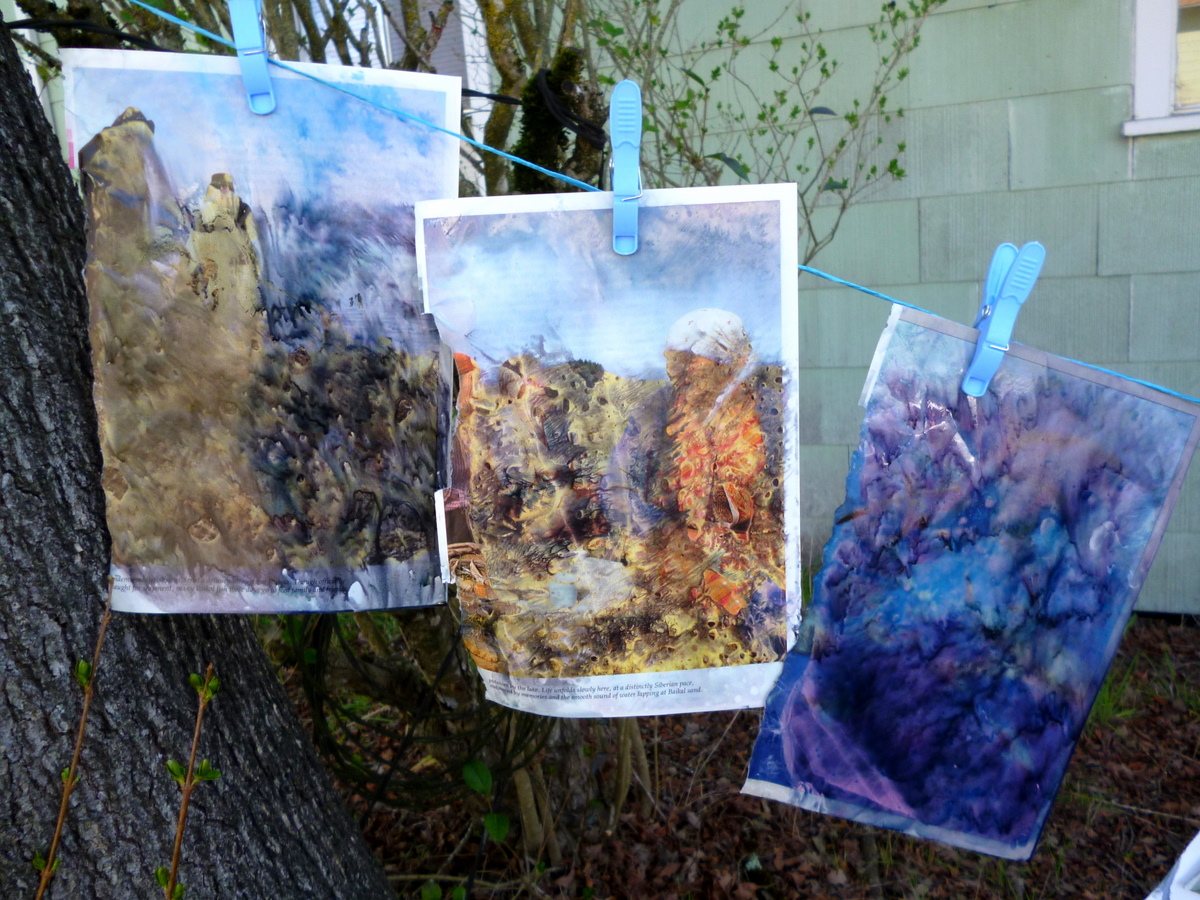
Our spring has been so wet. I love the feeling of the rain. Sorry, but it brings a wave of poetry on, especially e.e. cummings and Dylan Thomas– puddles, mud, and the green fuse that drives the flower. The image below is absolutely spontaneous, a world created by splashes, generative worlds of watery spring.
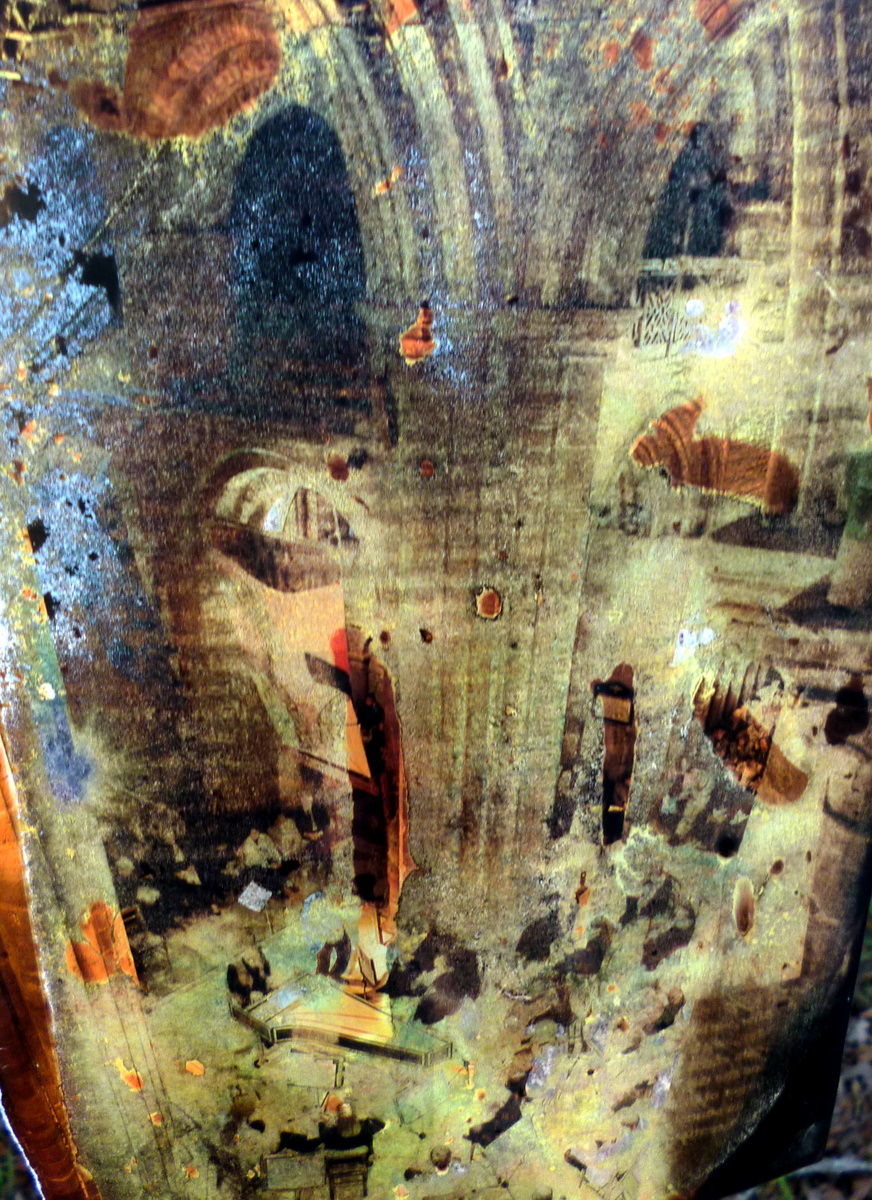
CitraSolv image on National Geographic page
What can you do when an art piece is wonderful and you had no part in it? There is nothing to do with this page of the National Geographic, altered by Citra Solv splashed on it and left to dry on a line, other than to toss it into a pile of other paintings as relentlessly beautiful as a pile of autumn leaves.
CitraSolv images drying on grass.
Many do show these, of course, or mount them and sell them on Etsy. I use them as collage pieces in paintings sometimes. Every single one of them is a delightful gift from a great spring or source somewhere. Of course, they are a combination of someone’s masterful photography and the Geo’s fantastic printing process, so each one contains seed germs of both talent and technology, an aesthetic DNA ready to abstractly bust out.
I think that these little altered National Geographic pictures are just evidence of a great Grace, grace without effort. I find it unfair that these are so beautiful and that I have to work so hard to make paintings. It’s unfair, but unfair in the right direction.
My mother was given a lifetime subscription to National Geographic in 1929, so these magazines have always been a part of my life. Each one is embedded with worlds of adventure in soy-based ink, released on the application of Citra Solv. Do you remember flipping through them as a child, seeking breasts or beasts? Were you forbidden to cut them up or destroy them?
It’s humbling to see what nature, chance, and the hand of others– the photographs we so relentlessly destroy to turn them into something else— can bring. It’s a form of faith rising after destruction. Exhilarating. Spring, after winter.
Mythic notes: Here’s a Dylan Thomas poem for spring. There are so many images here of dripping, whirlpools, fountains, and natural accidents of love; this reminds me of painting with water media. I have always loved the phrase “green age.” It’s what we can hope for.
THE FORCE THAT THROUGH THE GREEN FUSE DRIVES THE FLOWER
The force that through the green fuse drives the flower
Drives my green age; that blasts the roots of trees
Is my destroyer.
And I am dumb to tell the crooked rose
My youth is bent by the same wintry fever.
The force that drives the water through the rocks
Drives my red blood; that dries the mouthing streams
Turns mine to wax.
And I am dumb to mouth unto my veins
How at the mountain spring the same mouth sucks.
The hand that whirls the water in the pool
Stirs the quicksand; that ropes the blowing wind
Hauls my shroud sail.
And I am dumb to tell the hanging man
How of my clay is made the hangman’s lime.
The lips of time leech to the fountain head;
Love drips and gathers, but the fallen blood
Shall calm her sores.
And I am dumb to tell a weather’s wind
How time has ticked a heaven round the stars.
And I am dumb to tell the lover’s tomb
How at my sheet goes the same crooked worm.
There’s something compelling and fey when outdoor creatures come inside. Sandra Maresca’s narrative animal paintings move the animals into our intimate, domestic consciousness in a delightful way. Bright colors and primary forms lend a graphic, deceptively childlike look to the paintings, with echoes of folk motifs and domestic ornament. Sandra references the flattened, decorative “Les Nabis” style: iconic forms , local color, and applied arts designed for everyday enjoyment.
The paintings tell stories on many levels. Lambs on a bed make us think of the wool used in blankets as well as “counting sheep.” They also have a feeling of the “see no evil” monkeys, with secrets under the fleece. After all, they are sitting on that most intimate of worlds, the bed. When the wilderness is moved inside, on to a bed or chair, invading the private world represented by our houses, the animals begin to speak their own language of inhabitation.
The Outsider, 20″ x 20″, Sandra Maresca
Here the human is on the outside, looking into a wallpapered world occupied by the animals. The forest wildflowers now blossom on walls, while the trees have become furnishings. The green chair is like a forest floor, with owl and rabbit. Our houses used to be homes to domestic animals. When Scott and I visited Matera, in South Italy, where families lived in limestone cave warrens, the donkeys lived in the back of the cave, behind the matrimonial bed, while the chickens lived under it. I see our modern loss of connection to the animal world in a daily sense of farm, wilderness, home, and food as a wound; our longing erupts in overbred “purse dogs” and animals treated as human children. Sandra’s paintings have some echoes of Bonnard in her use of animals in patterned domestic spaces to define intricate worlds. Her animals instruct as well as entertain.
I saw Sandra’s show on the First Friday Art Walk in Guerneville in March. I was impressed by the fine gallery space that The Blue Door Gallery provided. Johanna Ottenweller, mosaic artist, has done a wonderful job of creating a Craftsman-style environment that displays art with simplicity and elegance. For more of Sandra Maresca’s paintings, visit her website or drop by the Blue Door Gallery (see details below). Sandra’s studio will be open during the Art at the Source open studio tours the first two weekends of June. Don’t miss her handmade fur and wool animal sculptures: adorable, totemic, and often beautifully disturbing, like something from the ancient days. I own one.
Blue Door Gallery
Owner/proprietor: Johanna Ottenweller, mosaic artist
16359 Main Street, Guerneville, CA 95446
Hours: Fri-Sun –Noon to 5:00pm
“So Much We Can Learn” Narrative Paintings by Sandra Maresca March 2- 31, 2012
Trojan Horse, "Final" Version. A Four Hands Painting.
The Trojan Horsewas surprising to both of us. Just how did this image develop, seemingly independently of plan or will? What was happening behind the Oz-like curtain of the studio process? Follow us through our start and stages.
Trojan Horse Part 1: The Start. A Four Hands Painting
The Start: We poured ink, gesso and paint. What a figure emerged! I named him The Prophet in my mind. It was off-balance composition, with emphatic marks and lines hovering like bats, and Halloween colors. Edgar Allen Poe might have been proud. We had agreed that we would work with large curves, a vertical or upright form somewhere, and calligraphic marker lines on this series, and all those forms were there– but– like a “bad” child, acting out. It wasn’t pleasing from the very start the way some of the abstract pours were; it was not initially not beautiful. However, it did invite radical action, which was fun.
Each Four Hands painting seemed to have its own soul or being trying to emerge. When two people work together, control is lessened and gaps are created where fate or luck can enter.
Trojan Horse Part 2: The Development. A Four Hands Painting
Each “problem” became an invitation in the next stages. Too warm? Add purple shapes. Periwinkle violet rectangles began to pop up. An “arm” of the form was eliminated. More gesso was combed on with one of Susan’s notched forms and a “coliseum” emerged. Horse + ruins =… oh dear, a Trojan Horse was emerging, that gift that kept on giving. The foreground aquired areas of blue and white as well. Torch forms, cakes, candles started to light things up with red. The canvas was very messy at this stage, with many distracting marks. Time to remove and transform. Heave-ho!
Susan had been exploring horses in her work, and I had just returned from Italy, where I bathed in Greco-Roman art and lost civilizations, so I supposed both of these elements emerged. Like a dream, though, it was more than that. The painting seemed related to Timelinein style and form, and was grouped with it in the show. Trojan Horseand Timeline share some aethetic of “event” or chronology, time on wires. You can see them together in the show.
Trojan Horse, "Final" Version. A Four Hands Painting.
More blue added, orange cut back, violet reduced, pure red accents. Opaques calm . A few greenish and brownish neutrals to rest the eye, and an iconic horse moves, as Joni Mitchell put it, on the “carousel of time.” Or a child’s hobby horse thumps through a field….What do you see? For another Four Hands painting, visit Susan Cornelis’ Conversations with the Muse.
This is Bea Tate-Endert’s studio window in the Barracks. Brushes and blossoms and Bea’s careful touch to her rich oil paintings brought an e. e. cummings poem to mind.
Spring is like a perhaps hand
(which comes carefully
out of Nowhere) arranging
a window, into which people look (while
people stare
arranging and changing placing
carefully there a strange
thing and a known thing here) and
changing everything carefully
spring is like a perhaps
Hand in a window
(carefully to
and from moving New and
Old things,while
people stare carefully
moving a perhaps
fraction of flower here placing
an inch of air there) and
without breaking anything.
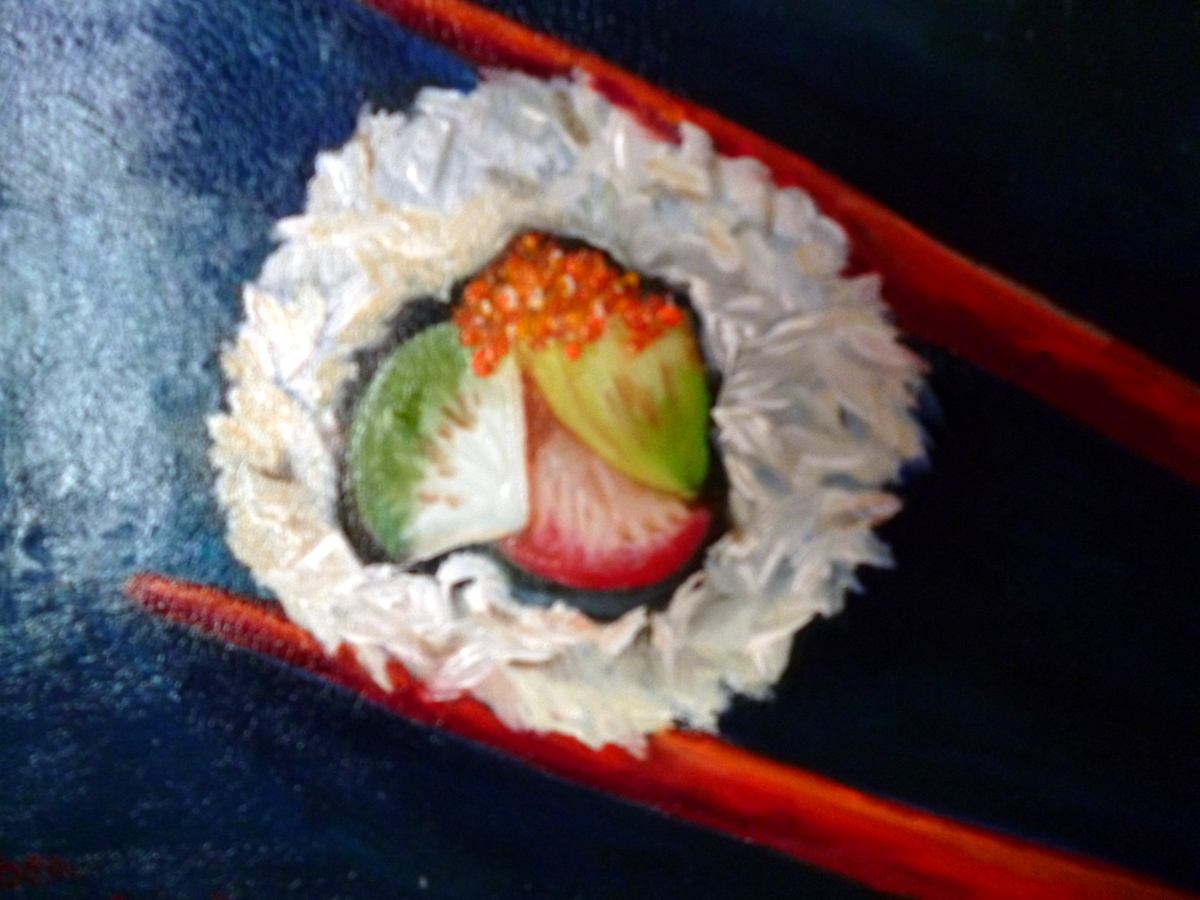
Here are two paintings by Bea. These sushi paintings are postcard-sized oils. Luscious!
The tobiko eggs shine and each grain of rice is deliniated. I might have to have this one.I am so lucky to have her across the hall from me. Her care and delicacy show her deep aesthetic celebrating food and the good life. Look at her Sennelier acrylic paints. Even they look good enough to eat!
AND–she invites me from across the hall to come over for absinthe, with sugar cube and spoon, in a French glass embossed with honeybees. Take your “perhaps hand” and put it in mine. Spring just got a lot better!

 It’s the rule of the Cosmic Trickster that you can’t know what your image might say. I puzzled over my image of Faulkner, doggies, and a flower, until my husband Scott said, “That’s easy. It’s Power: dog power for the body, Faulkner power for the intellent, and the flower is pure vegetative power, an idea bursting out.” Huh, and wow. Flower power?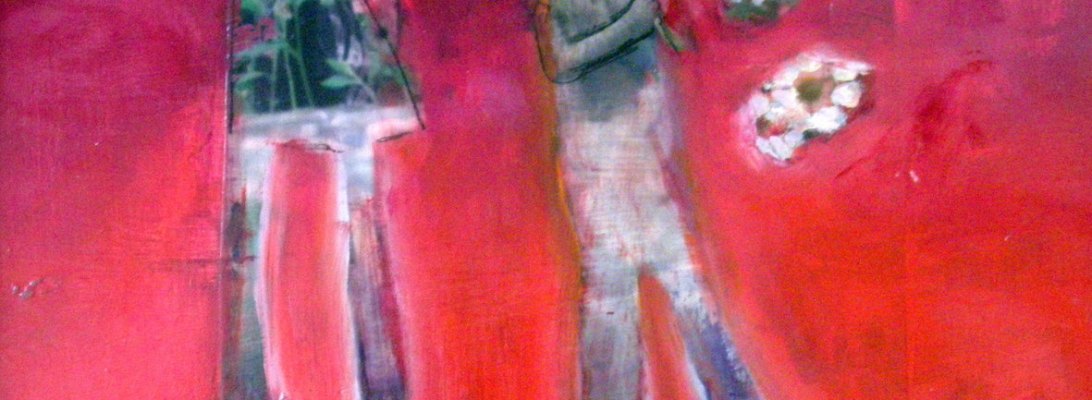
















 Saltworkstudio | Suzanne Edminster