
What’s an Alkonost?

The Alkonost is a Slavic/Russian folk tale woman-bird. Continue reading
What’s an Alkonost?
The Alkonost is a Slavic/Russian folk tale woman-bird. Continue reading

Small does not mean diminshed intrigue or impact. A good small painting reads big. I remember that in the Denver Art Museum that you could see the Georgia O’Keefe small painting from across a vast room, before we could even identify it as hers. It just shone. I’ve been working on larger pieces for a while now. It’s an interesting lesson: large is NOT small scaled up somehow. The dimension changes meaning. This one will be on display this Saturday.
Confession: the very small works are often traces of projects that lead to larger works for me. My own sense of detail is not robust; I prefer the BIG. Even my handwriting is large and scrawling. I like to work small on paper– it feels more open and free. But sometimes I do “smaller” canvases: 10″ x 10″ is one of the smallest. I like mixed media on smaller canvases to make more of an impact. Everything is small-ized now. Just think of your Iphone and Ipad.

Small can be very expressive. I did the piece above when my dad was diagnosed with cancer. I wanted to make a response that expressed sacrifice and rebirth as his living spirit started to transition. The Little Sun Cow below was just pure play and joy. We all have our art totems. Cosmic and regular cows are mine.

One artist who has a great sense of the small is Susan Cornelis. You can see her latest cool “fossil” smalls here. Come visit me this Saturday, or, better yet, start your own small series. Small can lead to big things. Surprise yourself!


“The creation of something new is not accomplished by the intellect but by the play instinct acting from inner necessity. The creative mind plays with the objects it loves.”
C.G. Jung, from Psychological Types
This quote made me pause. When we lose play, and give it over to force, we lose our contact with the creative world. On the other hand, the “inner necessity” has to include work and bringing the play or fantasy to fruition.
“The creative mind plays with the objects it loves.” This painting is called Europa. I wanted somehow to play with the Greek myth of the bull swimming with an abducted river maiden— and play simultaneously with abstract form. I experienced both these desires in a visceral, childlike way. I wanted to physically play with the figures in the myth, like playing with dolls or action figures, and I wanted to splash paint and watch it pool and run. The two plays came together in this painting. (Sometimes they don’t.)
This painting, an abstract mythic narrative, will be shown at The Gallery of Sea and Heaven in their upcoming Myth and Legend show opening February 16. They took two paintings. The other one is a private narrative , where the visuals construct a strange story; it did not exist until I collaged it. In other words, there’s definitely a story, but I don’t know exactly what it means, like the stories and plots of dreams.
I think of Jung with his Tower on the lake and his mandalas. He loved to play, and having a rich wife didn’t hurt the cause of “playing” with architecture . When we play, we always trust that the practicalities of survival will take care of themselves, like children. What “objects” do you love to play with?

 This is the Point Reyes Venus. I did a lot of silly pastel play, the brush gently following an intuitive coastline, based on a dawn I witnessed on Limantour Beach in Point Reyes. I rarely paint from discrete experience any more, so this was a lovely surprise when it was appreciated and sold this week. Take heart, artists, and treasure the “odd children” of your brush.

A big tuba shout out to you, friends, readers, and painters, for 2013! The Hubbub Club drove out all the creative heebie-jeebies during my new studio warming in the Uribe Gallery in the SOFA arts district in Santa Rosa during Winterblast 2012. It reminded me of the ruckus of a shivaree, and felt like an early New Year’s Eve party. Thanks to all my friends who came bearing gifts, good wishes, and their presence to the new incarnation of Saltworkstudio.
How to begin? I’ve been creating in fits and starts. I like this time of year for brainstorming and planting seeds. In 2013 I’m thinking of the Caerus Artist Residency, my studio classes, gallery shows, and more large mythological paintings. What’s on your docket?
In 2013, there are a lot of open studio doors, more than usual. I’m looking forward to showing regularly during Third Thursdays and the SOFA Strolls starting Thursday, January 17, 6-8 PM. These are fun, informal drop-in open studios, where you can wander around SOFA, catch up with friends, get a snack.

Come on over to my studio and visit. I have a biiiiiig SOFA sofa to lounge on.
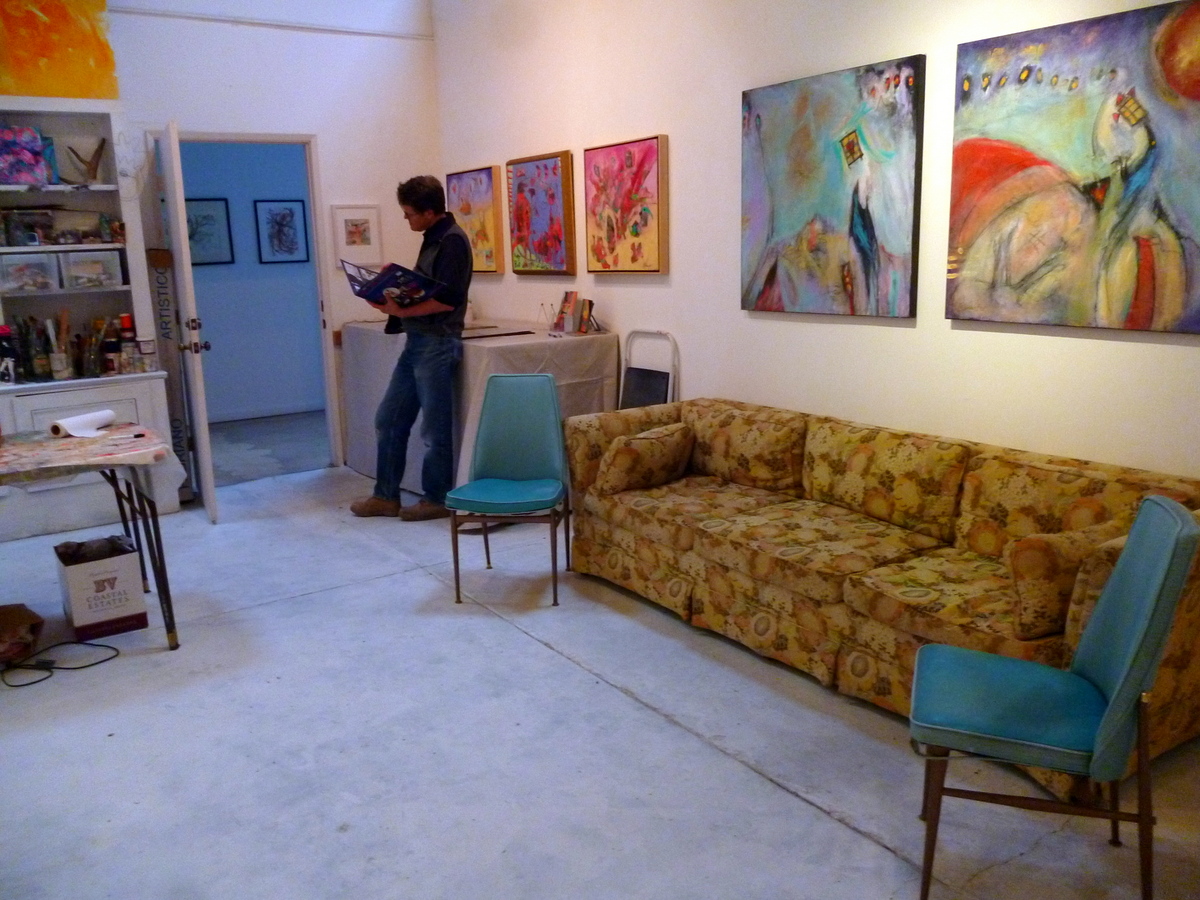
On January 27 my Sunday Studio painting classes begin. You can take all 3 monthly Sunday Studios for $150 if you register in advance. I’m also doing a Spontaneous Construction whole-weekend intensive class in April, for the springtime. In the new neighborhood it will be easy to get a lunch out or stroll in the park between paintings. There’s room in the classes right now- send in the registration form or contact me to sign up.
On a personal note, it’s fun but challenging to be open so much. It requires an open heart and the ability to go with the flow. My introverted self squirms a bit. I just want to hide in the woods with my deer antlers.

Antlers, because they are created and shed annually, are a symbol of renewal. I wish the best to you in your renewal for the New Year.
I’d like to invite you to stop by on Friday for my opening, Dionysia. Dionysus is not only the god of wine and parties, but of organic form and growth, a fundamental premise of intuitive painting. James Haug, proprietor of the Wine Emporium, is a great host and discerning patron of the visual arts. There will be live music by Johnny Harper, hot American roots guitarist. Wine, art and song are a time-honored recipe for a good time. You can find more details in my Facebook Invitation here. Remember, Friday, 5-8, Wine Emporium!
Dionysia is the real name for yearly wine festivals in Greece. They are often accompanied by theatre, but in this opening the tragicomic themes will be provided by the musicians, including new original songs by Sharyn Dimmick. You can enjoy a few of the Four Hands Painting Collaboration pieces that Susan Cornelis and I worked on earlier this year.
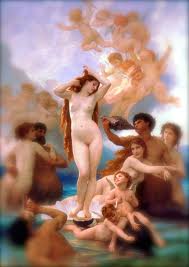
I’m showing some paintings that have never been exhibited before, several on mythological themes. Obscure Greek mythology always pokes its fingers into my paintbox. Point Reyes Dawn is based on seeing Bouguereau’s Venus at the DeYoung Impressionism exhibit a day before going to Limantour Beach at the Point Reyes National Seashore. The odd aqua pastels reflect the somewhat tweaked sentimentality of the painter, but the pink spotted whale is all mine. It’s the greenish painting in the slide show.
There’s another great reception right down the road at Retrospect, 4 x 4 , with 4 pieces each by Art Moura, Todd Barricklow, Judson King Smith, and Gregory Odle. It’s at 125 Petaluma Ave and it’s the same hours. I ‘d have to be shizophrenic to be at both, but I’ll try. You can find the Retrospect 4 x 4 FB invite here .
I like to paint in the fall and I’ll be posting some absolutely new paintings soon. Meanwhile, join me for some fun this Friday. It might not be as fun as the gathering in Bougereau’s Venus, but then again you never know. Suzanne
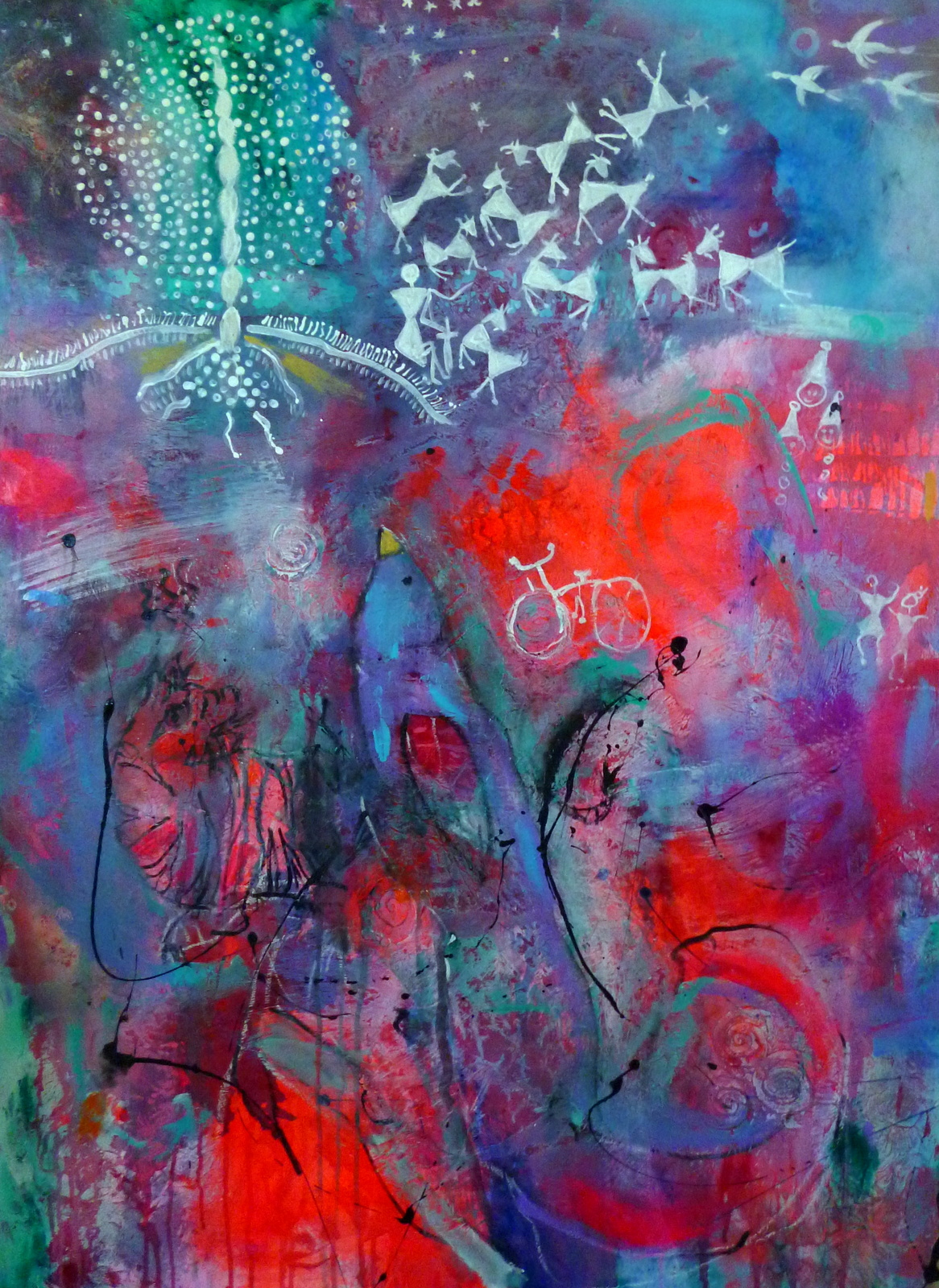
Artists are often asked how long it took to make a painting. Less often are they asked about materials, techniques, theme, and concept. I’ve decided to tell you what it took. My story is not unique; every artist has hundreds of these stories. Most artists are polite enough not to bore you with them. Here goes!
Materials: Golden liquids. Flourescent Nova colors. White acrylic ink and gesso. Huge to tiny brushes. Canvas prepped in 2010-2011 with gesso, lightweight spackle, and hand-carved forms. Masking tape to establish horizon consistent with previous series of 10 paintings. Then swaths of translucent red, then swipes of flourescent red-orange. Allow canvas to sit for 14 months to mature, and because you don’t quite know what it wants to be. 5 books on Hindu motifs, 2 books on symbols, 2 hours of research to establish authentic Warli painting examples. Notebook with notes. Film called “Upside Down”, an Indian movie not yet released in the US. Brushes borrowed from Karina Nishi Marcus. One glass of cognac drunk in her studio.
Techniques: pouring, stamping. Gesso applied with gloved hand, no brushes, for smooth yet organic texture. Mixing of whites to achieve varying translucencies for folk painting. Wiping back with variety of materials. Acrylic inks applied with brush and pen, water-soluble wax crayon scribbles, and 2 different varnishes, one spray and one applied by brush.
Experiential and conceptual development: one marriage, 1991-1998, in which I lived in Bangalore, India for several years and collected both fine and folk art. Conversation with Indian woman who decorated the threshold with gorgeous rice flour designs daily at 4 AM so that her husband could step through this blessing on his way to work at dawn, her paintings destroyed and rebuilt day after day. Color vocabulary from photographs and memories of India. Conscious decision to paint naively. Memories of circus and thoughts of Ganesha, a major presence in South India. Wanted to use a sort of ‘tumbling down the rabbit hole” theme used in previous paintings, where animals float and turn in a metaphorical world, Chagall-like. Mythic theme for paintings and series size established in the Terra Incognita series, 2011. A sadness over a recent death and a desire to use forms drifting up and away, or birds to symbolize soul in release and in captivity. Threw out color balance and let the colors blend randomly, as in India.Memories of elephant festivals and ecstatic dancing.
And luck.
Questions?
Studio Note: You can see “Upside Down”, both my painting and the film, at the Santa Rosa International Film Festival, which runs Sept. 12-21. Visit http://www.sriff.org/ for more information.
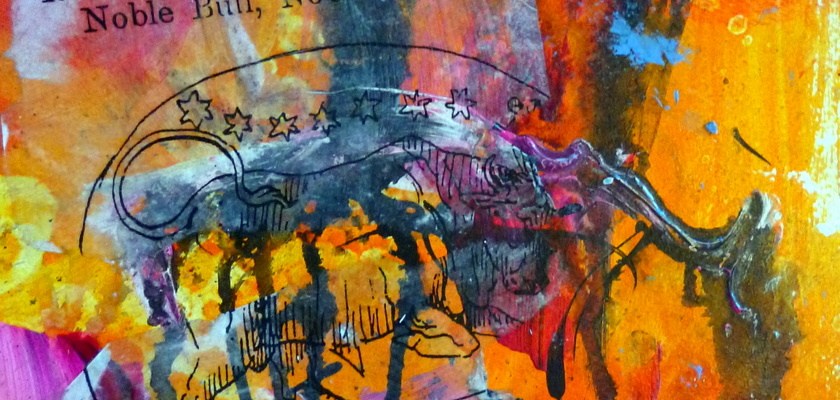
I am secretly annoyed when people ask me “How do you do it?” I have a job. I make art.
My first thought is that any young mother is ten times as busy as I am. It’s just that she doesn’t get the public accolades of an art show. Her project is her child. How do young mothers do it?
Here are a few hard-won ideas on how to make time for art.

Impose a commitment and yes, gasp, a few limitations on time and energy. Be accountable to yourself and a few other people as well.
Don’t over-dramatize or over-romanticize the time needed for art. Routine is not a dirty word for creative work. It’s the fuse for the fireworks. I know you know this already. Just sayin’.
Book recommendation: I found The War of Art by Stephen Pressfield incredibly useful. We make war on our own resistance. Though I don’t like war and warriors as a metaphor, he uses it beautifully, and it’s one of the best books on artistic discipline I’ve ever found.
I liked this recent article by Aimee Bender called “A Contract of One’s own. You can read it here. Both authors are professional writers. I’ve often wondered about the difference in time needed for writing and painting. Painting, I found, requires more time and more “stuff.” Anyone else have an opinion on this?

I always wanted to be offered a summer art residency. You know the dream. It involves perfect food at a lovely dining room table or magically appearing at your door. You have a cozy little cabin or an urban warehouse studio in an exciting part of a large city. Ocean, desert, mountains, lakes, or forests surround you. You have no real responsibilities except to your art. A convivial group of fascinating, talented artists would provide incisive feedback and hilarious, refreshing evening play. And of course I would blissfully, effortlessly, and ceaselessly create my new theme. And the Art Gods would say, “It is good.”
I wanted the feeling of leaving home, but underneath that, what I sought was a support structure outside the ordinary for creating art intensively for two weeks.  Heck, I’m an artist, with a good studio and great arts community. My job is to create, so why not create my own summer residency? My colleague Karina Nishi Marcus and I devised the Caerus Artist Residency.
Caerus runs from July 8 through July 21, 2012. It’s a work-in-your-studio residency, shared virtually. I was inspired by a Philadelphia artist who created his own summer residency in his own studio, and Nanowrimo, National Novel writing month, when writers all over the country commit to writing 50,000 words in a month period, receiving support and sharing online in a specified pocket of time.
Caerus (Ky-russ) is a lesser-known godlet. He’s the slippery opportunity in time, as opposed to the linear clock. We might call him inspiration or flow. Artists seek him. Sometimes it seems that time for creating art is being devoured in our consumer culture. We need to invite Caerus, or Kairos, sacred time, into our studios. Who knows which windows of inspiration might open for us?
We’ll focus on creating time for art for two weeks, minimizing other commitments as we can. At the end of two weeks, we’ll celebrate. You choose how much time you can devote to your art and fill in the free application form to join us. Caerus will be a forum for posting comments and photos on your process.
I’ve chosen to commit four hours a day in-studio. I’ll be working on the large pieces of the Dionysian project, and a new project I’ll reveal during the residency. As in a residency, I’ll have special arrangements for food and recreation, and minimize my other life duties.
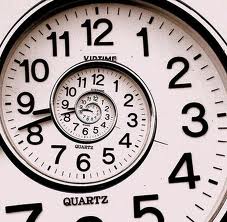 Come on, it’ll be fun. Whether your studio is a computer or a dining room table or a beautiful atelier, whether you have 15 minutes a day or 8 hours a day, you can participate in the Caerus Artist Residency.
All we have is time to give our art. Join us. Apply for the Caerus Artist Residency here.
 Saltworkstudio | Suzanne Edminster